Categories
Uncategorized

Letters and Form Letters: Two UBC exhibitions & an interview with Heather Passmore

For the month of January Never Dying Worm, at UBC’s AHVA Gallery, ran contemporaneously to the Morris and Helen Belkin Art Gallery’s Letters: Michael Morris and Concrete Poetry exhibition, and included Form Letters, a work by Vancouver-based artist Heather Passmore. Comprised of three hundred form letters, marching five high and dozens deep, Form Letters ran the length of the gallery’s front window and, hugging the wall’s north wall, extended into the interior space of the gallery. Viewed from outside, the front window functioned like a vitrine: giving the rows of letters the precious appearance of encased specimens, or historic documents – not unlike the appearance of many of the concrete poetry works, viewed behind glass in the Letters exhibition.

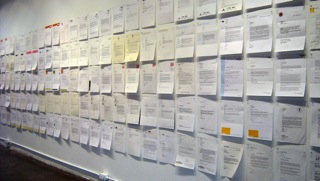
Form Letters, at “Form Letters,” March 18 – April 21, 2011, The New Gallery,
Calgary Alberta.

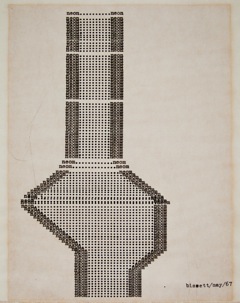
Unaccompanied by the digital reproductions of commissioned drawings which usually complement the work, this evocation of Form Letters was visually stark: standing alone as an overwhelming grid, with all of the references that it entails – to mathematics, technology, Modernism, historical painting, weaving, social control, the built environment of the city… A visible and knowable system, oscillating between a feeling of comfort and one of smothering constraint. The typed document is also a gridded space, as described by Liz Kotz at the Belkin’s Concrete Poetry Symposium in February.  With its mechanically prescribed dimensions and orientation, the typed page is an ordered space which ‘dirty’concrete poems – like Steve McCaffery’s Carnival (1973) or bill bissett’s Neon-Om (1967) – subvert to their own ends. Kotz went on to inquire about the relationship between the grids of modernist and post-modernist painting, and those of the typed page in concrete poetry.  Within this focused field, Kotz is concerned with what lies Between Poetry and Painting – which is incidentally the title of the 1965 Institute of Contemporary Arts exhibition oft cited for its influence on Morris’ work – seen while he studied at the Slade, in London.

bill bissett
Neon-Om, 1967
typewriter ink on paper
25.2 x 20.2 cm
Collection of the Morris and Helen Belkin Art Gallery Archives

In relation to this exhibition title, Morris’ works in the Letters exhibition can be understood as working in the spaces between traditional media. The Letter paintings, for example, transgress into sculpture by breaking the physical flatness of traditional painting with angled, inset mirrors – and then there’s something cinematic about the movement playing across the mirrors. As well, the paintings’ gradients might refer to photography, their titles refer to language, and if performed in front of, they might transform into theatrical sets, or play a trick of camouflage and recede into the architectural space. Passmore’s Form Letters, on the other hand, concerns itself with ‘the spaces between’. In a more relational sense Passmore addresses primarily the administrative space between artists and the curators, juries or committees who assess their work. The abstract processes of deliberation and evaluation are reified taking on a stubborn material form. The letters are also testimony to the galleries’ normally invisible bureaucratic language and labour, which has emerged from the artist’s archives to haunt the gallery walls.

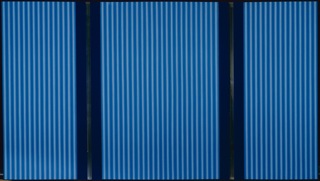
Michael Morris, Los Angeles Letter, 1968, acrylic on canvas, mirror and Plexiglas
184 x 327 cm
Collection of the Morris and Helen Belkin Art Gallery, The University of British Columbia
Purchased with the support of the Canada Council for the Arts Acquisition Assistance program, the Morris and Helen Belkin Foundation, and the Christopher Foundation, 2011

Where much concrete poetry investigates the visual and affective structures at work in typed language – making the language strange in order to expose what’s been there all along – Form Letters examines the rigid conventions of bureaucratic acceptance and rejection in particular: ‘making the language strange’ by crowding so much of it, so close together, and in its other evocations, by contrasting it with lush drawings which visually work their way around the language. Passmore remarks that “when you have to use a sort of political speak or office speak, you’re changing the whole culture of the room when you do that … definitely it’s something that needs to be noticed.”
Like the grids discussed by Kotz, the systematic straight lines, and regular size and rectangular shape of Morris’ paintings are physically suggestive of control and calculation. “I don’t know that they’re about the bureaucracy of the art world,” says Passmore, when discussing the somewhat coincidental relationship between the Letter paintings and Form Letters, adding, “They sure look bureaucratic.”
While discussing his work, Morris gestured towards the fact that his paintings came, in part, from the desire, as a young and relatively unknown artist, to “address the world” – Paris, London, New York, Peking, Rome, Los Angeles, Madrid – to clamour for notice and acclaim. Fifty years later, and in a qualitatively different artistic context, the desire Morris alludes to, Passmore’s Form Letters has laid bare. “UBC was good context for my letters to act instructively,” noted Passmore, “to demystify the process of being an artist for students.”

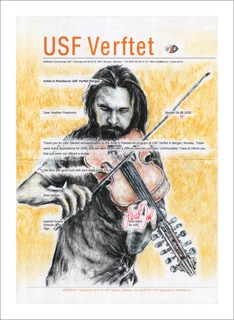
Form Letters, mixed media on form letter, 2008 – ongoing
Categories
Uncategorized

8th Annual Art History Undergraduate Symposium!

The Art History Students’ Association would love to invite you to the 8th Annual Undergraduate Symposium on Friday, March 16th from 2:30 to 7:30 PM in
The Lillooet Room (#301) in Irving K. Barber Learning Centre, 1961 East Mall, Vancouver, BC V6T 1Z1

The Symposium will consist of 6 individual presentations and discussions followed by a catered reception.

This year’s presenters are:
– Jocelyn Plant, “Imaging Anxieties, Creating Anxieties: Pieter de Hooch’s Interior of a Dutch House”

– Eve King-Harris” “Boundaries of the Breasts: Why Breastfeeding is Political”

– Erin Busswood, “Reclaiming Photography: The Social Potential for Providing Context to Our Personal Photographs within the Archive”

– Daniel Ralston, “Surveillance and the Colonial Gaze: A Panoptic Perspective”

– Kendra McLellan, “Vulnerability as Mediator: Sex, Pain, and Death in Philippe de Champaigne’s Dead Christ”

– Sophia Toft Moulton, “FACT/FICTION: Lady Brute in the Banal Beauty Inc. Archive”

Come out, and support undergraduate research in Art History!

Categories
Uncategorized

AMS’ Fiscal Sustainability Referendum

As some of you might know, the AMS is holding a referendum in order to gain permission to sell 3 paintings from its permanent collection.

While AHSA supports the idea of selling some of these little exhibited works, as well as the proposed usage of the funds obtained through these sales, AHSA feels that the decision as to which works to sell requires student or faculty consultation. Currently, the AMS proposes that these decisions be made by the AMS Student Council, independent of any input from AHSA, other student bodies, or the Department of Art History, Visual Art and Theory.

Furthermore, as the AMS have not specified which works they intend to sell, we can assume that they are likely to be those of the highest monetary value, regardless of their significance to the UBC community. Furthermore, as these works were purchased by the AMS, a student association, it follows that broader student input should be sought in the case of their sale.

As such, AHSA’s position on this issue is one of opposition. We hope that you agree that these decisions must be made in accordance with student input and/or faculty advisory.

Thus, we encourage you to vote “no” to Question 4 of the 2012 Fiscal Sustainability Referendum.

Categories
Uncategorized

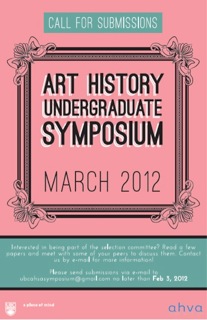
2012 Art History Undergraduate Symposium: Call for Submissions!

This is a wonderful opportunity to present a paper, and receive feedback from your professors and peers.

If that isn’t enough to assure your attendance, we hope that our offers of food and beverages will!

Those interested in becoming part of the selection committee, please contact us for more information.

Categories
Uncategorized

UJAH Information Sessions

The editorial board for the UBC Undergraduate Journal of Art History is composed of a small group of highly motivated students and each plays an important role in ensuring the journal’s success. Prospective editors need not be Art History majors or minors, but must possess an interest in the field, as well as strong editing skills. Second and third year students are strongly encouraged to apply in order to ensure the journal’s continuation.

Editors are responsible for soliciting submissions, evaluating and editing articles, and promoting the journal on campus.

Working as an editorial board member will allow students to gain additional academic editing and writing experience, preparing them for graduate school or future employment. It will also afford them an opportunity to exercise their critical faculties and contribute to UBC’s scholarly community. Additionally, members of the editorial board will be recognized for their work in one of the few academic undergraduate art history journals in Canada.

How to Apply

Join us for an information session on Wednesday, November 9 at 1 p.m. in IKB 316 or Thursday, November 10 at 1 p.m. in IKB 317. At these sessions, we will explain the editing and submission process,  acquaint you with the editor’s duties, and take your questions.

Submit an academic writing sample 5 to 10 pages in length, a current resumé, and a brief statement (no longer than half a page) that outlines your reasons for applying.

The application deadline for editorial board positions for the journal’s third issue is November 21, 2011.

Categories
Uncategorized

Group photo!

As promised, here is the group photo we took a few weeks back. The loveliest sun-blinded faces in all of UBC, in my opinion!

yum
Categories
Uncategorized

Welcome Back, Cupcake Fun, and just Weirdness

It’s a new year for UBC’s Art History Students’ Association blog! Stay tuned for news about film screenings (see “Helvetica” in the post below), art openings, art news, and general artsy fartsy-ness of the sort.

On that note, here is a something fun and yummy and art-related that I stumbled upon today: cupcakes designed by some of Britain’s top artists! Art + tastebuds = heavenly combination

cupcake by Sam Taylor Wood


Go to http://www.coxcookiesandcake.com/our-menu-limited.htm for more images.


And now it’s time for a slightly more bizarre story: EVA & ADELE are a couple who attend art openings all over Europe and view themselves as art. They claim to eat the same things, have come from the future, etc, etc… check ’em out! http://www.guardian.co.uk/artanddesign/2011/nov/01/eva-and-adele-interview

P.S: Group photo coming soon!

EVA and ADELE
Categories
Uncategorized

Film Screening: Helvetica

Hello there!

We are pleased to announce that there will be a screening of the film “Helvetica” Thursday, November 3, from 5-7pm in Laserre 107!

There will be popcorn!

Helvetica is a feature-length independent film about typography, graphic design and global visual culture. It looks at the proliferation of one typeface (which recently celebrated its 50th birthday in 2007) as part of a larger conversation about the way type affects our lives. Helveticahas been shown at over 200 film festivals, museums, design conferences, and cinemas worldwide.”

-from Helvetica

Categories
Uncategorized

Seventh Annual Undergraduate Symposium

You are cordially invited to the:

The 7th Annual University of British Columbia Art History Undergraduate Symposium will feature the research papers of five undergraduate students who have used innovative approaches to art and visual culture in a variety of historical periods and geographical areas. In the company of students, professors and other members of the community the speakers will present their work with ample time following to ask questions and make comments. Refreshments will be provided during intermission as well as during the reception after the event.

Categories
Uncategorized

Artful V.2.I.3 – February 2011

The latest issue of Artful is now ready for your reading enjoyment. Click the link below to download the pdf.

Cheers!

artful. February

Spam prevention powered by Akismet