I’ve moved my domain over here: tidbitsandfrolicking.com 🙂
New site!
Reply
I’ve moved my domain over here: tidbitsandfrolicking.com 🙂
Let’s talk politics.
Specifically let’s talk about the Canadian electoral system and how it affects climate policy.
Yes! Fun!
So here in the great North we have what’s called a Single Member Plurality system, also known as First Past the Post.
Basically this means that politicians run in a region, called a riding and if they receive more votes than the other candidates in that riding they receive a seat in the House of Commons. There are 308 seats in the House of Commons.
Okay great, pretty basic, if you’re from Canada you probably learned this in grade 4. But what does all this actually MEAN for our political institution?
Firstly, it means that ‘big tent’ parties tend to rule. I.e. in SMP systems there are usually two big parties with any chance of being elected, Canada is an exception with 3 (the Conservatives, Liberals and NDP).
It also means that regionally popular parties (such as the Bloc Quebecois) can do fairly well since they have concentrated support within their ridings rather than broad, diluted support across the country (such as the Green Party).
Under the system, parties may receive a disproportionate amount of seats. For example, in the 2008 Federal election, the Green Party won 6.8% of the votes and yet didn’t win a single seat out of 308. In the same election, the Conservative Party received 38% percent of the votes and yet won 46% of the seats, giving them a majority government.
In this way, a party with concentrated support gets to form the cabinet and thus holds most of the power.
In some cases, this can be good news for the environment. Jean Chretien used his authority to ratify Kyoto even though well… other members of government including the provinces weren’t quite down so to speak.
On the other hand, that power can be used to reverse enviro policy or downright do whatever the hell you want.
Example: Stephen Harper backing out of Kyoto (to be fair, we weren’t going to reach the targets in any case), and getting rid of previous policies like the One Tonne Challenge (a voluntary program: was it effective?) industrial regulations, energy conservation subsidies and the Climate and Partnership Funds (which accounted for the bulk of emission reductions under the Liberal program).
The Conservatives also passed the highly controversial budget bill C-38 which amended the Canadian Environmental Assessment Act, the Canadian Environmental Protection Act, the Fisheries Act, the Navigable Waters Act and the Species at Risk Act to name just a few.
The point is. The cabinet has a lot of power. And this can be good or bad for the environment.
But in Canada it’s mostly been bad.
Cabinet ministers aren’t the only ones who can introduce bills. Backbenchers can introduce private member’s bills BUT they’re rarely passed.
The NDP got pretty far with the The Climate Change Accountability Act in 2006. It was gonna commit Canada to 80% greenhouse gas reductions compared to 1990 levels by 2050.
Despite Conservative opposition, the bill made it through the House of Commons but was rejected by the Senate.
Don’t get me started on the Senate.
Another challenge is party discipline. MPs are expected to always speak and vote in line with their party, which is quite in contrast to the US system.
It’s also in contrast to the fact that the MPs are supposed to be representing their regional constituents.
Conservative MP David Wilks promised his constituents he would vote against Bill C-38 but ultimately party leaders decide if you can run again so he shut his trap and followed orders.
Last year (2013), Elizabeth May (Green Party) introduced “An Act to amend the Canada Elections Act.” It would allow MPs to speak freely without harsh sanctions. So far the bill has received a First Reading.
Personally. I’m all for some good ol’ fashioned reform. I’m not just talking May’s suggestion against party discipline but full blown electoral restructuring. How about some proportional representation? Eh? Eh? It could force parties to for coalitions in order to form cabiniethereby preventing policy extremes. I’m not saying I have the answers. But something ain’t quite right.
And what about that Senate? Appointed officials? Ain’t that a little old fashioned?
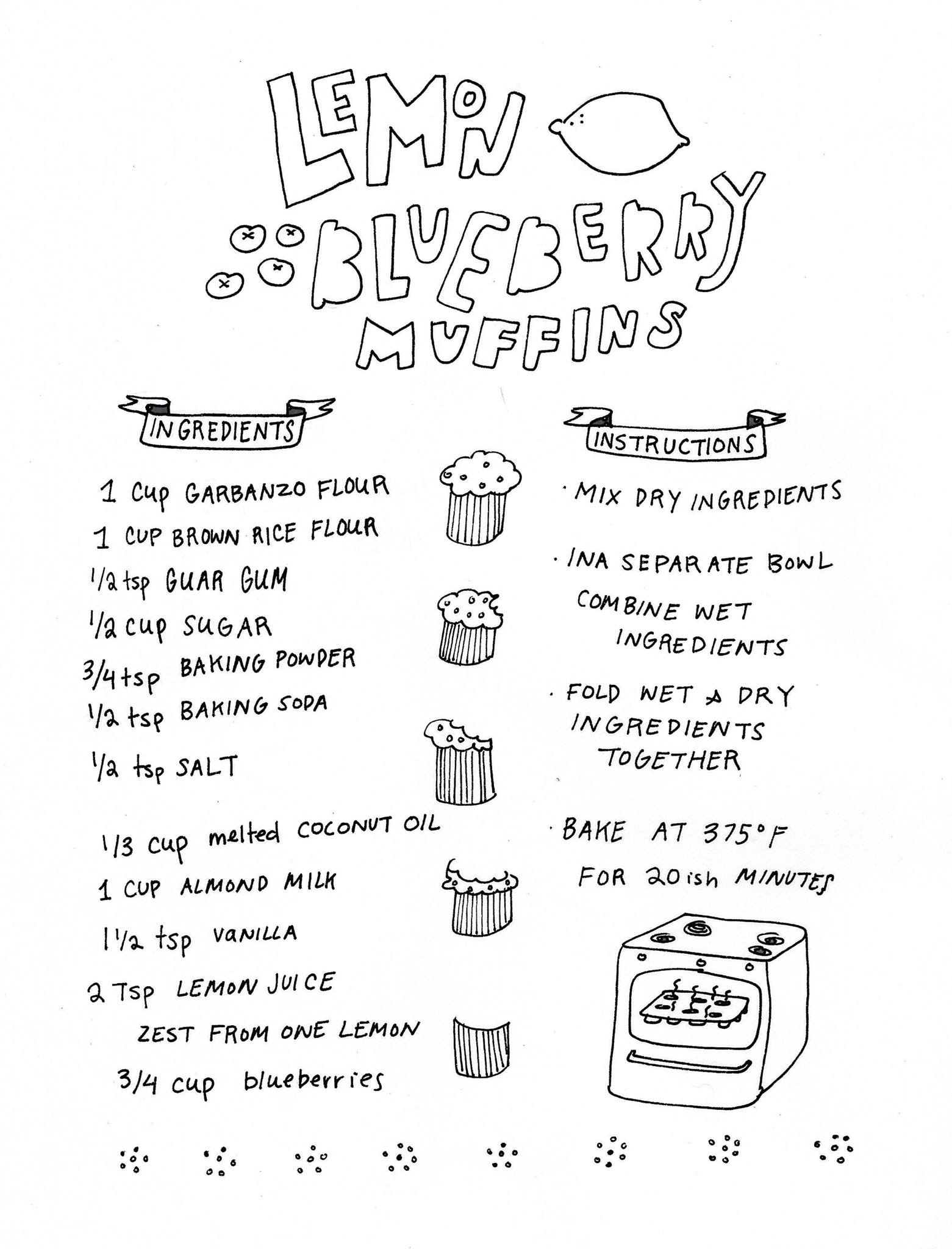
Another gem I made up for the Sprouts baking workshop. Remember not to taste the batter when cooking with bean flours. Yuck.
As per always, sugar can be subbed with xylitol, and feel free to play around with the ratios of brown rice and garbanzo flours. BUT other flours will yield different results! Every gluten free flour is different people.
And again, the time indicated is just when you’re allowed to look in the oven, not when they’ll be done. Use common sense. Poke that shit.
Again illustrated by my girl Lila Volkas who also happens to be my official recipe tester. Yay teamwork!
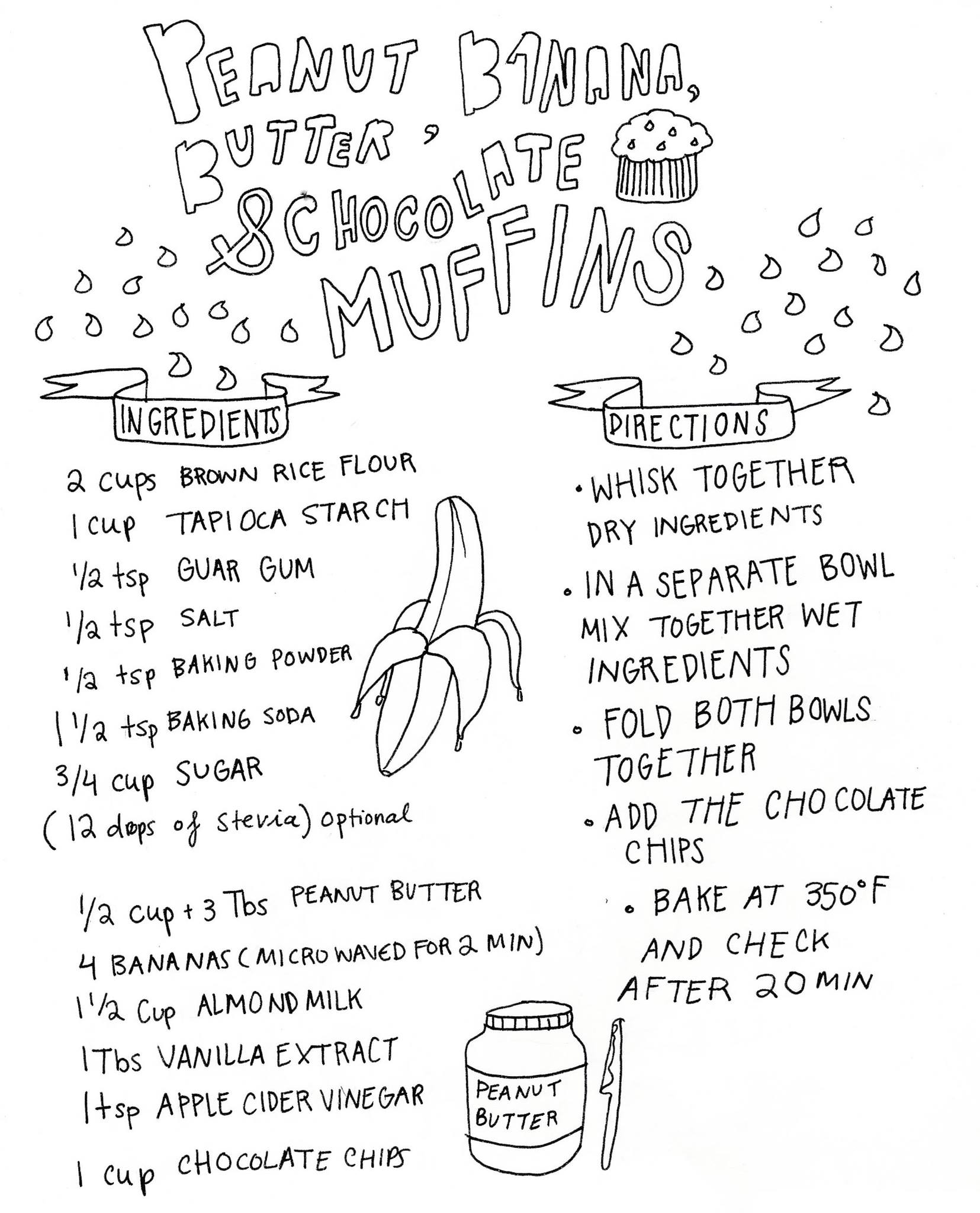
This is probably my most prized gluten free recipe. I held a gluten free vegan baking baking workshop earlier this year through Sprouts and this was the recipe I demonstrated. It’s oil free and can be sugar free if you sub the sugar with xylitol.
You can also sub some (or all) of the brown rice flour for garbanzo bean flour, but make sure not to taste the batter before it’s cooked cause raw chickpeas are plain nast.
The illustration is by my amie tres talenteux Lila Volkas. What a babe.
I don’t like to specify times because you should check it with a pointy thing. Gluten free flours are prone to collapse though so don’t open the oven until 20 mins or so.
Whenever I visit my parents, I have to make myself pancakes. It’s compulsory. My own little tradition. I’m quite proud of this recipe.
Fluffly GF V Pancakes
1/2 C Brown Rice Flour
2 Tbsp Potato or Tapioca Starch
1 Tbsp sugar or xylitol
1.5 tsp baking powder
1/2 tsp salt
1/4 tsp Guar gum or Xathum gum
splash vanilla
3/4 C almond milk
handfuls of choc chips, blueberries, whatever!
Make 4 thick medium sized pancakes- (1 VERY hungry person)
Cook on medium and flip when the bubbles have popped.
I get anxious in grocery stores.
Don’t get me wrong. I love food. Cooking it. Eating it.
But take this conundrum:
You want a head of lettuce.
The store sells three options.
1) Organic, in plastic packaging
2) Locally grown, conventional (bajillions of pesticides)
3) Conventional, half the price
Talk about a headache!
So which do you choose?
Specifically I’d like to talk about one aspect. Eating local.
The local movement has made huge ground of late, particularly here on the West coast of Canada (where most of our food comes from California).
But what’s the point?
CO2 emissions from transport?
What about the fact that ocean freighters are relatively efficient per pound of food transported? In England, since energy is largely derived from coal, it’s actually better (emissions wise) to buy produce from New Zealand in the off-season than locally grown produce that has been stored.
Here in BC, peppers and tomatoes are grown in green houses powered by natural gas because it’s cheaper than the grid (made up of 93% renewable energy such as hydroelectricity)
So if it’s not necessarily better for the environment, why eat local?
Why wait till Saturday to shop at the farmer’s market, to pay triple for lettuce?
I’ve heard the argument about supporting your local farmer. Feeding the local economy etc. etc.
But does that mean we should shun the fruit and quinoa from developing countries? Do our neighbours deserve our dolla bills more? There is certainly something to be said for knowing your farmer. Knowing whether or not they use pesticides. Understanding where your food comes from and all that crap.
What about food security? If our supply chains get cut off, how will we feed ourselves. This is a valid question, though very hypothetical. Canada is not on the verge of war and fuel for transport ain’t running out in my lifetime or the next or the next. Maybe we’ll eventually have to compete with more people on the planet and the prices will be driven higher. (But hey, would that just make local food economically competitive?)
How about freshness? In order for veg to not be spoiled by the time it reaches it’s destination it must be plucked waaaay before it’s ripe. This is where we find complaints of food not tasting good anymore. But am I going to taste the difference with my hypothetical head of lettuce?
Animal welfare. This one grinds my gears. There seems to be a common misconception that ‘local’ is synonymous with ‘good welfare.’
Wrong.
Battery cages exist in your community. I promise. That local pork didn’t see the local grass. Unless explicitly stated so.
So I suppose I aim to point out that as much as eating local can ease the conscience a snag, in many respects the “100 mile diet” and “locavore” movements are perhaps more trendy greenwash than all-encompassing solution.
I certainly don’t know what the solution IS. And I think about this full time.
Surely the answer is pluralistic. It depends on context.
In any case. This season I’m going to chase my local organic lentil loaf with some sickly sweet holiday dessert made from fair trade (also a buzzword), organic (presumably certified) sugar, shipped (hopefully by freighter) from Paraguay (developing country).
Here’s a badass muffin recipe I made up the other day. Involves apples (yay local!) and banana (yay…..!?)
Apple Muffins
Makes about 10.
2 C spelt flour
1/2 C cane sugar (or xylitol)
2tsp baking powder
1 tsp baking soda
1 1/2 tsp cinnamon
1 tsp ginger
1/2 tsp salt
1 banana – microwaved for 1 minute
4 tbsp coconut oil
1/2 C almond milk (or soy or whatever)
8 drops stevia (optional)
4 small/medium apples – grated
Whisk together dry.
Microwave banana and add wet, making sure coconut oil is melted.
Add wet to dry. Do not over mix.
Stir in grated apples.
Bake at 350F.
For a change of pace.
I’m not going to rant about animal welfare.
Instead on this fine December eve, beer in hand, I’d like to talk about something very prevalent in my thoughts this semester.
Hoarding.
Because I have a confession.
I have a lot of stuff.
I mean. You’re not going to see me on that intervention show where they find dead cats in the refrigerator.
But I’ll be the first to admit I have a lot of clothes I never wear.
It’s not that I shop a lot. At least not anymore. They just kind of…. add up over the years.
Over the summer I began the laborious process of purging. I got rid of a garbage bag (the big kind) of clothes and another one of shoes. Off to charity to find new homes.
Last night I got rid of another pile. Admittedly it took me three hours to go through everything, piece by piece, and rationalize why I needed to keep it, but I am quite proud of the results. 19 pairs of tights were just a start (when was the last time I wore tights? Highschool?)
I’m not here to preach of about consumerism in relation to the present holiday season. Although that may seem fitting. On the contrary, I’m in a state of contemplation of the emotional weight we put on things.
At what point does something become sentimental? Because you wore it to a special event? Because it was your mother’s? Grandmothers? What if you have a closet of their clothes?
Getting rid of things for me is difficult for two reasons: the classic hoarder question of “but what if I need this later?” and the sense of nostalgia. The memories triggered by that item.
In response to the first question “but what if I need this later?” It’s almost a reverse consumerism ideology if you think about it. Why would I get rid of it only to have to buy something new later? The question is. Are you really going to need 13 pairs of jeans?
In regards to the second. Is this item really our last connection to that memory? Of course not. We’ve just deposited it there. And next thing you know we have closet-fulls, nay, house-fulls of knickknacks designed to trigger memories.
I’m not quite sure where this is going. Maybe it’s the beer. But I for one am not comfortable with my memories and happiness finding refuge in the things I own. If I no longer have use for a dress I wore to a dance once… or even say… my graduation… should it not find a new home? Somebody put a lot of work into growing that cotton and manufacturing that thread and painstakingly sewing on all those sequins.
All this of course is very hypocritical. I’m still holding onto an ENTIRE CLOSET FULL of costumes from my musical theatre days. But hey. I’ll cross that bridge when I’m ready.
I suppose all this is to say that I’m approaching this holiday season mindfully. Trying to sort through needs versus desires and resisting the urge to buy too much crap for my loved ones.
I’m not going to get all snuggly and sentimental and tell you to give out hugs and coupons for quality time.
Nobody wants that.
Please don’t give that.
Refer below to pt.1 or this rant won’t make sense. (Do I ever?)
Okay.
So I was slightly dreading the tour.
Obviously I wouldn’t miss such an opportunity for the world, but similar to visiting a poultry operation last year I knew it wouldn’t be an enjoyable experience for me so to speak.
On the one hand, I was pleased to see animals housed together with room to move around and at least SEE the outdoors (though I wouldn’t say their runs were very large. Maybe 6 by 4 feet ish for the pigs and bunnies.) The sheep got to be outside on the grass and the monkeys had a tree to climb.
Compared to many research facilities this is no nightmare.
Compared to how animals are housed in meat production this was paradise.
I mean lets be honest, I’d rather have my back broken for trauma research (they always use pain mitigation) and get to move around and play with pen mates than be stuck in a gestation crate giving birth for my allowed lifespan and NEVER being able to turn around let alone see the sky.
But but but. Does that mean I support animal research?
Not a fucking chance.
Obviously.
You know me better than that.
Hell, I wouldn’t care if these animals were frolicking on a golden pasture until they reached their “humane end point” (and yes ALL animals are euthenized at the end of the experiment.) I just do not agree that animal testing is EVER justified.
And here’s where the utilitarians diverge from the abolitionists. The Peter Singers vs the Tom Regans.
Utilitarian philosophy argues that the utility gained from the research (i.e. the benefit it will provide for many humans and/or animals) justifies the detriment to the individual. One for all.
But honey. I’m not a utilitarian.
I don’t think we can decide on behalf of another being how it is going to spend its time on earth. (Okay I already see the fatal flaws in this argument. What if we’re making a decision that will improve its welfare blah blah blah. Let’s stay on track. We’re talking about animal testing here.)
And you ask. What if I had parkinsons? Would I refuse a treatment because it had been tested on animals?
Certainly not. But that doesn’t mean I think further research should be conducted this way.
And knowing absolutely nothing about medicinal research, I will argue that it can be done. The John Hopkins Bloomberg School of Public Health (ranked #1 in the US) opened the Centre for Alternatives to Animal Testing in 1981 and has had many acheivements including the development of vitro methods now widely used.
Sure, we don’t have alternative methods for everything. BUT MAYBE WE SHOULD BE TRYING TO THINK SOME UP. I bet 40 million could go a long way y’know?
Also. All this effort to look at squirrel fetuses and not enough time making the thinker think about why we need to know in the first place. Human curiousity is boundless, but where do we draw the line? This is an animal’s whole life we’re talking about. Just so we can know a little more about them?
D:
aaaaand I’m done.
So last week I had the opportunity to tour the UBC Animal Care Centre.Now, before you get excited warm fuzzies about baby raccoons in cribs or whatever comes to mind, I should note that “Animal Care” is really more of a euphemism. Located at the Centre for Comparative Medicine, tucked away in the South of campus, the facility is where the majority of animal testing takes place on campus.
The centre was built in 2012 for $40 M and specializes in larger species. There are about 75 animals currently in the facility not including 50 or so small rodents (i.e. mice, rats). The facility is also an emergency alternative to the general hospital during a disaster since the surgical equipment can also be used for humans.
During my visit I saw: white rabbits (for genetics research if I remember…?), pigs (for trauma simulations to do with helicoptor crashes- i.e. they would put the pigs in a simulator and break their backs), rhesus macaque monkeys (for parkinsons research), sheep, an alpaca (not for testing- leftover from when the facility wasn’t enclosed and the sheep needed protection), some crazy birds from the himalayas (researching their flight abilities in low oxygen environments), wild caught pregnant squirrels (researching how the fetus survives with little oxygen.)
Thats obviously a very crude depiction and of course my memory is incomplete but that’s what I recall.
UBC is currently the first university in Canada to release statistics about their use of animals. Transparency is not required for university institutions but information was released last year largely due to ongoing pressure from groups such as Stop UBC Animal Research. In 2011 UBC used 225,043 animals in research and claim the number is decreasing. For more info: http://www.animalresearch.ubc.ca/about-landing.html
Animal welfare was something discussed a lot during the tour and it is clear that efforts were taken when designing the facility to go above basic requirements. For example, all animals except for small rodents have outdoor access. Animals are always housed in groups rather than singley. SOME enrichment is provided, i.e. substrate such as hay or wood chips rather than bare concrete floor, maybe a ball or two. The monkeys had a climbing tree.
There are full time veterinarians at the facility not involved in the research whose job it is to observe the welfare/health of the animals and ensure they do not go past their “humane end point.” The humane end point is a predetermined point at which the animal MUST be euthenized. I.e. if a parkinsons monkey can no longer feed and take care of itself etc. Humane end points are decided upon when the researcher is applying for approval to do the project.
Researchers wanting to conduct research on animals must submit an Animal Care Protocol to the UBC Animal Care Comittee which is made up of various researchers, vets, UBC staff, students and two members of the public (often affiliated in some way.) http://www.ors.ubc.ca/ors/animal-protocol
I’ll leave it at that for now and save my rant for the next post. 🙂
So for my animal welfare class I’m writing my term paper on the comparative welfare of laying hens within common commercial housing systems (i.e. cages, free run/aviaries, free range) and part of the assignment was to make a website.