Selected Publications
Science Education Research – Why it matters!
Posted: December 9th, 2010, by Marina Milner-Bolotin (edit)
My field of inquiry is Science Education Research and the role of technology in improving how we teach sciences and mathematics and how our students learn these fields. I am interested in finding out how learners of all ages (elementary, middle, high school and university students, pre-service and in-service teachers, as well as laymen) learn science (particularly physics) and how we can teach it, so that our science courses (both for the science and for the non-science majors) turn the students on to science instead of turning them off it. I was very fortunate to be born in a family where science in general and physics specifically was considered to be interesting and exciting. As a result I grew up learning to notice things around me and ask questions. I believe that science is all about noticing interesting nature-related phenomena around us, asking questions and trying to figure things out. This curiosity about the world I live in made my life much more interesting and exciting. Today as a science teacher and a PER researcher, I study how we can create a similar environment for our students. I hope that our knowledge of how people learn science coupled with the modern technology and effective teacher training will help us to do a better job at teaching physics/science/mathematics in the future. That is what I am working on…
I am currently looking for graduate and undergraduate students interested in working with me. Please e-mail me if you would like to know more: marina.milner-bolotin@ubc.ca
For my most research research publications, please visit this site:
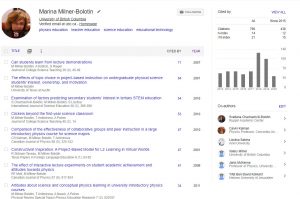
Selected publications and presentations: papers, books, book reviews, and interviews (up to 2016 – for more recent ones, please click on the link above):
- Milner-Bolotin, M. (2016). Rethinking technology-enhanced physics teacher education: From theory to practice. Canadian Journal of Science, Mathematics and Technology Education, 16(3), 284-295. doi:10.1080/14926156.2015.1119334
- Milner-Bolotin, M. (2016). Promoting Deliberate Pedagogical Thinking with Technology in physics teacher education: A teacher-educator’s journey. In T. G. Ryan & K. A. McLeod (Eds.), The Physics Educator: Tacit Praxes and Untold Stories (pp. 112-141). Champaign, IL: Common Ground and The Learner.
- Chachashvili-Bolotin, S., Milner-Bolotin, M., & Lissitsa, S. (2016). Examination of factors predicting secondary students’ interest in tertiary STEM education International Journal of Science Education, 38(2), 25.
- Milner-Bolotin, M., Egersdorfer, D., & Vinayagam, M. (2016). Investigating the effect of question-driven pedagogy on the development of physics teacher-candidates’ Pedagogical Content Knowledge. Physics Review Special Topics – Physics Education Research, 12(020128), 1-16.
- Milner-Bolotin, M. (2015). Visual Literacy Skills in STEM Education. In M. J. Spector (Ed.), The SAGE Encyclopedia of Educational Technology (Vol. 2, pp. 825-829): SAGE Publications.
- Milner-Bolotin, M. (2015). Technology-enhanced teacher education for 21st century: Challenges and possibilities. In X. Ge, D. Ifenthaler & J. M. Spector (Eds.), Emerging technologies for STEAM education (pp. 24). (accepted).
- Milner-Bolotin, M. (2015). Increasing girls’ participation in physics: Education research implications for practice. Physics in Canada, 71(2)(in press).
- Milner-Bolotin, M. (2014). Learning Physics Teaching through Collaborative Design of Conceptual Multiple-Choice Questions. Canadian Journal of Action Research, Accepted, 29.
- Milner-Bolotin, M. (2014, November 21-22). Closing the research-practice gap through innovative technology use in STEM teacher education. Proccedings of the Fifth GeoGebra North American Conference, Toronto, ON (accepted).
- Milner-Bolotin, M. (2014). Using PeerWise to promote student collaboration on design of conceptual multiple-choice questions. Physics in Canada, 70(3), 149-150.
- Milner-Bolotin, M. (2014). Making online graduate teacher education courses matter – from theory to successful technology-enhanced practice. In T. G. Ryan & D. C. Young (Eds.), Teaching Online: Stories from Within (pp. 10-31). Champaign, IL, USA: Common Ground.
- Milner-Bolotin, Marina. (2014). Promoting research-based physics teacher education in Canada: Building bridges between theory and practice. Physics in Canada, 70(2), 99-101.
- Hawkes, Robert, Iqbal, Javed, Mansour, Firas, Milner-Bolotin, Marina, & Williams, Peter. (2014). Physics for Scientists and Engineers: An Interactive Approach (Vol. 1). Toronto: Nelson Education.
- Milner-Bolotin, Marina, Fisher, Heather, & MacDonald, Alexandra. (2013). Modeling active engagement pedagogy through classroom response systems in a physics teacher education course. LUMAT: Research and Practice in Math, Science, and Technology Education, 1(5), 523-542.
- Milner-Bolotin, M. (2012). Increasing Interactivity and Authenticity of Chemistry Instruction through Probeware and Other Technologies Journal of Chemical Education, 89(4), 477-481.
- Milner-Bolotin, M., & Nashon, S. (2012). The essence of student visual–spatial literacy and higher order thinking skills in undergraduate biology. Protoplasma, 249(1), 25-30.
- Milner-Bolotin, M. (2012). Growing Water Pearls: Exciting Physical Science Activities on a Shoestring Budget. The Science Teacher, 79(Summer), 38-42.
- Milner-Bolotin, M. (2012). Water Pearls Optics Challenges for Everybody. The Physics Teacher, 50(1), 144-145.
- Milner-Bolotin, M. (2011). Science Outreach to Elementary Schools: What the Physics Community Can Do to Make a Difference. Physics in Canada, 67(3 (July-Sept.)), 174-176.
- Milner-Bolotin, M., Predoi-Cross, A., Austin, R., Dasgupta, A., Ghose, S., Steinitz, M., et al. (2011). Report on Canadian Team’s Participation in the 4th International Conference for Women in Physics. Physics in Canada, 67(3 (July-Sept.)), IWIP2-IWIP5.
- Milner-Bolotin, M., Cha, J., & Hunter, K. (2011). Facilitating engagement of pre-service elementary teachers with technology: Design and evaluation of effective multiple-choice science questions, Proceedings of the International Conference on Educational Technology, Madrid, Spain, November 2011.
- Milner-Bolotin, M., Antimirova, T., & Noack, A. (2011). Attitudes about science and conceptual physics learning in university introductory physics courses. Physical Review Special Topics – Physics Education Research, 7, 020107-020109.
- Milner-Bolotin, M. (2010). Book Review: “Back of the Envelope Physics” by Clifford Swartz. Ontario Association of Physics Teachers Newsletter (November), 3.
- Milner-Bolotin, M. (2010). Reflections on Teaching an Advanced Graduate Online Course in Educational Technology: Challenges and Successes. Ubiquitous Learning an International Journal, 2, 16-20.
- Thompson, R., & Milner-Bolotin, M. (2010). Interview with Marina Milner-Bolotin, June 2010. Physics in Canada, 66(3), 207-212.
- Milner-Bolotin, M. (2010). Audience Response System: Response to Readers’ Questions. Science Education Review, 9(2), 51-52.Thompson, R., & Milner-Bolotin, M.
- Milner-Bolotin, M., Antimirova, T., & Petrov, A. (2010). Clickers beyond the First Year: Interactive Teaching in Upper Level Physics Courses. Journal of College Science Teaching, 40(2), 18-22.
- Milner-Bolotin, M. (2010). Trends in Science Education Today: The Canadian Science Education Landscape. In D. A. Cancilla & S. P. Albon (Eds.), Moving the Laboratory Online: Situating the Online Laboratory Learning Experience for Future Success: Alfred P. Sloan Foundation.
- Kalman, C. S., Milner-Bolotin, M., & Antimirova, T. (2010). Comparison of the effectiveness of collaborative groups and peer instruction in a large introductory physics course for science majors. Canadian Journal of Physics, 88(5), 325-332.
- Noack, A., Antimirova, T., & Milner-Bolotin, M. (2009). Student Diversity and the Persistence of Gender Effects on Conceptual Physics Learning. Canadian Journal of Physics, 87(12), 1269-1274.
- Milner-Bolotin, M. “Exploring Scaling: From Concepts to Applications”, accepted for publication in the Science Education Review, 8(3), 70-77.
- T. Antimirova, A. Noack, and M. Milner-Bolotin, “The Effect of Classroom Diversity on Conceptual Learning in Physics”, in 2009 Physics Education Research Conference, edited by C. Singh, and M. Sabella, 1179, 77-80, (American Institute of Physics Ann-Arbor Michigan, 2009).
- Milner-Bolotin, M. (2009a). Letter: Editorial – “The Evolution of Teaching and the Role of Teaching-Only Faculty in Physics Departments”. Physics in Canada, 65 (April-May), 57.
- Schuster, D., Milner-Bolotin, M., Adams, B., Brookes, D., & Undreiu, A. (2010). “Motion Matching: A Challenge Game to Generate Motion Concepts.” The Physics Teacher, 47 (7), 381-384.
- Antimirova, T., & Milner-Bolotin, M. (2009). “A Brief Introduction to Video Analysis.” Physics in Canada, 65 (April-May), 74.
- T. Antimirova, P. Goldman, N. Lasry, M. Milner-Bolotin, R. Thompson, “Recent Developments in Physics Education in Canada”, Physics in Canada, January-March 2009, 65, (1), 19-22.
- Moll, R., & Milner-Bolotin, M. (2009). The Effect of Interactive Lecture Experiments on Student Academic Achievement and Attitudes towards Physics. Canadian Journal of Physics, 87(8), 917-924.
- Milner-Bolotin, M., “Canadian Science Education Landscape: Trends, Challenges and Successes”. Sloan—C Workshop: Moving the Laboratory Online: Situating the Online Laboratory Learning Experience for Future Success, Alfred P. Sloan Foundation, (To appear as a book chapter – expected May 2009).
- Milner-Bolotin, M., Rachel F. Moll, (2008), “Physics Exams Reconsidered: Using Logger Pro Technology to Evaluate Student Understanding of Physics”, The Physics Teacher, 46, 410-416.
- Milner-Bolotin, M. (2008). “Open Letter to Dr. Suzanne Fortier, President Natural Sciences and Engineering Research Council of Canada: Can We Afford Not to Fund Science Education in Canada?” Physics in Canada (Published in the May Issue).
- Antimirova, T., M. Milner-Bolotin, et al. (2008). “Physics Education on the Move in Canada.” Newsletter of the International Consortium on Physics Education (ICPE) (invited paper), May 2008.
- Milner-Bolotin, M. (2008). “10 Things Physics Teachers Can Do to Help Their Students Succeed at University Physics.” Ontario Section of the Association for the Advancement of Physics Teaching Newsletter ( January-February 2008.): 3-4.
- Marina Milner-Bolotin, Joss Ives and Jackie Stewart, Online database of environmentally oriented conceptual questions for science teaching, http://www.skylight.science.ubc.ca/node/437. Last updated, September 2007.
- Marina Milner-Bolotin, Tetyana Antimirova, (2007), “Physics Education in Canada: Recent Developments”, Canadian Undergraduate Physics Journal, Vol. VI, Issue 1, September 2007, p. 28-29.
- Marina Milner-Bolotin, (2007), “Teachers as Actors: The Implications of Acting on Physics Teaching”, The Physics Teacher, 45 (10, October 2007), 58-60.
- Milner-Bolotin, M., “Reflections on the University of British Columbia Faculty Teaching Certificate Program”, International Journal of the Scholarship of Teaching and Learning, 1 (2, July 2007), (http://www.georgiasouthern.edu/ijsotl/current.htm).
- Milner-Bolotin, M., Kotlicki A., Rieger G, (2007) “Can students learn from lecture demonstrations? The role and place of Interactive Lecture Experiments in large introductory science courses”, The Journal of College Science Teaching, Jan,-Feb, p.45-49.
- Milner-Bolotin, M., (2007) “Building Bridges between the Scientists and the Teachers to Bring the Joy of Science to British Columbia Students”, 30(9, Summer 2007), The Science Scope, National Science Teachers Association, 58-59.
- Milner-Bolotin, M. (2006), “Demonstration of a variable tension in the pendulum’s string” (Winter Issue of 2006), Newsletter of the Ontario Section of the American Association of Physics Teachers, Ontario, Canada.
- Milner-Bolotin, M. (2006), “Tips for Using Peer Response System (Clickers) in Large Introductory Science Classes”, Tapestry: Centre for Teaching and Academic Growth Newsletter, Fall 2006, (13), 7-8. The University of British Columbia. http://www.tag.ubc.ca/resources/tapestry/.
- Milner-Bolotin, M. (2005, July 13-16 2005). “The Role and Place of Imagination in Contemporary Science Education: A case study of the introductory physics course”. Paper presented at the 3rd International Conference on Imagination and Education, Vancouver, BC, Canada. (http://www3.educ.sfu.ca/conferences/ierg2005/viewabstract.php?id=109)
- Dan Phelps, Marina Milner-Bolotin, (2005), “A Model-Based View of Science Education — Improving on “Predict, Observe, Explain”, Momentum (The Journal of the Science Teachers’ Association of British Columbia), 3-4.
- Marina Milner-Bolotin, (2004), “Tips for Using a Peer Response System in the Large Introductory Physics Classroom”, The Physics Teacher, 42 (4, April 2004), 523-542.