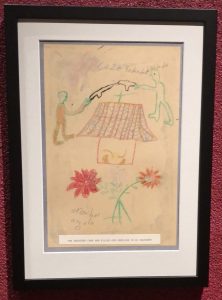
In Japan, where I am from, the experience of the World War Ⅱ has been tried to be conveyed to keep the catastrophic memory alive and to never repeat the bloodiness history again. The story people suffering from aerial attack and trying to hide the light inside their houses to prevent being bombed. People being trained to act and dress in a certain way to maintain the boundary toward the war. People believing that dying in the war for the county is an honoring thing. All these stories were carried on to my generation though education, TV shows, movies, comic books or other various means, even after 73 years has pasted since the war ended. Reading “Persepolis” in the ASTU class, made me remind all these stories and surprised me how the description of the war in Iran is identical to what I had learned about Japan. “Persepolis” is a comic book written by Marjane Satrapi, describing her own childhood memory in Iran in the time of the Islamic revolution and the Iran-Iraq war occurred. Although the background is completely different, the sad fact that Marji (the main character of Persepolis who also represents Satrapi’s childhood) suffered similar situations to Japan during the war, in spite of those effort of conveying the war experience to prevent the history to be repeated, made me wonder if conveying one’s memory or public story is a meaningless thing. Then, what does “Persepolis” tell us about what happened in Iran? What can a popular culture do to convey what happened in the past?
Japan has a huge popular culture, and I am also familiar with war descriptions such as “Barefoot Gen” (a series of comic books written by Keiji Nakazawa, about the nuclear bomb attack in Hiroshima) or “Grave of the Fireflies” (an animation film directed by Isao Takahata, about two siblings suffering the last few months of the World War Ⅱ in Kobe city). Both these stories and “Persepolis” is somewhat based on the true experience, while some fictional factors are also added, which means it’s not aiming at just retrieving the whole complete experience. Especially, we talked in class that the frequent use of black for the background in “Persepolis”, allowed Satrapi to avoid telling the whole experience, while it rather provided the strong dark and heavy impression. Also, I thought she drew it simply with less motions compared to most of the Japanese comic books, which left the space of imagination to readers. I felt she made readers to consider what was it like, and fosters them to find the left pieces of the experience that Satrapi didn’t include in her book by themselves. Maybe engaging with readers’ heart is the true meaning of telling a story rather than replicating the experience, and popular culture allows us to do this.
Another role that popular culture can play is to convey the author’s message. Satrapi states the purpose of writing “Persepolis” in the introduction, as to debunk the stereotype about Islam. Specifically, she writes in the book about how she thought about the veil, which women were forced to wear after the Islamic revolution. It reminded me what I learned in my anthropology class, which is out of the CAP course, about Elizabeth Fernea’s ethnographic work about women who wear the veil in Iraq. She argued women’s social life is actually very enriched, although the veil looks as restricting their freedom. While this approach also debunks the stereotype of the veil, it is interesting that Satrapi doesn’t state a clear view about the veil like Fernea, and rather disperses Marji’s unstable thought toward the veil and God. This also makes readers not just understand the information that is given but reconsider about the concept of Islam, through popular culture that is relatively casual and approachable way compared to a formal scholar writing or journals.
Overall, the popular culture nevertheless seems to be a powerful source to convey what happened or a certain message. Although we can’t just completely copy and retrieve what happened, describing memory can implant the strong feeling or impression about what happened, and sometimes change people’s mind. However, I personally think that this popular culture has not being able to maximize its power, due to the use or regulation of media by the government or other groups. As we learned in our POLI class, some states also try to control the information to restrict its population’s freedom, and depends on the mass communication to spread their thoughts to their citizen. In fact, “Persepolis” has been banned in Iran too. I feel the interchange and the balance of how and who conveys what , might be the important aspect that forms the society nowadays.
Time passes and the number of people who can tell the story of the past directly declines, while stories that we must pass to the next generation also increases day by day. We can become both the receiver and the teller of the story. How we use popular culture and how we approach to the information that we receive, is a crucial issue that we have to think again. If everyone could work through the information and could measure what is important, we might be able to really stop the repetition of history.