How hard is it to walk on the streets of a developed country and not see a pair of golden arches accompanied by the ubiquitous red and grey storefront? If you’re a travel aficionado like me, you’ll know the answer to this.
McDonalds…the emblem of globalization and arguably the most well-known chain of fast food restaurants, was founded in 1940 in California. It has now grown to serve 120+ countries around the world and counting!
As we recently learned in class, some companies stick with a standardized marketing strategy while others adapt to their situational surrounding. There are some things that are kept consistent, such as branding. In other words, people all over the world need to have ways of associating the products that they see with McDonalds. This is why you wouldn’t see them changing their logos, colour scheme or interior design. BTW, I’ve noticed a rebranding trend going on whereby they’re trying to establish a classier image by emphasizing modernity and comfort in the design of their interiors, but that is another story I won’t dive into this time.
The following are instances in which the storefront changes to adapt to a country’s culture and as you can see, a lot of McDonalds stores blend into the traditional architecture of the building in which they are found. If you have the time, Flickr has a group that aggregates all the McDonalds storefronts people post on the site. There are over 8,500 of them.
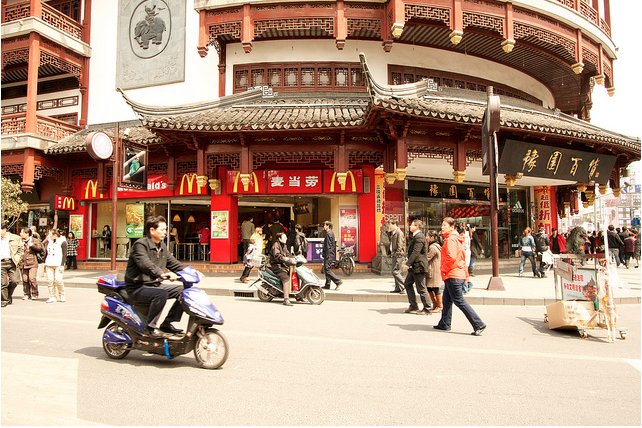
We’ve just briefly touched on the situation analysis but something else to consider when expanding globally is the Marketing Mix! For the four P’s – Price, Product, Place and Promotion, I’m going to provide examples of how McDonalds is a “chameleon”.
- Price–A bit of macroeconomics/econometrics here, but economics have actually developed this index that measures the difference in PPP between countries. It’s called the Big Mac Index because it uses the price of Big Macs around the world. Talk about globalization. The point is that you’d think that currency rates would ensure that you’d pay the same price for a burger in Australia as you would in Japan, but this is not the case. The most expensive Big Mac is in Norway and the cheapest Big Mac is in Ukraine.
- Product–It is truly amazing how products will differ around the world. For Americans, there’s always some sort of new variation of beef coming out, but in other parts of the world…some cultures just aren’t beef fans. It is said that pictures speak louder than words.


And now for my favourite…

- Place–Just check out the link for the storefronts! It’s also interesting to see how McDonalds integrates itself into traditional architecture. I love how they vary their locations and yet stay recognizable.
- Promotion–McDonalds uses celebrity endorsement in some countries. A lot of the commercials are geographically unique.
I hope you had as much fun reading this post as I had writing it.
C