Earlier during dinner today my mom was telling me a story on how a 15-year-old student appeared on Dragon’s Den asking for an investment on his app. I instantly thought it would be the perfect topic for one of my blog posts. As I did more research on the story, I discovered that the entrepreneur’s name is Aanikh Kler and that he is currently attending St. George’s School. His app is called UndrTheRadr Ringtones and it “delivers high-pitched smartphone ringtones that only children and teens can hear.” The reason for this is because as an individual age, they are less able to hear high-pitched sounds. This app produces ringtones in 17kHz and higher. The Dragons, as well as the author of the article, have tested it and it actually works! The competitive advantage UndrTheRadr app has over similar apps is that 20% of sales go towards Free the Children (which was mentioned in one of my previous posts) to help build schools in developing nations. This is a clever and innovative way for Aanikh to appeal to his competitors’ consumers; a great advantage for a start-up entrepreneur. His app also ties in with the idea of being socially responsible as he is donating part of his sales to charity. Come to think of it, why did I not come up with this idea?
Response to Kiki Jiang
Adding on to Kiki Jiang’s post about animal testing in the cosmetic industry, I too believe that this unethical practice weakens a company. However this could be an opportunity where companies can conduct some market research to find out what their potential consumers are looking for in their products. Perhaps some consumers are not too bothered by animal testing if this means that the products can be bought at a lower cost. I am assuming though that majority of the consumers are willing to pay a higher price in order to save little creatures from being tested and tortured. By choosing the non-animal testing route, the company is also being socially responsible. Consumers seem to appreciate the trend of socially responsible companies because this way, they do not feel guilty purchasing the company’s products. The only major problem I see is how drugstore cosmetic companies can maintain their low price if their costs increase due to a stop in animal testing. For higher-end cosmetic brands, since their demand is more inelastic, they are less likely to face this problem. I hope in the end the cosmetic industry in general realizes the negative impact they are making from animal testing.
An Inspirational External Blog
Honestly speaking, I did not know business blogs – outside of UBC students’ blogs – existed! In fact, when I saw in the criteria that an external blog must be linked to one of our posts, I felt lost and confused. Lo and behold, Google saved the day. I found myself scrolling through pages and pages of business blogs until I discovered one that captured my attention.
For this post, I chose to write about www.successful-blog.com. The blogger, Liz Strauss, is an international business strategist and the CEO and Founder of SOBCon. On her blog she writes about business and social web strategies, while mainly focusing on relationship building as a crucial part of a business. In my opinion, Strauss’ blog was the most interesting blog I have come across because unlike many business bloggers who write blog posts in an article format, Strauss tends to write in lists. I personally find reading lists much more pleasurable and easier to comprehend. I also find some relevancy and helpfulness to her posts as I can sometimes relate them back to my own personal life. Not to mention, some of her posts are quite inspirational that it gets me thinking of my future as a businesswoman. In the end, I am positive I will continue to use this blog as a resource in the near future.
Response to Cynthia Chiang
If I had to choose the one class I was most impacted by, it would have to be class 15 when we learned about creating shared value, social entrepreneurship, and corporate social responsibility. This lecture made me open my eyes to the possibility of operating a business firm while simultaneously help the greater good of the community. As much as I would like to be successful financially, I believe it would be more fulfilling if I can improve even the slightest bit of a heartbreaking situation. Cynthia Chiang actually touched upon a social enterprise called Me to We in which she actually supported by starting a club called Free the Children at Burnaby North Secondary. It is thanks to her that I have learned plenty, not only of the club but also of the situation in developing countries. Agreeing with her point, social entrepreneurship is something I am passionate about and am willing to further expand my knowledge on.
“Successful for me doesn’t necessarily mean a lot of money,
but a business known for its integrity”
– Martha Getachew (ARC Initiative Entrepreneur)
Rogers Nationwide Outage
If you recall, approximately a month ago, Rogers’ wireless services had an outage nationwide. Rogers’ nine million subscribers did not have any service for at least three hours. The CEO not only issued a statement of apology, but also credit postpaid its customers for one day of service due to the outage.
A downfall as large as this brings major setbacks to the company; frustrated customers, massive cost of credits for subscribers, lowered reputation and more. Rogers did come up with a quick tactic to solve part of its problem – credit postpaid to subscribers – but do they have any long-term strategies to prevent this issue happening again in the future? Point being, they can’t always apologize by paying for their subscribers’ bills, since that will become extremely costly. They need to reach the root of the problem and solve it from an IT perspective. For example, given they have both an MIS and a BTM, these two groups need to discover what went wrong, communicate the issue to the rest of the company and formulate a long-term plan to solve the problem. Looking at things from a long-term perspective not only will save them money, but it will also save the relationships with subscribers, as well as their reputation.
“Sad To See My Baby Go”

I cannot remember the last time I paid to watch a movie or listen to an artist’s album, but I am certain I am not the only one. Ever since one of my best friends introduced me to a website called isohunt.com, my addiction to films has grown to an unhealthy habit. One day I was scrolling through vancitybuzz.com and came across this article. As soon as I read the title of the article, I could feel my heart sink to the inner core of the earth. My worst nightmare has occurred. I should have seen it coming considering the fact that the policy against illegally downloading music and movies online is becoming stricter; I just did not expect it to happen so soon.
Even though what Gary Fung – the founder of isohunt.com – was illegal, he is still, by definition, considered an entrepreneur. He noticed a problem (people not wanting to pay for music and movies), saw an opportunity (downloading music and movies from the internet) and solved the problem (created isohunt.com). Despite legal issues, he still took the risk and was rewarded with success; until he was sued $110 million by Motion Picture Association of America.
Farewell Mr. Fung, it was good while it lasted.
image: Isohunt Screenshot. Digital image. Vancitybuzz. N.p., n.d. Web. 14 Nov. 2013. <http://www.vancitybuzz.com/wp-content/uploads/2013/10/Screen-Shot-2013-10-18-at-11.14.02-PM-900×538.png>.

As soon as I saw the words: “we must prepare for a long period of harder times,” I instantly assumed Canada’s economy would undergo another phase of recession. We are not though. We just have to adjust to a lower standard of living from a result of a permanent shift down in economic growth, according to economist Jeff Rubin. In my opinion, that still sounds as bad or maybe even worse than a recession. But Jeff Rubin assures his readers that there is a brighter side to this permanent change. However since I consider myself a pessimist, I want to focus on this one statement:
“We’re going to see a huge jump in post-secondary enrollment at a time when we’re cutting funding for post-secondary education. More and more young people are going to live with their parents and stay in school longer as an adjustment of these developments.”
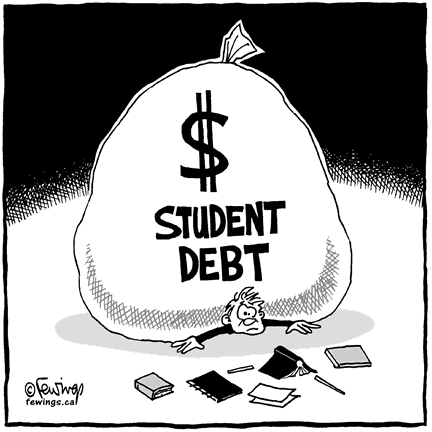
I must admit that this statement – said by an economist – put me through a mini panic attack. If post-secondary is cutting down on funding, then does that mean the quality of education lowers? If I have to stay in school longer, then does that mean my debt will increase even more? And how am I supposed to pay off my student loans if the unemployment rate is rising dramatically? Evidently this major economic problem will be difficult to fix, as it seems to be a never-ending cycle. I highly doubt this situation can recover by the time I graduate university but I suppose a little optimism would not hurt.
The Early Bird Gets the Worm

Upon reading the article published by The Globe and Mail titled “How Blackberry blew it: The inside story” I can finally see how not being able to adapt to the market can push the company to bankruptcy, or at least close to it.
Blackberry was once the leading company in the smartphone industry but now that major competitors such as Apple and Android has joined in the industry, it is safe to say that Blackberry lost its game. When Apple released the first iPhone, they started a major trend that Blackberry found difficult to adapt to and compete with. Apple started the trend of sleek, touch-screen phones, and clearly consumers prefer this design far more than the design of Blackberry phones. What Blackberry had over all the other smartphone companies however is their physical keyboard. And instead of using this feature to differentiate themselves from Apple and Android, they decided to jump in the bandwagon of touch-screen phones. This was a weak move on their part because not only were they unoriginal with the concept, they were also slow to release their product. Thus the demand for the Z10 was extremely low and all the unsold smartphones are now written off.
BP Trial Spill

Swear to tell the truth and nothing but the truth? Wrong. This is the case in BP’s latest trial regarding the 2010 U.S. Gulf oil spill. In fact according to The Globe and Mail’s latest article, “BP knew its Macondo well could explode.” And what made it worse was the fact that they lied about how much oil actually leaked into the ocean. How is it that one company cannot own up to the disaster they have created from the start? Instead of coming clean about their part in the pollution of a vast area of the ocean, they decided that it would be best to save the company’s name by telling white lies. Then now – two years after the fact – karma caught up to them, unleashing the horrific truth for the public to witness. If they were an ethical company, they would have confessed in the first place and took rapid action to clean up the mess they have caused. However they now have to live with the shameful reputation they have given themselves.
image: BP Logo. Digital image. N.p., n.d. Web. 14 Nov. 2013. <https://farm4.staticflickr.com/3399/4647242210_81f71aa041.jpg>.
UK Has to Pay!

A tragic fire in the Rana Plaza building in Dhaka, Bangladesh left 1,200 employees dead. These employees were once the workers of big-name retail companies such as H&M, Tesco, Tommy Hilfiger, Calvin Klein, Zara and more. Out of respect for those dedicated workers, many of UK’s retail companies signed a “legally binding initiative” in order to improve the work conditions of present employees to prevent future accidents. This contract states that these companies must provide financial support for the advancement in fire safety as well as overall building design. Their plan is to also force factories to conduct a public inspection, or get blacklisted upon refusal. The companies threatened by this plan include: George, Next, Matalan, River Island, Sports Direct, Peacocks, Shop Direct and the Arcadia group. The mentioned companies did not sign the pledge by the given deadline. The reason for their absence varies from excuses such as “unaware of the agreement” to taking part of a “different non-binding agreement.” Whether or not these excuses are legitimate, I still believe that each company involved has a responsibility to support Bangladesh in this difficult time, especially after all the labour this small developing country has done for a large empire such as United Kingdom.
article link: http://www.theguardian.com/business/2013/may/14/fashion-retailers-fail-to-sign-bangladesh-accord
images: Dhaka, Bangladesh Clothing Factory. Digital image. The Guardian. N.p., n.d. Web. 14 Nov. 2013. <http://static.guim.co.uk/sys-images/Business/Pix/cartoon/2013/5/14/1368562122569/Bangladesh-clothing-facto-008.jpg>.