Categories
COMM101

Me to We: A Social Enterprise

Taken from http://www.metowe.com/me-to-we-is/

Me to We is a social enterprise selling socially conscious and environmentally friendly clothes, books and music – as well as life-changing experiences. Also, it provide inspiring speakers, leadership training and transformative travel experience. Me to We aims to transform consumers into world changers. Half of its profits are donated to its charitable partner, Free the Children (a non-profitable organization), and another half is reinvest to grow their social enterprise.

The videos below show some detailed information of Me to We and Free the Children.

YouTube Preview Image YouTube Preview Image

So far, Me to We has made a positive social and environmental impact. Only in last year, Me to We saved quantities of water and pesticides, planted 80,000 trees, visited 194,430 students in developing countries, and gave numerous leadership workshops to youngsters. Also, it inspired 1,358 people to donate more than 120,000 hours of volunteer services on life-changing trips to developing countries.

Me to We is a definitely a good example of social enterprise. It combines the passion of a social mission with an image of business-like discipline, innovation, and determination. Its social mission is to encourage its customers to be involved in the undertaking to make a better world, to fight child labor, and to remove the barriers to children’s education in third countries. Its social mission is explicit and central. In addition, it seems that, unlike other social enterprises, Me to We has embarked on a path of sustainability and self-sufficiency. The annual report of Me to We shows some further information.


MORE INFO: http://en.wikipedia.org/wiki/Free_the_children

Categories
COMM101

Groupon: An Enterprising Company

This is the preparation task of Class 19, which is “blog about one company that you considered to be entrepreneurial”.

Article:

http://www.nytimes.com/2010/11/18/business/18sbiz.html?_r=1&ref=entrepreneurship

Groupon is a social-coupon website founded by Andrew Mason in 2008. Groupon offers its followers a deal-of-the-day coupon and the followers are encouraged to share it with social networks. Once a certain number of people sign up for the offer, the deals become available to all. Otherwise, no one gets the deals that day and they will not be charged. Actually, the coupon on Groupon can be regarded as a kind of quantity discount. Groupon makes money by sharing profits with those retailers.

The video below shows how exactly Groupon works.

YouTube Preview Image

The risk is reduced for both buyers and retailers. Also, the idea makes fully use of the power of social media and Internet, which guarantee the success rate of most of the deals. Groupon’s innovative business model is proven to be successful – in April 2010, Group raises $135 million from its investors. Seeing this fairly smart and innovative idea and the fast growing market of e-commerce, Mr. Mason takes full advantages of it and creates a quite considerable amount of wealth in a pretty fast speed. A $350 million revenue in 2010 best exemplifies Groupon’s fast growth.

Undoubtedly, Groupon shows the essence of entrepreneurship to the full extent. It derives from a new idea and is operated under a new business model. Also, it creates a unique service in the e-commerce market relying on the platform of social network. It conforms to the Schumpeter’s view of Entrepreneurship from all aspects.

Categories
COMM101

How can a company retain talent?

Article:

http://online.wsj.com/article/SB10001424052748703523604575605273596157634.html?mod=WSJ_business_whatsNews

I chose to write something about this article because it reminded me something that we learned on class18.

YouTube Preview Image

This event reminds me of the Equity Theory which I learned on my OB class. The theory clarifies that upper-level employees with more education tend to make more other-outside comparison. (quote from “Organizational Behavior”, Page147). In case of this, Google must make sure that its employees must be treated equitably; otherwise its employees are definitely likely to quit. Therefore, in my opinion, Google took the right action to retain its employees.

In addition to that, in my point of view, Google can also take other effective actions to avoid the detection of its employees. For example, Google can choose to motivate its employees more intrinsically by creating the sense of competence and sense of choice. In other words, Google can empower their staffs. This will definitely create more job satisfaction and affective commitment employees. Also, I think Google can pay more attention to creating an enjoyable organizational culture that all the employees’ shares and like, since organizational culture can be regarded as a social glue and will definitely enhance stability.

Overall, as I see it, Google should try to make its employees love their company rather than just simply give them more salaries. That is definitely a better choice for Google to retain its employees.

MORE INFO:

http://business.asiaone.com/Business/News/Office/Story/A1Story20101111-246815.html

Categories
COMM101

My Thoughts of Sustainability of Supply Chain

I chose to write this article because I learned some knowledge about supply chain and supply chain management in my COMM101 class.

Two Articles:

http://www.mnn.com/eco-biz/sustainable-business-practices/stories/sustainable-supply-chain-an-overview

http://www.mnn.com/eco-biz/sustainable-business-practices/stories/eco-friendly-supply-chain

After seeing the articles above, I have a general understanding towards the sustainable supply chain.

In order to attain a much more efficient and economic supply chain, managers now are paying more and more attention on supply chain management. Besides trying to figure out a way to shorten the delivery time and figure out how to make a more accurate forecast, managers now also try to make the supply chain more sustainable and eco-friendly.

Why corporations pay so much attention on sustainable supply chains? In my opinion, there are four main reasons.

Firstly, there are more and more sustainability-minded customers in the contemporary society. Customers have a growing concern on whether the products have a green production process. Also, a research shows that there are also an increasing number of customers who want to know the product’s entire lifecycle. Thus corporations try to meet these customers’ demand. Secondly, corporations are mindful of meeting current and future environment-related legislation. Thirdly, corporations want to create a better corporation image and public relation by giving customers the impression that those corporations have a sustainable supply chain. Last but not least, eco-friendly supply chain can help firms to reduce cost. Such supply chains can reduce unnecessary waste, improve raw material utilization, reduce energy use, and improve efficiency.

Currently, there are quantities of examples that companies are taking actions on building up a more eco-friendly supply chain, for example: Wal-Mart, Apple, Marriott, and McDonald’s.

MORE INFO:

http://www.accenture.com/NR/rdonlyres/A67BA82D-EC74-4B71-A039-481B4C308351/0/Accenture_The_Sustainable_Supply_Chain.pdf

Categories
COMM101

Disney Sweatshops

For decades, people around the world have associated “Disney” with innocence, imagination, and purity. However, nowadays, the Disney’s sweatshops have aroused the society’s wide attention. In some third countries such as China, Haiti, and Vietnam, working conditions are so nasty that far beyond people’s imagination.

So, behind the scenes of this gigantic company, what is the truth? What on earth is behind the bright name?

YouTube Preview Image


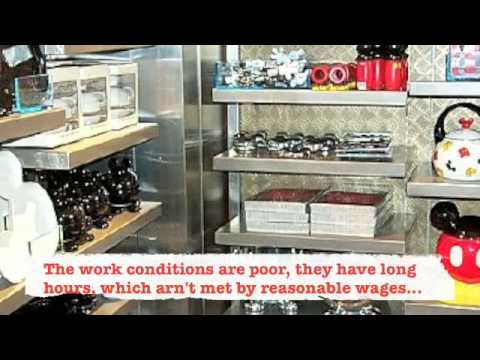
Take sweatshops in China as an example. There is information showing that the workers earn between 13.5 and 36 cents an hour; however, a research shows that wage earner must make 87 cents an hour to meet the basic survival needs of a small family in a major Chinese city. As you see, the workers in Disney sweatshops earn only one-third as much as the lowest standard. Not only that, workers suffer illegal fines. Workers are fined for talking or going to the toilet without permission. Unfair fines are frequently handed out. They range from 60 cents to 35 dollars, which can cost up to two months of pay of those already poor people.

Surprisingly, in such low wages, workers, however, work extremely long hours! Despite the Chinese labor laws that establish a maximum 49 hour work week, they work 112 hours a week! One worker said, in some sweatshops, there are even no set working hours. There is a quota every day. Sometimes, in the peak season, the quota can be 4000 toys a day. If they don’t finish it, they will be beaten.

There is a report of an investigation carried out by 10 Chinese university students. They conducted the investigation as undercover workers in their summer vacation. The report shows the real working conditions in 5 Chinese factories.

All the workers are exposed to constant toxic chemicals. However, there are even no protection equipments. Food there is described as pigs feed. Dorms have no hot water. In addition, the report shows that, there are lots of work-related injuries. Some workers lost their fingers, palms, and even arms. Even in this condition, they can’t stop working. The link shows a news that a child was died during his work.

The link shows more detailed information about workers’ working conditions.

In these sweatshops, the code of conduct which Disney is proud of seems like hollow words. As the problem of business ethics are becoming increasingly serious and widespread, more effective actions should be taken to protect those poor workers’ rights.

MORE INFO: http://blog.buzzflash.com/alerts/109

Spam prevention powered by Akismet