Categories
Uncategorized

Getting In the Mind of a Marketer

I’m a critical reader who likes to approach articles with different perspectives in mind. I believe that more angles I can cover, the more informed my decisions will become. Yet, I’ve found that sometimes the most insightful information isn’t in the body of an article at all.

Take for example an ow.ly link I found on Twitter today: ow.ly/rsLxk (courtesy of HootSuite).

At first glance, the appeal of the link is found in the statement “How do you become a leader in customer service? With a social media response rate of 95-99%.” This is a specially crafted statement designed to draw my attention and lead me to click on the link. Clearly, the tactic was successful as I have not only clicked on the link but I’ve also written a blog article on the topic.

Sometimes I feel “cheated” out of my decision to click on shortened links because I’m unable to see a lengthened link before I’m led to the page. In this case, the full length of the link “ow.ly/rsLxk” is actually:

http://blog.hootsuite.com/davids-tea/?utm_source=content%20team&utm_medium=owned%20social&utm_campaign=content%20team%20owned%20social

This tells us a lot about what the article was written for. For those of you who have seen long links around with “utm_campaign” tags at the end, this is basically a method for marketers to quantify where the link traffic is coming from. It does the reader absolutely no harm, but I find it interesting to dissect the segments of “utm-tagged” links.

In this case, I can discern that this article was tagged with “utm_source=content%20team,” “utm_medium=owned%20social” and “utm_campaign=content%20team%20owned%20social. What this immediately tells me is that this article is an “owned” article that contributes to to campaign “%20team%20owned%20social.”

What does this mean?

This means that someone at HootSuite is testing a campaign tagged “%20team%20owned%20social” and we’ve clicked on a link from an “owned” medium in a “social” setting. If I could wager a guess, I’d say that the Marketer wants to measure just how many inquisitive minds are clicking through Twitter (a “social” media outlet) to get to their blog (an “owned” media outlet) in order to view content releated to “davids-tea”.

It’s quite possible that the “Davids-Tea” article was posted elsewhere by HootSuite, resulting in slightly different utm_campaign links. By compiling a portfolio of relevant links and capturing traffic metrics using some tool (usually Google Analytics) the marketer can derive the most effective mediums of communication.

“But Chris, this is horrible! Big Brother is spying on us again!”

No, it is not.

I firmly believe that, by doing such tests, marketers can help release interesting and relevant content to the world. Marketing is sometimes perceived as a negative factor because certain aspects are intrusive (think: unwanted phone calls, spam mail, etc). But such tactics are not overt and actually have very little intrusive factors. Privacy rights aren’t even being violated, as traffic metrics are captured in bulk and have no relation to the individual viewing habits of the reader.

Just some food for thought I’m cooking up at 2am in the morning: instead of viewing marketing as “a process of selling us unneeded stuff,” think of marketing as “a means to get cool stuff to your attention.” No-one ever forces a consumer to actually buy anything; the trick to good marketing is to appeal to a consumer and figuring out what they actually want to look at, what they want to buy, what they would like to invest their time on.

It takes hours upon hours for a Marketer to figure out what you, dear reader, consider valuable in your life. And the fruits of their research can always be found in the background of the articles, pictures and videos that we consume daily.

Let’s look into the source code of things.

As an exercise, go to any website that you frequently visit and then press “ctrl-u.” This opens up a new window of the blog’s source code. If the blog has been streamlined to be found easily by web crawlers (internet slang for search engines), you should see a slew of words that appear near the top of the code such as:

<meta name=”keywords” content=”Chris, social media, blog”>

This is basically the page’s way of screaming out “HEY THIS BLOG IS TALKING ABOUT SOCIAL MEDIA” so that Google can pick it up and stick it in search results. The interesting part is that most consumers will never see the work that’s put behind this back-end information.

I consider Marketing as part of the vast realm of social sciences. Pages are continually being tested over and over again to see what actually catches people’s attention. Does “Video Campaign A” result in more views, or do consumers prefer “Video Campaign B?”

These are questions I ask myself whenever I read articles on the web, or simply see an advertisement on my way to the bus stop. We’re surrounded by a vast network of information, and the attention span of each individual person is only so short.

So, the next time you read that article online, take a moment to think about how the article got to you. There’s more than meets the eye.

Until next time, signing off.

-Chris

Categories
Uncategorized

The Appeal of Social Media

Social Media as an Amplification Tool

“Social Media” has been a hot topic in the field of marketing for a great many years. Often considered a double-edged sword, the concept of social media is particularly enticing to marketers because of the improved reach and engagement over traditional marketing methods. However, a poorly-executed social media campaign can backfire just as quickly as a successful one.

Take JP Morgan, for example. Underestimating the possible backlash from Twitter users, they launched a “Twitter Takeover” campaign with the following question: What career advice would you ask a leading exec at a global firm? Tweet a Q using #AskJPMJP Morgan then proceeded to deal with 7 hours of vicious tweets from Twitter users, ultimately withdrawing the campaign by tweeting “Tomorrow’s Q&A is cancelled. Bad idea. Back to the drawing board.”

And yet, some companies have found ways to make social media work. “Viral marketing” has essentially become the holy grail of marketing. The rampant virality of a video or photo across social networks is absolutely astounding, and the spread is essentially cost-free. The famous Old Spice advertisement currently has over 47 million views on YouTube, a number greater than the entire population of Canada!

YouTube Preview Image

About a month ago I wrote a blog post that likened Business to a boat, with Marketing steering the wheels. Social media, in this day and age, is akin to giant waves in the ocean; they can either propel your boat forward at great speeds, or send it plundering to the depths of the ocean. A good marketer can navigate those waves.

A good marketer, in my opinion, uses social media not only as a tool for propagation but for communication.

Social Media as a Means of Communication

A brand manager’s role is to ensure that the brand’s message remains strong, consistent and adaptable in the ever-changing market. Social media is an excellent way for a brand (like Old Spice) to invigorate its message, to communicate directly with consumers, or even to show some personality.

Sure, you will have the occasional “troll” or “hater” that threatens to damage your brand’s reputation. But by keeping on top of communication channels, a social marketer can turn consumer comments into great opportunities. A great example is a response post by Bodyform:

Roughly one year ago, a man named Richard Neill poked fun at Bodyform, stating that they had set unrealistic expectations for their products. Left alone, this comment would have received very little attention and would have prompted negative comments, if any.

However, Bodyform replied quickly and creatively.

YouTube Preview Image

The CEO of Bodyform replied with a tongue-in-cheek video that “apologized’ for setting unrealistic expectations while promoting the Bodyform brand. This response garnered much interest and eventually became viral, much like Old Spice.

The flexibility of social media not only allowed Bodyform to respond quickly and in a public manner, but also provided the means for the video to become viral. Over the years, I’ve seen many companies use social media in creative ways.

Great brands require hard work, dedication, and consistently wonderful products. Social media helps the brand promote their product(s) through amplification, but that only goes so far. A truly responsive brand will go out of their way to communicate with the consumer, gather input, and work towards making the entire consumption experience satisfying.

And guess what? Satisfied consumers come back.

Until next time, signing off.

-Chris

Categories
Uncategorized

Brand Associations and Anime Campaigns

A little over a week ago I talked about Internet Explorer’s new Anime campaign. As a fan of Anime I’m often put-off by poorly executed campaigns or completely enthralled by the good ones. Overall, I have some very mixed feelings about leveraging Anime for commercial reasons.

The Japan Horse-Racing Association’s Attack on Titan campaign is one of the campaigns that have left me confused, wondering “what did I just watch?” and “why did they do this?” After further thought, the campaign starts to make more and more sense outside of the traditional goals to “increase traffic.”

In case the reader has no idea what Attack on Titan is, it is a popular anime released last season that revolves around the premise that humanity is prey to self-regenerating Titans. In order to stave away the Titans, the remaining population of humans live their lives within the protection of 50 metre walls. These walls are eventually breached, and the anime centers around the efforts of Eren Jaeger on his counter-attack against the Titans.

YouTube Preview Image

The anime received global recognition and a huge fanbase, prompting a lot of companies to run Attack on Titan campaigns (Pizza Hut being a prime example). It’s a fairly straightforward strategy to align yourself with popular regional mediums to enhance reach and engagement, but these campaigns are often misaligned with the brand’s values.

The topic of today’s blog is the Japan Horse-Racing Association’s Attack on Titan campaign, featuring their own website at http://shingeki-jra.jp/. On this site, they have a full-screen intro video featuring our heroes on horseback, racing against titans while you play minigames in order to influence the result. What’s interesting about this campaign is its focus on horses, and the power of the Titans.

I enjoy following these campaigns not only because of how ridiculous they can be, but because they make quite a bit of sense.

There is a technique in Marketing called a “Brand Association Survey.” The purpose of this technique is to unearth some of the associations, both positive and negative, associated with a brand. Here’s an example:

When I say the brand “Coke,” what comes to mind?

You may reply, like me, with the following terms: “red, cool, cold, ice, sweet, unhealthy…uh…profitable, pepsi, polar bears, fun, children, lego, toys…” etc.

The first set of terms I spat out (from “red” through to “unhealthy”) would be the “primary associations.” If Coca Cola were running this servey, they’d say “hey, this guy thinks of “ice” and “cold” whenever he hears “Coke.” Let’s center a campaign around enforcing that association (hence the polar bear campaign)! Alternatively, they could say “hey, this guy thinks of “unhealthy” whenever he hears “Coke.” Let’s center a campaign or product around tackling that association (hence Coke Zero).

Now, when you think of “Titans” what is the first thing that you think of? Here’s a picture to aid your thoughts:

Credits go to goruditai of DeviantArt

I personally think of “muscle, power, strength, intimidating” and other similar terms. These are great associations to have when you’re a Horse-Racing association! Hence, this campaign makes sense.

Interestingly, this is not the first anime campaign sponsored by the Japan Horse-Racing Association. The previous one centered around the Neon Genesis Evangelion franchise which is most commonly associated with-get this, giant robot/cyborgs. I think I’m seeing the link, here!

YouTube Preview Image

I could probably go on for days about the implications of such campaigns, but right now seems to be a suitable place to stop. I hope to cover how these campaigns contribute to a company’s ROI in a blog post in the near future!

Signing off,

Chris

Categories
Uncategorized

Snapchat, Facebook, and the Hold-Out Strategy

At the time of writing, it has been 4 days since Snapchat formally refused Facebook’s acquisition offer of $3 billion. The main question on everyone’s mind is: Why?

General consensus agrees that Snapchat may have dropped the ball on this opportunity. Pooja, a colleague of mine, reasons in her blog post that Facebook and Snapchat are “miles apart in their positioning” and that Facebook attempted to buy Snapchat in order to “swallow the competition.” I agree with Pooja that this could be a plausible reason, but I offer an alternative perspective.

Before I explain my rationale, let’s step back in time to 2008. This is back when Microsoft attempted to acquire Yahoo! (yes, this actually happened!). At the time, Microsoft saw potential in Yahoo!’s search engine and offered a bulky 62% premium in its offer ($45 billion for a company worth roughly $27 billion). This move was done in order for Microsoft to drive critical mass, increase scale of economics, and access Yahoo!’s engineering talent to accelerate innovation.

And what did Yahoo! do? Yahoo! rejected the offer. Yes, Yahoo! rejected a ridiculously sweet deal with a 62% premium. And what did Microsoft do in response? They offered higher.

Microsoft re-evaluated its offer to Yahoo! and offered an additional $5 billion to its initial offer. Yahoo! ultimately did not accept the offer (which was a terrible decision, in my opinion) but the strategy to wait clearly worked at least once. Yahoo! ultimately pushed its requests too far, which prompted Microsoft to withdraw the offer. Although this strategy was ultimately a failure, it does show the merit of waiting to evaluate a company’s true valuation.

This strategy is called a “hold-out strategy,” at least according to discussions with my Strategic Management professor. The idea behind this strategy lies in the concept of trade, that no-one will offer a deal unless they gain some benefit from the deal. Let me put it this way. Let’s say that you have a really cool action figure, and I offer to buy it for $8. Clearly, since I offered to buy the figure, I value it greater than $8 (perhaps at $10). Your best move is to respond by offering to sell the figure for $9, which is greater than $8 but still less than $10. Assuming that no other kid on the playground has this particular toy, I may actually consider buying it.

This is how I see the Snapchat/Facebook acquisition. I do not think that Snapchat’s services are worth $3 billion, but Facebook clearly does. Relating this back to Pooja’s article, if Snapchat is really seen as a threat worth removing for $3 billion, it may be in Snapchat’s best interests to become that “bigger threat” which will prompt Facebook to consider raising its offer.

I find acquisition strategy (poison pill, white knight, etc) to be similar to a big game of “chicken.” It’s really hard to determine the real winners in such a game, so only time will tell how the course of this interaction will run.

Until next time, signing off.

-Chris

Categories
Uncategorized

Internet Explorer Launches Anime Campaign

Internet Explorer has been going through some tough times. After a multitude of attacks, security and usability issues, the granddaddy of web browsers has dropped from over 40% share of web browser usage in 2011 to just over 20% in 2013. Although their web browser seems to have a long ways to go, their marketing campaigns are often quite in-line with consumers. At the very least, they’re creative and fun!

Their “Browser You Loved to Hate” campaign, launched in 2012 to promote the use of IE10 for Windows 7, resonated with consumers born in the 90’s and raised quite a bit of attention on social media outlets. Specifically targeting hateful perceptions against the web browser, the IE marketing staff delivered a tongue-in-cheek message to try the browser before hating on it.

YouTube Preview Image

Later renditions of the campaign also appealed to nostalgia with consumers born “in the 90’s.”

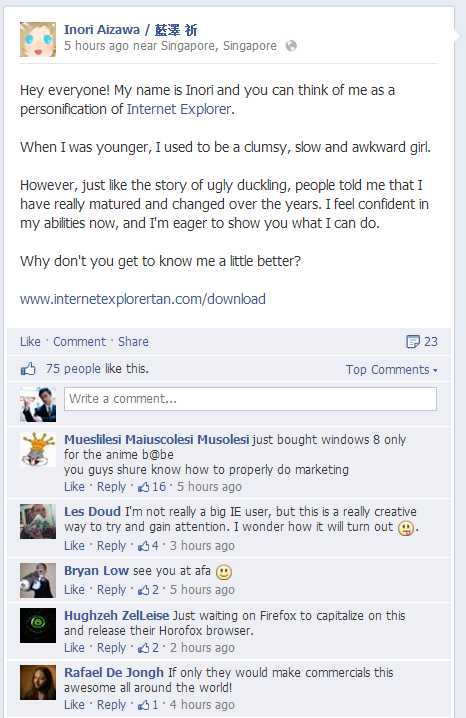
But Internet Explorer isn’t one to stop fighting early. Earlier today, IE released a video of an “Anime” featuring their new mascot “Inori Aizawa.”

YouTube Preview Image

I’m a little skeptical of Anime campaigns. Some of them have been very successful, while others have come off as downright embarrassing. In recent history, Domino’s CEO was featured in an advertisement with Hatsune Miku in a very strange campaign. Although the ad was ridiculed by many consumers, the end result was that demand for Hatsune Miku Dominos Pizza “exceeded 10 times [their expectations].”

Here’s the ad:

YouTube Preview Image

The real question at hand is: How will IE’s decision to launch a campaign featuring their new mascot in Anime form translate to new users? Well, they’re clearly trying to appeal to the audience that watches Anime. Specifically, given the style of the campaign, they may be trying to activate nostalgia of some sort with consumers who watched Saturday morning cartoons during their early school years. Their current positioning on their Facebook page implies that they want to sell IE10 as an “ugly duckling” that has grown up to become a beautiful web browser (see below):

Only time will tell how this campaign will affect consumers, given the deeply-rooted negative perceptions towards IE. Will this campaign be a bang or a bust?

Sasuga, Internet Explorer. Shiranai.

Until next time, singing off.

-Chris

Categories
Uncategorized

Crowdsurfing Ideas – Crowdsourcing

Sometimes, Marketers try too hard.

We’re taught all these cool approaches to analyze data and extract insights. However, I’ve always been a backer of listening to the end consumer before making any business decision. I can cite the famous “New Coke” case in which Coca-Cola spent loads of money on market research to launch “New Coke,” only to have the figurative can blow up in their face. The consumers didn’t like the change, and the launch failed miserably.

Link to image: Senseslost.com

Coca-Cola was, and still is, one of the most valuable brands in the world. They’re experts at what they do. So what went wrong?

To simplify the explanation, consumers simply did not want the familiar “Coke” product that they knew and loved, to change into something new and unfamiliar. Even if blind taste tests indicated a preference for a sweeter beverage (New Coke), consumers would still prefer old coke simply because of the nostalgic feelings it brought back.

Sometimes, science can be wrong! Why? Because humans are irrational beings. I would highly recommend that you read Dan Ariely’s “Predictably Irrational” for some more insight into this, but the key takeaway I want to bring from this is that “people can do strange things, but in the eyes of the marketer, they are always correct.”

Source: Wikipedia

It seems that new-age marketers have not only learned from the Coke case, but are taking advantage of now-more-vocal consumer. Instead of instigating the research themselves, savvy marketers are now directly taking input from consumers themselves. I mentioned this in my previous article about sourcing ideas from social media sites, but the concept of “crowdsourcing” is just so relevant in today’s digital age.

Why waste so much effort moving around and testing an idea, when your customers can simply move it for you?

Granted, you’ll need a large enough representation of the market to prove any point. However, when enough users are speaking, it’s as if the crowds are crowdsurfing your new campaign ideas. Take H&M for example. Just recently, they’ve launched a new campaign to allow customers to vote on their philanthropic activities. This move is, in my opinion, quite brilliant. Not only does H&M gain the most effective use of their philanthropic money, but they also gain a lot of free attention from local buzz.

I’m interested to see just how far crowdsourcing can get us as a civilization. The digital age is upon us-why not join the revolution?

Until next time, signing off.

-Chris

 

Categories
Uncategorized

Monetization and Social Media

A very interesting Reddit debate is going on right now.

Thumbnails are pretty lame. Click on the image to view the full post!

Quick summary: Director of Anime Expo hosts a discussion on “why people download anime illegally, and […] what [you] would do to change the industry.” Receives 269 comments within 8 hours.

There are some very interesting comments here about the monetization of a very large, and growing, industry. But what I would like to focus on are the comments made by the original poster (OP):

Click on the image to view the full post!

The OP claims that anime titles and companies in Japan are not looking at social media sites like Reddit and MAL. If you’ve been following any of my recent posts, you’ll realize just what kind of an opportunity these companies are missing out on.

There is a gold mine out there.

I’m an image! Please click me!

Here we have a consumer from Indonesia who feels that s/he is forced into a position where illegal downloads are the only option, since legal options don’t exist or are unattractive. Through this one Reddit post, we’ve already identified a possible audience to cater an existing product to; the only difficulty is measuring the size of this market and profitability. But, if done properly, someone out there could capitalize on a potential high-margin market.

I’m a very big supporter of listening to the consumer through social media channels, and here I feel that this Reddit discussion greatly supports my point. There is a lot to be learned from these channels, and I’m on a mission to become a social media master.

Until next time, signing off.

-Chris


Categories
Uncategorized

Pokemon! Gotta Catch ’em All!

Ah, Pokemon. The iconic symbol of a 90’s childhood. Pokemon and Yu-Gi-Oh! have always touched a soft spot of mine.

Not only are their products good, but the respective marketing strategies for both fandoms are surprisingly effective. Just take a look at this Pokemon dubstep video ft. Lindsey Stirling:

YouTube Preview Image

Released merely one day ago with already 301k views, and over 25k likes? Needless to say that this video is popular and well-liked. The bit.ly link embedded in the video leads to a Pokemon X/Y preorder page, with the end url “/KurtHugoSchneider_Pokemon.” Needless to say that this video was, at least in some way, commissioned by one of the parties involved in selling the upcoming game. And it’s great exposure! Fans of Pokemon (and Lindsey Stirling, Kurt Schneider) have a great video to watch, and Pokemon/EA have increased their landing page visits by a good amount. So how do those sales numbers add up?

Assuming that 1/10 people click on the link, they would have received over 2.5k visits in one day directly onto their pre-order page. Assuming that 1% of these visitors actually end up buying the game, that translates to 25 new pre-orders…which is $1000 (25x$40) in the bank.

Product campaigns have intrigued marketers for years, but I am particularly interested in how even “fan-made” videos can help a company sell a product. Such is the power of YouTube, Facebook, Twitter, and other “social media” sites around the world…

More to come on that topic later!

Signing off,

Chris

Categories
Uncategorized

Sustaining Greatness in Gaming – Part 2

Once a boxer becomes a champion, he must now defend his title. The fight never ends.

In my last blog post I talked about my thoughts on what defined a successful product. In summary, I thought that a great product needed to be appreciated by its target market, and that the product needed the exposure to reach that market.

This post will define the other half of the battle: sustaining your success.

So you have a great product. Your fans are willing to throw money at you to keep making great things. Your product is being mentioned in online circles, promoted through word-of-mouth, and all is going well. There’s only one problem.

The world never sits still.

Whoever currently enjoys your product will eventually get tired. Newer, cooler things will roll out, and new technologies will render your product obsolete. Your fans will eventually become complacent and you’re bound to need to roll out something new-but what?

This is where paying attention to your customer pays off.

In eMarketing, we discussed the concept of the conversation prism. This convoluted diagram essentially lists all the different mediums where an online community can discuss, or observe, your brand.

In my opinion, diagrams are useless unless they help explain something or suggest new methods of working. This diagram does both. First of all, it explains where your product *could* potentially be talked about. This includes places like Facebook, Twitter, or Reddit. By going around the circle, you can identify all the different sources for ideas from your very own customers.

Remember my definition of a “good product” in part 1 of this post? “A great product is anything that is perceived to be attractive by the target market. That is all.” What does this mean? This means that the customer is king.

A lot of business students I talk to say that it’s in a firm’s best interest to “maintain an ongoing relationship with its customers.” When I ask them about it, they reply “so that they can keep making money off of loyal customers.”

I like to look at it a little differently. A firm keeps a lasting relationship with its customers so that it can, or should, pick up ideas. Oddly enough, I talked about this a year ago in my post “Listen to your consumers!” and I’m reiterating the same message now.

This title of this blog post is “Sustaining Greatness in Gaming” because I believe that great game developers listen to the feedback of its players. I keep tabs on popular trading card games and online MMORPGs/MOBAs, and although the problems differ one thing always stays the same: the players want the developers to listen.

Let’s go back to discussing FTL: Faster Than Light. The developers for the game are currently hosting an AMA (Ask-Me-Anything) on Reddit along with some other awesome dame developers. Here, they directly answer the questions of their players and create hype for new products. In particular, they’re getting feedback on what’s cool (or not) in their games. This is essentially free, painless market research.

These are the top posts in the comment thread. If I were the marketing manager for Subset Games, I’d be taking a lot of notes from this thread. We have people voicing their opinions on the product, creating new ideas for future releases, and doing all of this absolutely free This is a gold mine of information, and it would be foolish to disregard these comments.

However, what’s very interesting is the response of the developers. “While we have some minor stuff in the works […] it’s unlikely that we’ll be jumping on to a sequel.” What does this mean? To me, this simply means that they’re going to release something new. Something different. Rather than staking all of their success on one given product, they’re going to expand their portfolio to include other games as well. This is a great move as far as strategy goes, and there is only one piece of advice I’d give to the developers:

Make sure you listen to the players.

It’ll be hard to live up to FTL, but if you’re great at inspiring joy in consumers (e.g. PopCap Games, creator of Insaniquarium and Plants vs. Zombies) you’ll likely create another fabulous product. And that will sustain your success.

So what is a successful firm? I’d like to define it as an entity that listens to its audience and creates great products again and again, time after time. If you can do that, I’d classify you as successful.

That’s all on success and sustaining greatness from me. See you all next post!

Signing off,

Chris

Categories
Uncategorized

Sustaining Greatness in Gaming – Part 1

Firms exist to create and sustain competitive advantage

Firms exist to create great products and services. Customers will pay for said product/service, and business owners profit so that they can spend their money on great products and services. And that is how the world goes ’round.

But what, exactly, makes a great product?

A great product is anything that is perceived to be attractive by the target market. That is all. If children love your board game, it’s a great board game. If avid knitters love the texture of your knitting thread, you have great thread. If a scientist is able to advance his work through your series of PCR thermal cycler, you have a great…well, thermal cycler.

But what happens when your product isn’t perceived by *all* of your target market to be as awesome as you’d like it to be?

Artists and indie game designers rarely unanimously agree on their thoughts of an “excellent game” or “beautiful work of art.” Each and every one of us have varying opinions, and it’s only natural that these opinions conflict with others. This basis is the source of my ongoing respect for artists and game designers: the less well-known your product is, the more degrees of freedom you’ll have to work with. You don’t have to cater to the masses’ cravings for explosions and violence if you have a beautiful story. You don’t have to use high-definition graphics to convey the emotions of an 8-bit character. And because you don’t have to cater to the masses, you can do whatever you want. You’re limited only to your ideas, and those are endless.

But, if your idea is beautiful, chances are that someone else will agree with you.

And that idea will explode.

We can look at a huge variety of indie games that have made it big. Let’s focus on FTL: Faster Than Light, a RTS game created by Subset Games.

Source: Wikipedia

FTL is a wonderful game with hours upon hours of replay value. Replay value is, in my opinion, very indicative of a game’s success. It means that the gamer is willing to spend more time on your game, and that is (almost) always a good sign. Unless a gamer is constantly frustrated going forward, many hours spent on a game is indicative of a flow state of mind, which is basically that feeling you get when you’re completely immersed in completing a task (cleaning a room, dancing at a party, playing games or writing an interesting blog post(hah!)).

Long story short: FTL is a great product and many people recognize that.

Great products don’t mean anything unless people know about it

Back in the day, when you needed to visit a good restaurant you’d have three options to help choose where you’d dine:

1) Which restaurants are close, and how much do they charge?

2) Which restaurant does my foodie friend Fred recommend?

3) Which restaurant’s advertisements seem appealing?

Essentially, your decision is based on convenience, recommendation, and other appealing factors.

In this day and age, you’d probably look up prospective restaurants using Google and read online reviews. Or you’d tweet #hungry and your foodie friends would tweet back #tryChung’sChineseFood. Or you’d receive a groupon for 50% off at a nearby sushi restaurant. The internet, and social media, is essentially supercharging the exposure of great products/services, and damaging the genuinely bad products/services.

So how do indie games fit in?

FTL: Faster Than Light won many awards when it first came out, due to its grueling difficulty and interesting mechanics. But That would appeal to a gamer’s valuation of the game. But the most important factor for indie games is probably the gaming community itself. A positive recommendation, passed on from one user to another, has the potential to go viral and reach insane levels of exposure. This is the concept of a meme: a piece of cultural data that is passed along from person to person until it has gone “viral.”

YouTube Preview Image

It was only a matter of time before I talked about viral videos.

Okay, so FTL never went “viral.” But it did get very popular, and its release in Humble Bundle 9 only increased its popularity.

So you have the two parts to a successful product: A great product that appeals to its target market, and the exposure it needs to get out there and rock.

But, there is a missing piece.

And I will discuss that critical piece in my next blog post.

Momentarily signing off,

Chris


Spam prevention powered by Akismet