Categories
Uncategorized

Internet Explorer Launches Anime Campaign

Internet Explorer has been going through some tough times. After a multitude of attacks, security and usability issues, the granddaddy of web browsers has dropped from over 40% share of web browser usage in 2011 to just over 20% in 2013. Although their web browser seems to have a long ways to go, their marketing campaigns are often quite in-line with consumers. At the very least, they’re creative and fun!

Their “Browser You Loved to Hate” campaign, launched in 2012 to promote the use of IE10 for Windows 7, resonated with consumers born in the 90’s and raised quite a bit of attention on social media outlets. Specifically targeting hateful perceptions against the web browser, the IE marketing staff delivered a tongue-in-cheek message to try the browser before hating on it.

YouTube Preview Image

Later renditions of the campaign also appealed to nostalgia with consumers born “in the 90’s.”

But Internet Explorer isn’t one to stop fighting early. Earlier today, IE released a video of an “Anime” featuring their new mascot “Inori Aizawa.”

YouTube Preview Image

I’m a little skeptical of Anime campaigns. Some of them have been very successful, while others have come off as downright embarrassing. In recent history, Domino’s CEO was featured in an advertisement with Hatsune Miku in a very strange campaign. Although the ad was ridiculed by many consumers, the end result was that demand for Hatsune Miku Dominos Pizza “exceeded 10 times [their expectations].”

Here’s the ad:

YouTube Preview Image

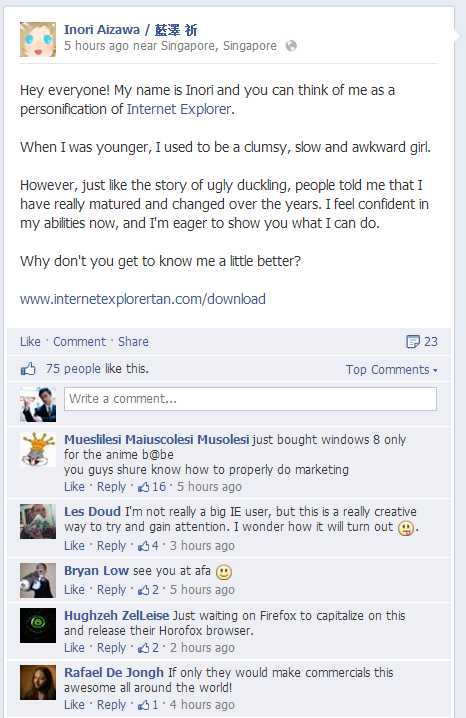
The real question at hand is: How will IE’s decision to launch a campaign featuring their new mascot in Anime form translate to new users? Well, they’re clearly trying to appeal to the audience that watches Anime. Specifically, given the style of the campaign, they may be trying to activate nostalgia of some sort with consumers who watched Saturday morning cartoons during their early school years. Their current positioning on their Facebook page implies that they want to sell IE10 as an “ugly duckling” that has grown up to become a beautiful web browser (see below):

Only time will tell how this campaign will affect consumers, given the deeply-rooted negative perceptions towards IE. Will this campaign be a bang or a bust?

Sasuga, Internet Explorer. Shiranai.

Until next time, singing off.

-Chris

Categories
Uncategorized

Regional Differences in Pricing

I’m a fan of a certain Anime series called Tengen Toppa Gurren Lagann. It’s a motivational roller coaster of emotions and over-the-top action. I love it. Here’s how much an import of it costs online.

At the moment, you might be saying “Holy moly! You mean to tell me that a box of CD’s will cost you almost half a grand?! You must be nuts to even think about buying this thing!” And you’re probably right. Not many people in North America, save for the fanatics or the 1%, would ever dream of buying this glorious box. You’re probably thinking that the marketing managers messed up their pricing strategy. Now, here you’re probably wrong.

Let me introduce a fictional character named Cras.

Cras


Cras is your typical North American male. He’s 16 years old, talented but unmotivated, and enjoys playing video games in his spare time. He works part-time as a swimming instructor. There is no way that he will blow over $500 for an anime series he can watch online for free (legally, of course!).

Cras’ friends feel the same way as Cras. They’re pretty interested in explosions and giant robot fights, but they’re not going to spend a lot of money on this hobby when they can be out playing League of Legends or buying cheap games on Steam.

In fact, a large majority of North American males would probably fall under the same category as Cras and Co. They love the series and the concept, but wouldn’t be able to dish out $500-600 to pay for this product.

Now allow me to introduce George.


George is an Anime fanatic from Japan. He’s 16 years old, likes to hang out with his friends from school, and tutors Economics part time. His favorite flavor is vanilla, and just so happens to love the series Tengen Toppa Gurren Lagann.


George’s friends also love Tengen Toppa Gurren Lagann, and George is willing to save up money from his part-time job to buy the product. He’ll be so cool!

There are obviously some cultural differences between the two pools of people, effectively making them two separate market segments. The North American market is huge, and has an abundance of products to buy (like phones, cars, games, etc). The Japanese market, conversely, is very small. Consumers in this market also has an abundance of products to buy (phones, cars, games, etc), but the amount of Anime fanatics in this market is dramatically higher than those in North America. This is because Anime is made in Japan, and is more well-known there.

Since there are so many substitutes for Anime (as a hobby) in North America, and the amount of fanatics is statistically very small, the price sensitivity of this market is very elastic. This means that a lot more people will buy a product if it is comparatively cheaper, and a lot less people will buy a product if it is much more expensive (see terrible diagram below).

From this diagram, we see that if a product sold for $600 in the North American market, 10 people (only the most fanatical) would buy it. If the product were priced more reasonably, say $100, a lot more people (100 people!) would buy the product. Feel free to tag on a few extra zeroes in the Quantity axis if you want the diagram to be more realistic.

Let’s say the producer wants to make as much money as possible from the North American market. Let’s see the calculations:

$600 x 10 people = $6,000

$100 x 100 people = $10,000

If the producer wants to maximize profit here, he’s sell the product for $100 in North America. He’d make $4,000 more than pricing the product at $600, and making money is cool.

Now let’s look at the Japanese market.

Anime is made in Japan, and so the product gains more publicity and popularity here. The amount of fanatics is statistically greater per area in this region. The price sensitivity of this market is very inelastic (see shoddy diagram below).

This hastily-drawn diagram with incomplete labels implies that the fanatic-dense population is willing to pay *any* price for the product. Think of a rich Star Wars fan bidding to buy the original Darth Vader light-saber used in the movies. $30,000? $40,000? It doesn’t matter, he’s going to buy it anyways! Here we can see that even if the price dropped by $500, only an extra 100 copies of the product will be sold (because the 100 fanatics were planning the buy the first 100 copies, and the next 100 copies were bought by people who were interested but on a budget).

Here, if the producer wants to make the most money, the calculations would look like this:

$600 x 100 people = $60,000

$100 x 200 people = $20,000

Whoa, man! You’d better price that thing as high as possible in Japan! You’d make a lot more money than trying to sell lots of cheap copies, I tell you. And since Japan is the main market for Anime, the product is priced at $600.

“But, Chris!” you may ask. “Why don’t you do both? Sell the product for $600 in Japan and $100 in North America? you’ll make ALL THE MONEY!”

Well, sorry, but I’m afraid it doesn’t really work that way. Jonathan Clements in his talk about Anime mentions a peculiar phenomenon that occurs when you segment the market this way. I’ll try to explain it in as few words as possible.

Remember George? Well, he has internet. And an American credit card. And Ebay exists. You can guess what happens next.

George is pretty furious to see that his North American counterpart is able to buy the same product he is, for half the price (let’s say North America prices the product at $300 instead of $100 to make up for import costs). So he goes on Ebay and buys 100 copies of the product from North America and imports it BACK into Japan. Being the businessman he is, he sells it to his buddies and classmates for $400 each. Eventually, enough of these reverse-imports occurs so that 80% of the Japanese market can now access the product at the reduced price of $400. From a company perspective, these are the calculations that occur:

Sell product for $600:

$600 x 100 (Japan) + $600 x 10 (NA) = $66,000

Sell product for $100:

$100 x 200 (Japan) + $100 x 100 (NA) = $30,000

Sell product for $600 in Japan, $300 in NA, 80% of Japanese market opts to reverse-import the product from North America:

$600 x 20 (20% of Japan) + $100 x 220 (80% of Japan and all of NA) = $12,000+$22,000 = $34,000

“Uhhh,” says the producer of the product, “I think that I’ll make A LOT MORE MONEY if I sold this product for $600 instead of trying to segment the market.” And he would be right.

And this is why we can’t have nice things. (I’m joking).

Interestingly enough, the Anime industry is an interesting industry because although most of the money is made in Japan, a huge audience pool lies in Europe and North America. Some production companies have noted the untapped market in non-Asian areas, and have produced anime to cater to a more western audience (Cowboy Bebop). Others stick to Japanese-oriented humor (Haiyore!, Joshiraku). And some have decided to produce “good Anime” that fit their own tastes and dont’ conform to any particular norm (Neon Genesis Evangelion).

Next week, I’ll be talking about how such companies market their products for different audiences, and how their efforts have stacked up on the rankings.

Until next time, signing off!

-Chris

Categories
Uncategorized

Disintermediation and the Anime Industry: Evolution is Critical

Today in our eMarketing class, we discussed the concept of disintermediation and Justin Lew brought up the example of Netflix. The fact that Netflix completely revolutionized the way consumers consumed TV and other forms of digital media is not a new topic; the online model has been adopted by a wide range of industries, from books to groceries and everything in between, since the late 90’s/early 2000’s.

Business students often learn that disintermediation is efficient because it “gets rid of the middleman,” saving costs and streamlining the supply chain. But that middleman can also fight fire with fire and find that an online model can help their own business by offering more choices, bundles, or just general convenience (see:  Expedia.ca). By reinventing themselves through disintermediated online models, existing firms and new entrants around the world continue to challenge the conventional model(s) of doing business.

Disintermediation through adopting an online business model can not only provide a firm with competitive advantage, but can make opportunities out of threats and give birth to a whole new niche to target.

Take the streaming Anime industry, for example.

Five years ago, Japanese animation (Anime) was rather hard to obtain in North America and catered to a niche market. Licensing companies made money primarily on the sale of DVD’s or expensive, new Blu-ray technology. This period of time was also in an era when piracy was at a high; consumers of Anime tended to illegally stream or download series because the pricing for a nice product was either too high or the licensing process took too long after a series was released for a fan to buy the official product. The piracy issue became so bad that Funimation and Bandai, two major licensing companies, issued a statement against Crunchyroll, a website which was, at the time, a source for illegal streams of Anime.

Funimation stated that:

The battle against unauthorized distribution of anime is a battle that Funimation cannot fight on its own.  Without proactive and effective copyright policing and enforcement by those that control anime content, sites like this will continue to gain a reputation as outlets for free anime”

Bandai supported the action with the statement:

Bandai Entertainment Inc. will continue to work with other U.S. companies and Japanese licensors to fight against downloading and its negative impact on the US anime industry

These two licensing giants acted swiftly in response to Crunchyroll as it secured a capital investment of $4.5 million USD from venture capital firm Venrock, publicly denouncing the act of supporting a site that streamed unauthorized anime. And for good reason! As owners of the licenses, Bandai and Funimation had good reason to be upset. The market had essentially become a war between the “expensive, slow, but official licensors” and the “quick to update, free, but illegal streamers.” It was a rough time for licensing companies.

Fast forward to 2012, three years into “the future.”

The rampant piracy of anime has hit Bandai Entertainment hard, and Bandai was forced to cease the distribution of new releases, essentially shutting down its future prospects in the Anime industry. And what of Crunchyroll? Crunchyroll became the only site that offered a unique value proposition: paid, online streaming Anime. Crunchyroll essentially became the Netflix of Anime when it hit 100,000 paid subscribers just over a year ago. Bandai, which relied on physical sales of its Anime, had opted out of the seemingly dead end business prospect. But Crunchyroll continued to support the idea of online Anime streaming by selling premium subscriptions that cost between $5-$12 a month. What irony! Not only did the once-illegal streaming company secure a solid stream of revenue, but it was finally able to do what Bandai and Funimation could not: cater to the needs of the casual Anime watcher.

Before Anime could be streamed legally, the only source of legal Anime was either shown rarely on TV or purchased for huge prices. There was a mismatch between Supply and Demand; physical Anime was much too expensive for the casual consumer and, even today, continues to cater to a niche market for a ridiculous price. With the introduction of online Anime streaming, casual Anime watchers finally have the ability to pay a fair amount ($5-$12 per month) to consume Anime with easy access (streaming). This opened up a completely new market to cater to, and Crunchyroll continues to expand its product offering by selling Anime-related merchandise.

Time and time again we marketers are shown that online business models can completely turn a conventional business model on its head. In this blog post I showed that not only can this result in competitive advantage, but can open up the potential to cater to a completely new market. A point I brought up earlier was regarding the mismatch between the Supply and Demand of a typical Anime viewer; I will probably expand on this point in a later blog post.

But, for now, I thank you for reading this post all the way to the end. I’ll see you next time!

Signing off,

Chris

Spam prevention powered by Akismet