A little over a week ago I talked about Internet Explorer’s new Anime campaign. As a fan of Anime I’m often put-off by poorly executed campaigns or completely enthralled by the good ones. Overall, I have some very mixed feelings about leveraging Anime for commercial reasons.
The Japan Horse-Racing Association’s Attack on Titan campaign is one of the campaigns that have left me confused, wondering “what did I just watch?” and “why did they do this?” After further thought, the campaign starts to make more and more sense outside of the traditional goals to “increase traffic.”
In case the reader has no idea what Attack on Titan is, it is a popular anime released last season that revolves around the premise that humanity is prey to self-regenerating Titans. In order to stave away the Titans, the remaining population of humans live their lives within the protection of 50 metre walls. These walls are eventually breached, and the anime centers around the efforts of Eren Jaeger on his counter-attack against the Titans.

The anime received global recognition and a huge fanbase, prompting a lot of companies to run Attack on Titan campaigns (Pizza Hut being a prime example). It’s a fairly straightforward strategy to align yourself with popular regional mediums to enhance reach and engagement, but these campaigns are often misaligned with the brand’s values.
The topic of today’s blog is the Japan Horse-Racing Association’s Attack on Titan campaign, featuring their own website at http://shingeki-jra.jp/. On this site, they have a full-screen intro video featuring our heroes on horseback, racing against titans while you play minigames in order to influence the result. What’s interesting about this campaign is its focus on horses, and the power of the Titans.
I enjoy following these campaigns not only because of how ridiculous they can be, but because they make quite a bit of sense.
There is a technique in Marketing called a “Brand Association Survey.” The purpose of this technique is to unearth some of the associations, both positive and negative, associated with a brand. Here’s an example:
When I say the brand “Coke,” what comes to mind?
You may reply, like me, with the following terms: “red, cool, cold, ice, sweet, unhealthy…uh…profitable, pepsi, polar bears, fun, children, lego, toys…” etc.
The first set of terms I spat out (from “red” through to “unhealthy”) would be the “primary associations.” If Coca Cola were running this servey, they’d say “hey, this guy thinks of “ice” and “cold” whenever he hears “Coke.” Let’s center a campaign around enforcing that association (hence the polar bear campaign)! Alternatively, they could say “hey, this guy thinks of “unhealthy” whenever he hears “Coke.” Let’s center a campaign or product around tackling that association (hence Coke Zero).
Now, when you think of “Titans” what is the first thing that you think of? Here’s a picture to aid your thoughts:
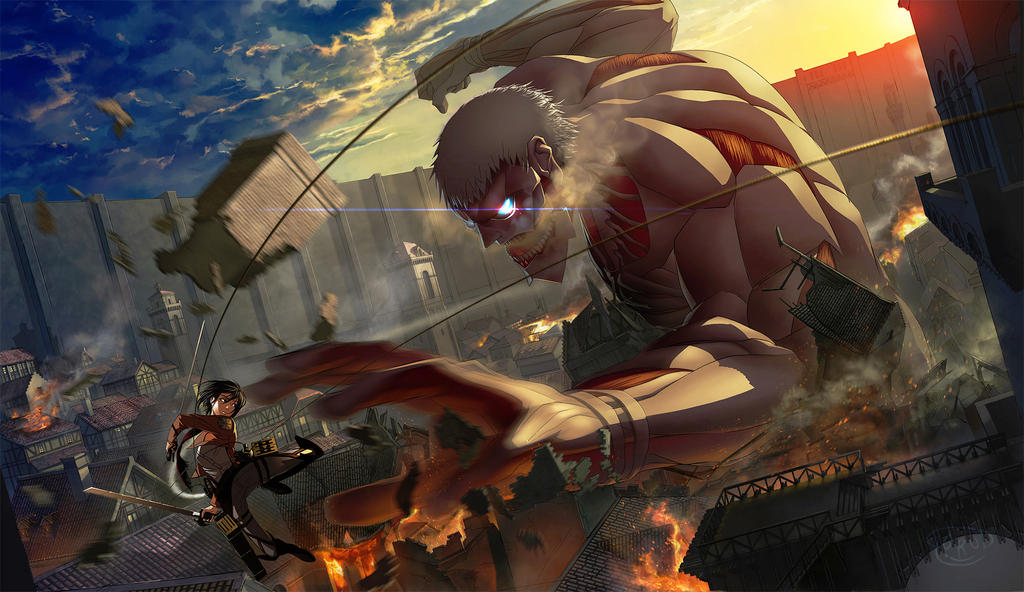
I personally think of “muscle, power, strength, intimidating” and other similar terms. These are great associations to have when you’re a Horse-Racing association! Hence, this campaign makes sense.
Interestingly, this is not the first anime campaign sponsored by the Japan Horse-Racing Association. The previous one centered around the Neon Genesis Evangelion franchise which is most commonly associated with-get this, giant robot/cyborgs. I think I’m seeing the link, here!

I could probably go on for days about the implications of such campaigns, but right now seems to be a suitable place to stop. I hope to cover how these campaigns contribute to a company’s ROI in a blog post in the near future!
Signing off,
Chris