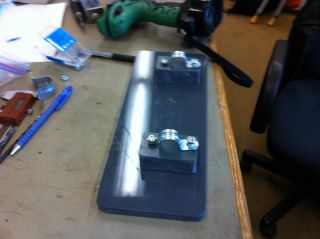
For this week, construction is well underway. Our team has been working in parallel to finalize the electrical system and the mounting system. With Scott Jackson’s assistance, we have completed the counter mechanism and are ready to implement it in the Capilano Trough. We’ve also constructed a mounting system to hold the counter and pipe in place during use.
Mounting system for counter & tubing
For next week, our final piece of construction is putting together the box that will house the counter. This casing will protect the fish fry from the electrical system and ensure the electrical system lasts longer as it will not be exposed to water.
Once these components are finalized, we will be able to go to the hatchery next week to implement our prototype. We hope to work with Streamkeepers to make sure we safely install the counter in a way that is least disturbing to the fry. Our group believes that this is good practice for us as future engineers to develop a habit for considering the societal and environmental issues in an engineering project. As engineers, we concern ourselves with providing services to society that extend beyond basic structures or goods. A sustainable, easy-to-use fish counter is just our first milestone.
Looking forward, we will be providing Streamkeepers with a manual that describes how to use the counter and where our group acquired the materials for it, as part of our way of making maintenance and handling simple and user-friendly.
This week, our group continued with the design of the electrical system. Under Scott Jackson’s supervision, we were able to construct a prototype counting system consisting of a photosensor epoxied to a clear pipe and attached to an electrical circuit constructed on a breadboard. This circuit was nearly identical to the one in the original schematics.
Confident that this design is effective, we have placed orders for the materials required to construct a full scale sensor system. These purchases are being made through Scott Jackson as he has the contacts to get the necessary equipment such as the counter, mounting platform, and various circuit components.
With the electrical system nearing completion, our focus turns to the housing system, and how we will attach the fish counter to the Capilano Trough. For this, Justin will be visiting the hatchery on Friday to make more observations of the site. Key things that we are looking for are whether the trough is magnetic (allowing a mounting system that employs magnets), and its overall dimensions so we can design the funneling system and if necessary, design for clamps to hold the counter in place. The funneling system is the method by which we will divert fish towards the pipe with the attached sensor system.
We’ve also learnt that the time the fish want to move is between 1.5 to 2 weeks, so we have decided to design for an operating period of 3 weeks, allowing plenty of time between recharging.
Once the order comes in, we will move forward with constructing the hatchery fish counter, while under Scott Jackson’s supervision. This is in accordance with the instructions of Mark Rigolo, PEng, Director of Laboratories in the Civil Department, who has approved our safety plan and procedure.
This week, the focus of our group project was on crafting a design for the electrical system. The push for this direction came from our meeting with Joel Atwater, our group mentor, last Friday.
Under his guidance, as a group we were able to set the design parameters for the electrical system, the housing system, the piping system, and the filtration system. We split these design parameters under minimal function requirements (MFR) and evaluation criteria/goals (EC/G). An MFR is a pass-fail test to see if a design does what it is supposed to do, for example, does the fish counter count the fish? An EC/G is more of an evaluation of the functionality of the design, such as: how accurate is the fish counter?
This detailed look into the project focused our group and got us working and dividing labor for the four subsystems mentioned above. The top priority was the electrical system, because its size and functionality defines the parameters of the housing system and of the piping.
That left us the weekend to research possible designs. A good suggestion by our mentor was an elegant modification to the circuit design in the original schematics. He proposed we use an Arduino microcontroller. This would allow us to write a program for the circuit to make it do exactly what we want.
We also managed to contact an electrical engineer graduate who made a YouTube video about his own counter. He was helpful and gave us some information on possible circuit requirements. This, along with preliminary designs for the housing and piping systems, put us in a good position to talk to Scott Jackson, an engineering technician for the civil department.
We met with Scott on Wednesday and he gave us his input on the circuit. Although he thought Joel’s idea of using an Arduino microcontroller was a good one, he felt that with the time constraint of the project and our group’s inexperience with program writing, that a more simple solution would be appropriate. His suggested circuit is very similar to the design in the original schematics.
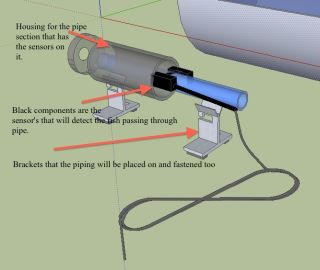
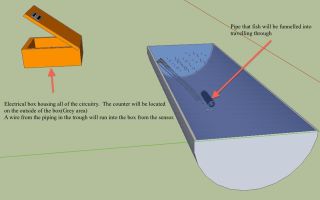
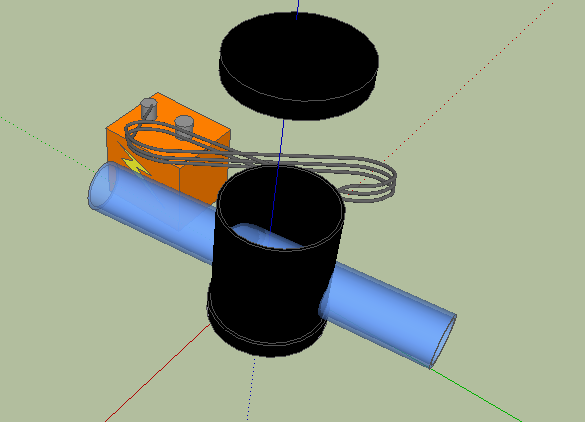
The major change he proposed is keeping the circuitry and power separate from the sensor. Essentially, by having only the photo sensor and receiver in the housing system and running a cable to an external box with the counter and power cell, it would allow for easier access to the fish counter and battery replacement. This would also protect valuable electrical components from potential water damage.
conept design demonstrating the piping, housing, and external power source
He also suggested we use an infrared light source instead of a bright light which might unnerve the fish fry passing by it. He offered to help us build the circuit as soon as we had more information on the project environment, such as the required pipe diameter
With Scott’s help, we managed to create a list of required materials, most of which should be available on campus, and also figure out what information we need about the fish fry to continue towards the completion of this project. Our group is very excited to be nearing the construction phase for the electrical system.