Categories
Uncategorized

Reading Break!

We’re glad that reading break is coming!

The week of February 13th was pretty busy for us (Labs, Reports, and Midterms), hence we were not as productive as usual.

However, we have some updates about the sun trajectory and at what times the greenhouse will be shaded by the dome of the Science World. In our previous calculation, we just assumed that the height of the building is infinitely tall, hence the greenhouse will be shaded at around 3pm all year long. Now, the spherical shape of the dome, and the height of the pedestal of the dome (i.e. the building that houses the lobby – we assumed it’s about 12m tall) are being considered. Therefore, we came up with new approximations.

The Greenhouse will start be shaded:

  • at around 2pm on Winter Solstice (December 21),
  • at around 3pm in October and March,
  • at around 4pm in May and August,
  • and around 5pm on Summer Solstice (June 20)

We used Sun Path Diagram (downloaded from http://www.gaisma.com/en/location/vancouver.html ) and superimpose it on the greenhouse on the Plan view of KSSP Science World sent by our client.
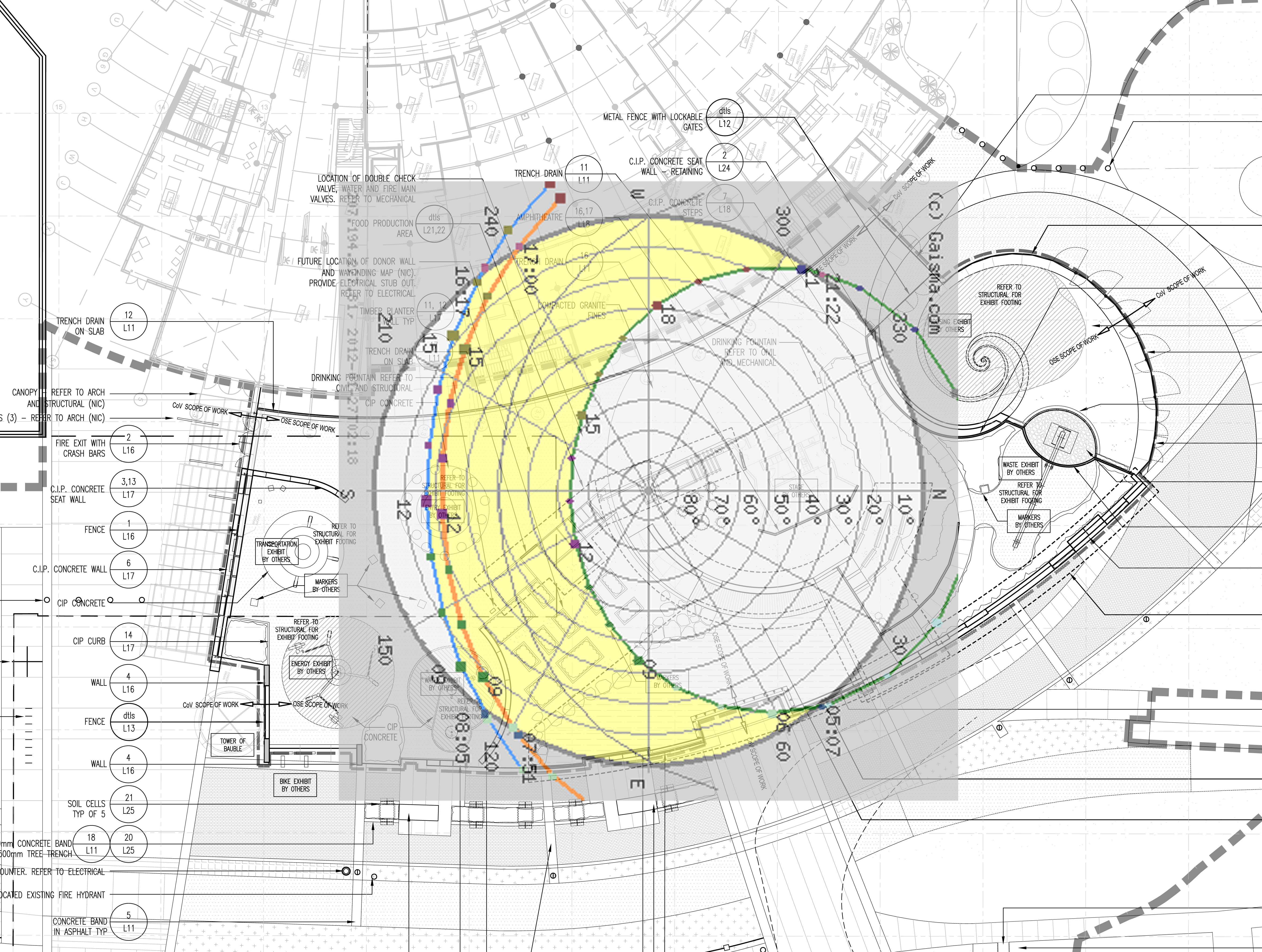
The Yellow colored area are the all possible trajectory path of the sun throughout the year. The blue line is the sun path during winter solstice (21 December), and the green line is the path on summer solstice. Those lines are also numbered (06, 09, 12, 15, 18, etc) to tell where the sun is at 06 o’clock, 09 o’clock, 15 o’clock, etc. The geodesic dome of Science World is located approximately at west-southwest of the greenhouse. Therefore, the greenhouse is more likely to be shaded sometime between noon and sunset.

The approximation needs a lot of iterations which will be too long to be posted on a blogpost. A more comprehensive explanation will be submitted along with the ECD (as our client asked). Our deliverables to the Science World will be an ECD, a report about material options for the greenhouse, and a report about the sun trajectory. The ECD will also be sent to Susan Nesbit.

Our possible next meeting with the client is on Thursday, March 1st 2012. Mila told us to avoid Friday, so that more people from Science World can attend the meeting for our presentation.

We are looking forward to it!


Cheers!

UBC CSL – KSSP Greenhouse Project
 

Categories
Uncategorized

February 3, 2012

Today, on Friday, February 3rd, we finally had the chance to meet Laura Sand, the manager and horticulturist at the UBC Greenhouse, to give us a tour at two of the greenhouses at UBC. They are located at the rooftop of Biological Science Building North Wing. She was very helpful, and even let us to visit the greenhouse anytime we want. Here are some of our findings:

  • Sunlight catchment is very important for greenhouse as it is the primary source of heating, and is essential for photosynthesis. Since the KSSP greenhouse will be built close to the main building, by checking the sun trajectory of Vancouver, the greenhouse will be shaded by the dome after 3pm throughout the year. Therefore, we need to maximize the catchment of sunlight by placing the slope of the roof towards southeast direction.
  • In the greenhouses, some sodium lightings are installed to mimic the light intensity of sun. Laura mentioned 1 or 2 lightings will be sufficient for 1.6×2.2 m2 greenhouse, and be turned on according to the needs of the plants. Each lighting fixtures will cost approximately $60. Even though it’s not the main purpose of the sodium lightings, they also contribute to the heating of the greenhouse. The temperature in the greenhouse was about 28 degree Celsius.
  • As for air circulation, a manually operated vents and electric fans were installed in the greenhouses.


We also came up with some decisions during our regular class meeting on Monday, January 30th. These are the highlights of the group meeting:

Materials:

  • We decided on galvanized steel frame (little maintenance required, low cost, almost completely recycled / recyclable) and glass (recycled / repurposed product, traditional aesthetics, highly transparent allowing lights to come in).
  • Did you know that bubble wrap can also be used for insulation? Just smear a little water on the window, lay the bubble wrap on it. Once the water dries, the bubble wrap will stick there and retain the heat.

Interactivity: Considering that the majority of visitors are kids around 9-13 years old along with their parents (Source: Science World media kit), we came up with 2 interest points for the greenhouse.

  • One is a transparent pane of glass along a plane bed put near the glass wall to allow small kids to see the soil profile, plants’ roots and hopefully some potatoes or carrots that are growing underground.
  • Second, screens and fixed panels with pictures can be installed for adults to be engaged with the greenhouse while their kids are busy getting fascinated with the soil profile. The screen and panels will include facts related to sustainability, local food production, or perhaps, a calculation breakdown about how much money and greenhouse gases can be saved by growing your own food.

And finally, to make the greenhouse more appealing, colorful plants such as purple cabbage, capsicum, tomatoes, carrots, herbs, and edible flowers can be planted.


Charles seems to be enthusiastic to learn more about greenhouse, and he’s setting up another meeting with expert, David Kaplan from UBC Land & Food System Faculty, for a tour of another greenhouse. We are looking forward to it and hopefully can learn more about designing an efficient and sustainable greenhouse.


Cheers,


Matthew

Spam prevention powered by Akismet