Categories
Marketing Music YouTube

Rebecca Black Beats Bieber and Britney

It’s official: Rebecca Black is more popular than both Justin Bieber and Britney Spears. By iTunes’ standards, that is. According to forbes.com, “Friday,” the 13-year-old’s debut single, “amassed a staggering number of downloads, reportedly topping 2 million” only a week after its release. The fun, fun, fun song gained near-instantaneous notoriety for being, well, really bad. As everyone with a computer is probably already aware, “Friday” deals with such prominent issues as choice of breakfast cereal and vehicular seating arrangements – on a Friday, of course. (Re)watch the video below, but be warned that the song is as addictive as it is lyrically uninspired.

YouTube Preview Image

More than anything, this shows the incredible, nebulous potential of interactive video-sharing sites. YouTube is inundated with content, much of it overlooked in favor of videos with the highest view count. But when something grabs viewers’ attention – such as a catchy song of unparalleled mediocrity – it has the potential to explode into prominence due to the social, accessible nature of such sites; parodies of Rebecca Black’s video, one of which was my first exposure to the viral sensation, are everywhere. And YouTube isn’t the only social media site suffering from “Friday”-overload. Twitter is all a chatter with mentions of Rebecca Black, who continues to be a trending topic.

Judging from the content of its website, Ark Music Factory – the company that produced “Friday” – is exactly what the name implies: a mass-marketing manufacturer of indistinguishable, pint-sized pop stars. The record label is currently promoting “Butterflies” by Alana Lee, “the girl who introduced Rebecca Black to Ark Music Factory.” As shown below, her song and video follow the same formula as “Friday:” simple, repetitive lyrics + peppy tween girl + incongruous appearance by older male rapper = viral success in the making.

YouTube Preview Image
Categories
Marketing YouTube

The End for Doritos

YouTube Preview Image

According to a recent  post on AdFreak, the Doritos “Pug Attack” commercial – along with Bud Light’s “Dogsitter” – triumphed as the best commercial of Superbowl XLV. As can be seen above, “Pug Attack” relies on three key elements to grab viewers’ attention: ridiculous overacting, dramatic music and the undeniable power of Pug Cuteness. The commercial’s simplistic humor is endearing, but I don’t find it particularly interesting or groundbreaking.

But Doritos has since won me over. Not with an adorable animal = likable product advertising scheme, but rather with a weird one. Every time I turned on the TV last week, it seemed I was watching the following commercial.  Even if my mind was elsewhere – say, considering possible topics for my next marketing blog post – it inevitably caught my attention with its inexplicable French dialogue.

YouTube Preview Image

This commercial is so weird. I love it! Every detail accentuates the weirdness, from the strange, cubic containers that each conceal a single Doritos chip to to the sweat peppering the nervous inventor’s face. Rarely do I get this excited over a simple commercial, but that’s the point: unlike the Doritos Superbowl ad, this commercial is anything but simple. It is unique, creative and engages the audience’s attitudes on every level. Behaviorally, I’m incited to explore the contest’s website and contribute my own outlandish entry, while cognitively I’m inclined to think of Doritos as a brand that is innovative – they’ve proposed two previously unheard of flavors, Buffalo Wings N’ Ranch and Onion Rings N’ Ketchup – and cares about the input of its customers. As my excited reaction attests, I also feel more positively about Doritos – a product I was previously apathetic toward.

Categories
Marketing YouTube

Dead Space 2 Mocks Moms

“That’s so silly,” was my mom’s disparaging comment upon glancing at the following commercial for Electronic Arts’ Dead Space 2.
YouTube Preview Image
Initially, I agreed with my mom’s assessment. It wasn’t until I read the Dead Space-related post on Victoria Capron’s blog that I reconsidered my opinion from a marketing standpoint. The commercial is undoubtedly silly; the appalled reactions of real-life mothers (200 of whom participated in EA-sponsored focus-group sessions) are juxtaposed with violent, cringe-inducing footage from the game. The promotional website highlighted in the ad – appropriately titled yourmomhatesthis.com – emphasizes the game’s Mature rating, which it garnered due to excessive “blood and gore, intense violence and strong language.”

So, as a woman in the commercial asks, “Why would they even make something like this?” The ad appears to be targeting teenagers and tweens, for whom parental outrage – and associative products that are “too cool” for the older generation to grasp – can be an appealing prospect. However, with its 17+ rating, the game is being marketed to a demographic that can’t legally purchase it. Additionally, the commercial is only shown in the evening, when viewership among kids is low. Therefore, there is a discrepancy between the ad’s apparent target market and those who will view the commercial and legally purchase the game.

Perhaps, as Victoria pointed out in her blog post, Electronic Arts is betting on children influencing the purchasing decision of their parents. But maybe Electronic Arts could better – or, at least, more accurately – market Dead Space 2 by promoting the game’s overwhelmingly positive reviews, rather than relying on shock value and hype to attract young buyers.

Categories
Marketing YouTube

The Snuggie Phenomenon

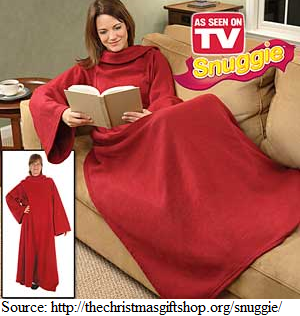
Let me preface the negative statements-to-come by admitting something: I love my Snuggie. This defies logic, considering the product’s poor quality and relative uselessness, but there it is. In an attempt to decode the mystery of the Snuggie Phenomenon, which has captivated more than 20 million people in America alone, I considered their marketing mix:

Product: The blanket with sleeves, designed to combine ease of movement with comfort. One size is supposed to fit all; I’m 5”3’, and my Snuggie pools around my feet. But is it as “ultra-soft” as the commercial attests? Not so much. The material is coarse and loses its warmth retention after one wash.

Price: $19.95 plus the cost of shipping and handling – a steep price to pay for what is essentially a backwards-worn bathrobe.

Place: Available since 2009, the Snuggie can be purchased from online retailers like Amazon.com, as well as through infomercial call-ins and specialty stores.

Promotion: The nauseatingly cheesy, overly cutesy infomercial that had me – inexplicably – reaching for the phone the first time I saw it at 2am. This strangely addicting commercial was then parodied into stardom by pseudo-celebrities like Ellen Degeneres and Jay Leno. Snuggie creator, Allstar Products Group, encouraged spoofs – and the buzz generated by them – through competitions and postings on the Snuggie Fan Club website (yes, it exists). Word-of-mouth did the rest.

Competitors – the Slanket, the Freedom Blanket, the Blankoat – have arisen over time, but none can match the hype of the original. I love my Snuggie. My brother may insist on calling me “Harry Potter” whenever I wear it, but I don’t care; this brand’s quirky, silly-fun (genius?!) advertising won me over.

YouTube Preview Image

Spam prevention powered by Akismet