Kill The Winner

What We Don’t See At Sea

When we are taught about the ocean’s food chain in elementary school, it seems simple enough. The tiny plankton at the bottom are the primary producers, equivalent to the plants on land, and everything gets bigger and more interesting from there.

The layman's ocean food chain

Figure 1. The Layman's Ocean Food Chain

In fact, plankton themselves hold an enormous amount of diversity. The term “plankton” include not just plants, but every kingdom of life. Huge diversity exists within each kingdom as well, multiple species fill each ecological niche in each environment (1).

Now, that level of diversity may seem odd. For one ecological niche in one environment, shouldn’t one species come to dominate? One would think that one species would prove best able to grow in the environment, take up the most nutrients and crowd out its competitors. Yet this diversity still exists.

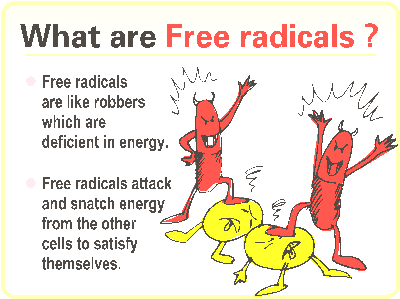
For oceanic bacteria at least, the reason seems to be that they are trapped in a bitter conflict, a race between their own rate of replication and how quickly their tormentors destroy them. It is a war between bacteria and viruses, one which kills as many as 50% of the ocean’s bacteria every day (2).

Killing The Winner

The Blue Shell (Nintendo Corp.)

How does this explain the level of bacterial diversity? Bacteria must find a balance between their own success and avoiding eradication by viruses. Traditionally, an organism is considered  most successful when it grows to reach the highest population that its environment can support.

Viruses usually prey on only one species. A bacterium that has achieved complete success has made itself completely vulnerable to its viruses. In a dense population of its target species, a virus will spread like wildfire, and is much more likely to completely eliminate its prey (1). This concept is called “kill the winner.”

With population density limited in this way, there is room for other species to move into the same niche in the same environment, although it may not be as well suited as its competitor. So long as no one species reaches a density that allows a runaway viral infection, it will survive.

The ecological niche still supports a maximum number of organisms, but viruses kill the winner, ensuring a diversity of species in the same niche.

To help to illustrate the relationship between rates of infection and population density, adjust the population of this zombie apocalypse model using the + and – keys. Note that when the population is dense, the infection spreads much more quickly. If the humans start off winning, they lose very quickly.

Unlike the survivors in this simulation, bacteria can replace themselves, allowing a sustained population. Between rates of replication and death by infection, each bacterial species must find a way to succeed as best as it is able.

References

(1) Fuhrman, J. A.; Schwalbach, M.: Viral Influence on Aquatic Bacterial Communities Biol. Bull. 2003204, 192.

(2) The Annenberg Foundation: The Habitable Planet. http://www.learner.org/courses/envsci/index.html (accessed 03/12, 2012).

How Forgetting Might Become the Norm

Memory is a strange thing.

The more we learn the more we seem to forget, quite literally, and in so doing we help ourselves learn even more.

A strange proposal then would be whether it possible to forget the baggage we don’t like, keep those we do, and maybe throw in some fun stuff that never happened. It all sounds crazy, but this world is a crazy place.

YouTube Preview Image

To start with how, let’s look at how memories are formed. In the brain, chemicals and proteins are released that help neurons pass electric potentials between themselves, and this helps the neurons make new ion channels with each other. It’s like making phone lines of memory between brain cells. The creation of these circuits is called Consolidation and until recently was thought to be concrete.

That “recently” happened when a young graduate named Karim Nader discovered that when memories are remembered or “Reconsolidated” they can be wiped out if the chemicals aren’t there to make the connection.

It turns out that when you remember something, a few things happen. Similar memories that would compete with that memory can be mixed in or weakened/eliminated by the prefrontal cortex and the memory itself is literally rebuilt.

"Seems Like a Good Idea" Image:Eternal Sunshine of the Spotless Mind

Because of this, every time you remember something it gets a little altered in the process, and if the chemicals are blocked, the reconsolidating memory becomes wiped.

“This is crazy and awesome, but too crazy for me, can I make bad, painful memories better without this?” Yes you can. Because memories are associated with different emotions or perceptions, they’re located in different places. Negative ones are found in the amygdala, though they can be removed and relocated elsewhere. How? Think about the memory in a happier setting when you’re immune to feeling blue, it will remain in your mind but won’t have the same emotionally negative effects. This is why ecstasy is one of the most effective PTSD treatments ever.

"Pacman, eating pills to invoke trippy colours and devour your ghosts" Image:Pacman

“How can I make this more fun?” PLAY TETRIS. Playing Tetris within 4-6 hours of trauma significantly reduces the associated trauma with a painful memory. Yes folks, drugs and videogames are the answer, Pacman had it right.

“This is cool, can I be programmed with happy thoughts?” Yes you can. It turns out we’re really good at remembering things that never happened. Dr. Elizabeth Loftus has demonstrated that 1/3 of subjects can be tricked into thinking false memories are their own, even with only one exposure to it. This is why people can be convinced they met Bugs bunny at Disneyland.

“Nice, can I have this memory wipe as a pill please?” Not yet, but a scientist named Dr.Sacktor has found the primary and defining chemical involved in (re)consolidation. It’s called PKMzeta, a form of protein Kinase C. It’s needed to maintain memories, and inhibiting it while remembering something leads to a swift and selective wipe of that something.

“Do you think I can get a prescription?” You may in the future if you have chronic neuropathic pain. It likely will have the same effect on the spine as the brain, and it might even help people with addictions.

All in all this is fabulous news. Though it can be a lot to take in, whether it makes you fear an Orwellian mind control police or you’re just excited to become a mind-tweaking psychonaut, it likely won’t matter as you’ll probably forget you thought about it anyway.

"A Sea of Potential" Image from: http://thetechnologicalcitizen.com/?p=2471

Is Daylight Saving time change a good idea?

Sleep deprivation. Picture courtesy of Yoni Freedhoff

We have all just experienced the agonizing pain of waking up 1 hour early on a monday morning. According to a recent study, daylight saving time change might not necessarily be beneficial to your health.

It has been found the “Monday and Tuesday after moving the clocks ahead  one hour in March is associated with a 10 percent increase in the risk of having a heart-attack,” says UAB Associate Professior Martin Young, Ph.D., in the Division of Cardiovascular Disease. Furthermore, the risk is decreased in October by 10 percent.

Need more sleep? Courtesy of Omnigraphics Inc.


This study also indicated heart-attack tends to peak on Monday when most people get up earlier to go to work. Why this is happening is not exactly known however, Yougn proposes “Sleep deperivation, the body’s circadian clock and immune responses all can come into play when considering reasons that changing the time by an hour can be detrimental to someone’s health.”

How does these three factors affect the risk of  heart-attack?

Sleep deprivation has been a well studied topic, it has been found “individuals who are sleep-deprived weigh more and are at an increased risk of developing diabetes or heart disease,” furthermore sleep depriviation alter infalmmatory response, which can contribute to a heart attack.

According to Young, “every cell in the body has its own clock that allows it to anticipate when someting is going to happen and prepare for it,” but when cell clocks are anticipating another hour to sleep that they won’t get, the negative impact of the stress worses”

Lastly, in the case of immune function, because “immune cells have a clock, and the immune response depends on the time of day, and acute time change can be detrimental to the immunte system response”

This study may sound scary, however our body’s clock eventually synchs with the environment.

But do not worry!

Professor Young have a few tips for this problem!

-waking up 30 minutes earlier on Saturaday and Sunday to prepare for the early start on monday

-do more exercise

References

References

  1. Circadian rhythm sleep disorder.  http://www.sciencedaily.com/articles/c/circadian_rhythm_sleep_disorder.htm (accessed 03/12, 2012).
  2. Circadian rhythm. http://www.sciencedaily.com/articles/c/circadian_rhythm.htm  (accessed 03/12, 2012).
  3. Jet lag. http://www.sciencedaily.com/articles/j/jet_lag.htm (accessed 03/12, 2012).
  4. Sleep deprivation. http://www.sciencedaily.com/articles/j/jet_lag.htm (accessed 03/12, 2012).

Fermentation, giving variety to our diet

Fermentation is a type of biotechnology, where development of microscopic organisms promotes food preservation by generating preservative substances such as alcohol, acid and antimicrobial matters. Although fermentation is defined by the process of disintegration of carbohydrates in anaerobic environment, the term also suggests breakdown of carbohydrates as well as carbohydrate-like components in both anaerobic and aerobic conditions. Many examples of fermentation can be found in our daily lives, including drinks such as wine and sake, dairy products such as yogurt and cheese, meat products such as salami, bologna and prosciutto and other foods such as sauerkraut, soy sauce and miso. Although breakdown of carbohydrate is the main reason for the changes apparent in fermented foods, there are also other various reasons as well, such as modification made to proteins and lipids via microorganisms, which alter the physical and chemical parts of food. However, fermentation is different from genetic engineering, in which gene is modified to create better organism.

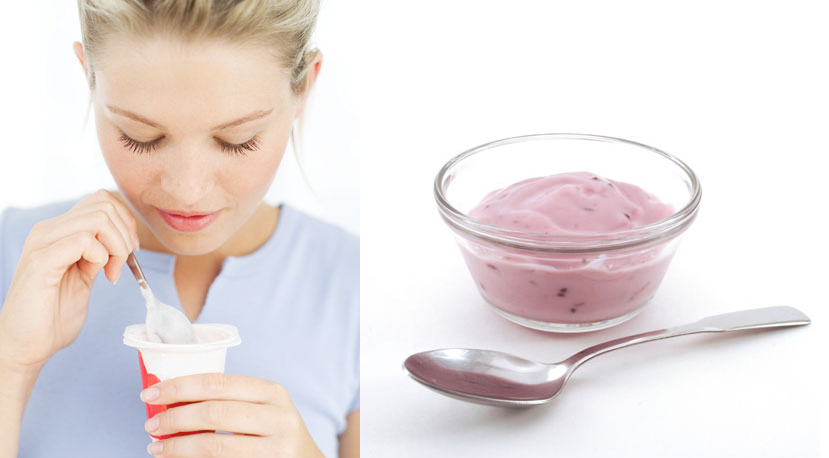
Picture of yogurt. Photo by Richard Scherzinger.

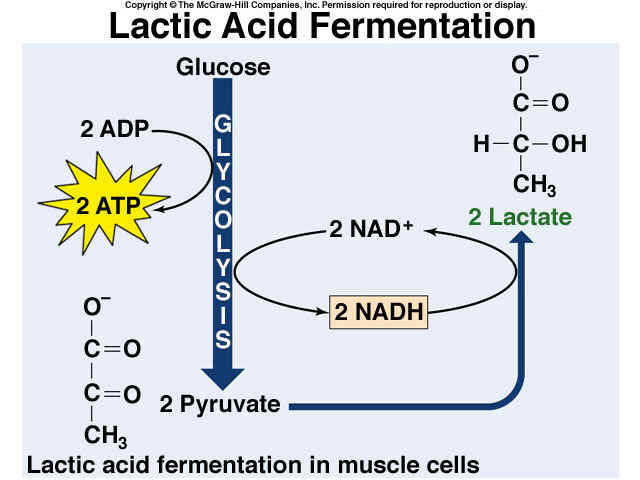
The principle of fermentation lies in the different types of microorganisms. The development of alcohol and acid-producing microorganisms suppresses decaying process by restraining the metabolism of proteoylytic and lipolytic microorganisms that spoil products. Alcohol and acid produced from fermentation are called antimicrobial agents. They are of many by-products of cultivating microorganisms in various kinds of food. Different types of alcohol and acid can form according to the food they grow upon. Some specific microorganisms contain lactic acid bacteria, acetic acid bacteria, yeast, and mold. Different microbial change occurs for each type, producing distinct products. For instance, lactic acid bacteria produce lactic acid from lactose and glucose, and generate fermented food like yogurt. They especially help in suppressing spoilage-causing and disease-causing microorganisms.

Lactic acid fermentation. Photo credited to McGraw-Hill Companies Incorporation.

One of the reasons for consuming fermented food is due to the higher nutritional value in many of the fermented food compared to the unfermented source of food. For instance, mold fermented food, such as miso, carries higher level of B-vitamin than the material to start with. Secondly, fermented food enhances our uptake of minerals and vitamins as microorganism frees indigestible nutrients of plants for humans to digest. Moreover, microbial hydrolysis of indigestible cellulosic components happens during fermentation, leaving fermented food more digestible. Not only fermented food is beneficial towards nutritional value, it also brings variety to our food choices. For example, kimchi is a famous Korean traditional fermented food that most of Koreans enjoy in their daily meals.

Picture of kimchi by Mat-jjang, a Korean blogger.


Here is a youtube video of the process of making kimchi if anyone is interested.

YouTube Preview Image


Sources

What is fermentation http://www.wisegeek.com/what-is-fermentation.htm

Yogurt http://www.foodsci.uoguelph.ca/dairyedu/yogurt.html

Fermentation as a method of food processing http://www.eden-foundation.org/project/articles_fermentation_thesis.pdf

Yeast fermentation and the making of beer and wine http://www.nature.com/scitable/topicpage/yeast-fermentation-and-the-making-of-beer-14372813

Bill Nye is Good.

Hello fellow students of Science 300 and valued readers of science.

My name is Bruce Wayne and when I grow up, I want to be like Bill Nye. Well that’s what I would say if I was younger and was not a multimillionaire entrepreneur, but that’s not really the point.

Picture of Bill Nye during the 90's, Image by Ace Online Schools

For those who grew up in the 90’s like myself, Bill Nye is a very familiar name. For those who are unfamiliar with Mr. Nye, he is a science educator that became popular in the 90’s for his science television show Bill Nye the Science Guy which ran from 1993 to 1998. It was an education show for preteens with good humour and pop culture references. What was different about his show was that Nye made science fun and enjoyable, but also relate-able as well, something that most education shows seem to miss out on. Each episode focused on a number of different topics such as the Earth’s crust, sound, blood circulation. The theme song was also incredibly catchy. There have been many times in high school where I have chanted “Bill Bill Bill!” under my breath while writing science exams. It was that catchy. For those lucky enough to grow up in the 90’s, Bill Nye was the reason to why science was cool and why wearing a bowtie was cool as well.

Bill Nye the Science Guy

Bill Nye the Science Guy, Image provided by Escapist Magazine

So why am I writing about Mr. Nye? Well being in a course that teaches how to communicate science to the population, I thought it would be perfect to write about the my childhood figure who taught me the wonders of science. Communicating science right?

I truly admire Mr. Nye’s ability to clearly communicate science to the general public in a way that everyone can understand. Not only that, Bill Nye is also incredibly talented in presenting science to multiple age groups and audiences. In fact, he has created a few shows such as Bill Nye the Science Guy and his more recent, The Eyes of Nye that dealt with more politically relevant topics such as global warming, genetically modified food, and antibiotics.

In the following clip, Bill Nye explains the dangers stemming from explosion of a nuclear plant in Japan that happened in last year March. For someone like myself who is not very well versed in nuclear physics, I found I could follow much of what Nye was trying to explain pretty easily. What helped a great deal as the fact that Nye talked clearly and slowly. He explained using comparisons and even took time to explain background science essential to understanding further concepts such as explaining what “aftershocks” and what that has to do with the “epicentre”. He also did not use exclusive jargon, but used words the general public would apprehend. It’s a pretty valuable thing to be able to speak in front of thousands and make most of the people understand science in a casual and intelligent way.


YouTube Preview Image

YouTube clip provided by FoxNewsInsider


Taking this course and learning about how to communicate science reminded me of times when I was younger the Saturday afternoons of watching Bill Nye the Science Guy. It’s cool to think that right now I am learning the skills to perhaps someday create my own show about science on a local cable network.

Cool right?

I’d probably call my show “Bruce Wayne the Scienceman”.

Is Too Much Exercise Good For You ?


Benefits of exercising is not a new topic . Almost everybody (at least in north America) has heard once in their life time that in order to gain a stronger immune system you have to have a proper diet and consistent exercising habit. It is recommended by government of Canada to be involve in at least 30 minutes of moderate to vigorous activity exercising 5 days a week (http://www.healthyalberta.com/Documents/Choosewell-Logbook-2011.pdf).

it is important to have a balanced diet and consistent exercise pattern to achieve optimal health (http://www.justprnews.com/15416/colon-cleanser-for-a-healthy-body-and-mind/)


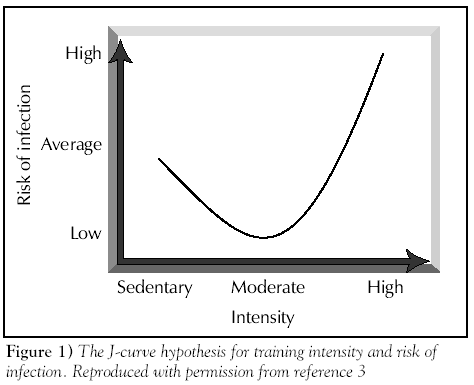
However it has been proven scientifically that long, vigorous exercising can suppress the immune system and in fact makes the body more vulnerable to infection.

One of the studies that supports this finding is the study that was published in journal Brain, Behavior, and Immunity, conducted by Murphy and his colleges which the link to the study is here http://www.ncbi.nlm.nih.gov/pubmed/18616997. They have divided mice into two groups. One rested and the other group ran on treadmill for three days until they were exhausted. Both groups were exposed to influenza virus; the group who were running had more severe symptoms of the illness

The second study (http://www.sciencedirect.com/science/article/pii/S088915910500067X) which its result agreed with the above experiment also published in journal Brain, Behavior, and Immunity, examined the influence of the virus on subjects who were already sick.  In this study one group of sick mice were allowed to rest while the second group ran leisurely  for 20 to 30 minutes , also there were a third group in this study which ran for two and half hours. Each group repeated the routine for three days. Their results were very interesting: 50 % of the sedentary mice dies , while only 12 % of the gently jogging mice passes away and 70 % of the third group could not survive the virus. Therefore what we can learn here is what my father always tells me:” do not overdue anything in your life,  and be reasonable in your decisions”

The reason for such finding is still unclear. Scientists believe that intense work out suppresses immune response for a period of time immediately after you have finished your workout. An associate professor of sport and exercise sciences at Loughborough University  says“the longer you exercise the longer the period of suppress immune system”

relationship between exercise intensity and risk of getting an infection (http://www.cps.ca/english/statements/hal/exerciseillness.htm)

At the end, I would like to emphasize that it does not mean that you should not exercise , in fact Jeffrey A. Woods, a professor of kinesiology and community health at the University of Illinois believes that “in general, moderate exercise, such as a leisurely jog or walk, may prop up your immune response and lessen the duration and severity of a mild infection”. Here is a video that lists the benefits of exercise :

YouTube Preview Image

Hence, Exercise but DO NOT OVERDUE IT .