Tag Archives: aging

Drink Yourself to Health


Courtesy of ThinkStock

Although water, tea, beer and coffee are drunk in greater quantities, wine holds a special place in many cultures. Just think of the holiday season that is approaching andd how wines often pair with great holiday meals.

Wines, especially red wine, have been found to contain several compounds such as resveratrol, melatonin, and flavonoids that are beneficial to human health.  These three compounds target different health issues and each will be discussed further in depth.

Resveratrol is produced when the grape skin is fermented during the wine-making process. According to a review article published in 2008, resveratrol was shown to provide the cardio-vascular health benefits normally associated with a caloric restriction of about 20% to 30% of the calories from a typical diet. Such caloric restrictions promote longevity in mice. “Caloric restriction is highly effective in extending life in many species. If you provide species with less food, the regulated cellular stress response of this healthy habit actually makes them live longer,” says Christiaan Leeuwenburgh, chief of the division of biology of aging at University of Florida’s Institute on Aging.

Melatonin  is a naturally occurring compound found in plants and animals including humans, and is also present in red wines. Besides its commonly known function as a control over our circadian rhythm,  it is thought to reduce oxidative damage by  its antioxidant properties and therefore to slow down aging.

Flavonoids also are antioxidants and are present in all plants. Major dietary sources of flavonoids include red wine, tea, dark chocolate, and citrus fruits. According to an article from Psychology Today, they are believed to reduce risks of cancer, stroke, heart disease and asthma.

Courtesy of Cardiocore

The information above suggests that drinking red wine may prolong life, slow down the effects of aging and help avoid certain diseases.  However, excessive consumption of alcohol is associated with health risks that may mitigate the above benefits. Perhaps, with wine, the key lies in moderation, if only to avoid nasty headaches!


Check out this video if you want to learn more about benefits of red wines.
YouTube Preview Image

//

Is Immortality at Hand?

I don’t want to die.  Ever.  Don’t ask me what I would do after I would have visited all the countries in the world and watched all the re-runs of Two and a Half Men.  I just don’t want to die.

I’m not the only one.  For as long as history can recall, people have been trying to find ways around death.  Whether it is through religion, alchemy or science, us mortals have been trying to put an end to aging and death.  Today, scientists might actually  be onto something which could give us a shot at immortality.

We know that, in humans, cells reproduce through mitosis, a process in which a cell separates its nucleus’ chromosomes into two identical sets, in two separate nuclei.  In 1961, Leonard Hayflick demonstrated that normal human cells can undergo about 40 to 60 divisions before entering a phases of senescence (that is, before becoming old and losing their ability to divide).  Senescent cells don’t replace themselves with new cells.  They stay in the organism to which they belong, accumulating damage until they reach a point where apoptosis, the process of programmed cell death is reached.  A simple way to put it is that once cells stop reproducing, the body gets older.

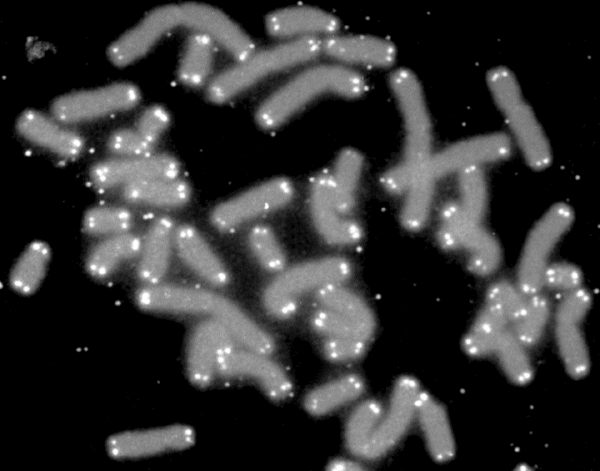
But why can cells only divide 40 to 60 times?  It’s because each time cells divide, their chromosomes get chopped off at both ends.  This is fine at first because human cells start off with “caps” of otherwise useless padding of repetitive strings of DNA called telomeres.

Telomere Caps

Human chromosomes (grey) capped by telomeres (white) Source from Wikipedia

As cells undergo successive divisions, the telomeres get shorter and shorter until eventually they are no longer long enough to enable complete and relatively error-free duplication of the genetic information that they encapsulate.

From this, it seems that if we could find a way to ensure telomeres remain long enough, we could have endless cell divisions, be forever young and become biologically immortal.

It turns out that an enzyme called telomerase lengthens the telomeres by adding bits of DNA padding to them.  Moreover, ways to activate telomerase production have been identified.

I should probably nuance the above by saying that there are still many hurdles to be passed before we can get immortality treatment at local clinics.  Cancer features prominently among them.  Indeed, cancers are collections of rogue cells that gained the ability to divide infinitely through some fluke of the telomere / telomerase regulation mechanism.

That being said, we humans can go very far to get what we want and avoid what we don’t.  Many want to avoid death for themselves and those they love.  Thus, I wouldn’t be surprised if we finally got our chance at immortality before I die.

The following video is a podcast from Dr. Ed Park explaining the aging as a result of shortened telomeres.

YouTube Preview Image

For more information on the topic:

http://www4.utsouthwestern.edu/cellbio/shay-wright/intro/facts/sw_facts.html

http://www.viewzone.com/aging.html