Tag Archives: hearing

Why are some sounds so displeasing to hear?

New study ranks nails run along a chalkboard as one of the most unpleasant sounds to the human ear.

The Amygdala- Active in processing negative emotions

Why is it that certain sounds are so displeasing to the human ear?  For example, the sound of nails running along a chalkboard is synonymous with shivers down the spine.  A new paper published in The Journal of Neuroscience examines the interaction between the emotional and auditory parts of your brain while hearing a variety of sounds.  Scientists at Newcastle University have found that while hearing some sounds, a heightened activity and interaction occurs between the Amygdala part of the brain, which is active in processing negative emotions, and the auditory parts of the brain.  Researchers believe this interaction could explain why some sounds are perceived as unpleasant.

Researchers at the Wellcome Trust Centre for Neuroimaging and Newcastle University used functional magnetic resonance imaging (fMRI) to examine how the brains of sixteen volunteers responded to a variety of sounds.  The sixteen participants (seven females) ranged in age from 22-35 years old and had no prior history of neurological or psychiatric disorders.  The participants were asked to listen to 74 different sounds while in the scanner.  The participants then ranked each sound they heard on a scale from 1 (least unpleasant) to 5 (highly unpleasant).  Here is an example of how some sounds stacked up.

Most Unpleasant Sounds

  • Knife on bottle
  • Fork on glass
  • Chalk on blackboard
  • Ruler on bottle
  • Nails on chalkboard

Least Unpleasant Sounds

  • Applause
  • Baby laughing
  • Thunder
  • Water flowing

Spectrotemporal Representations

Researchers then studied the relationship between the rankings of unpleasantness and the spectrotemporal features obtained from imaging from the fMRI.  Analysis of both the rankings of unpleasantness and the acoustic features of the sounds themselves, found that any sounds within the frequency range of 2,000 to 5,000 Hz were found to be perceived as unpleasant.  The figure to the left shows examples of the spectrotemporal representations for six sounds (the mean unpleasantness is featured in the top right corner of each plot).  These images suggest that sounds with high spectral frequencies and low temporal modulation frequencies are correlated to sounds ranked with high unpleasantness.  It was found that activity in both the auditory complex and the Amygdala were directly proportional to the ratings of perceived unpleasantness.  From this study, it was concluded that the Amygdala is in charge and regulates the activity of the auditory part of the brain, therefore provoking a negative response to some sounds.

Want to see if you agree that the sound of nails running along a chalkboard is highly unpleasant? Take a listen.

YouTube Preview Image


To read the full journal article click here


This blog was written by Layla Vera


Scientific Advances in Treatments for Deafness

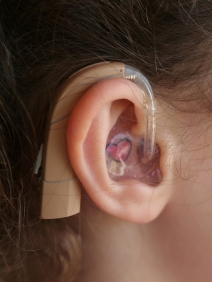
Behind the Ear Hearing Aid
http://www.hearing-aids-wizard.com/image-files/behind-the-ear-hearing-aid-decorated.jpg

One important characteristic of being human is our complexly developed senses; our senses are what place us at the top of the food chain. However, one in twenty five people in Canada are unable to experience one of the most fundamental senses for survival: hearing. Scientists have aimed to develop technology to improve the quality of life for those who are hearing impaired. There are already methods that are successful in improving hearing: the hearing aid and the cochlear implant. Furthermore, recent research  suggests that embryonic stem cells could also be of great help when treating the hearing impaired.

The hearing aid is the most common type of treatment that doctors recommend for hearing loss. It is an electronic device consisting of a battery and some form of a miniature loudspeaker that amplifies sounds that the user is unable to detect. Moreover, the device is customized to the ear shape of the user and fits comfortably inside the ear. An advantage of the hearing aid is that it is cost effective; no matter the financial state of the patient, it is possible to find an affordable device. A second advantage to the hearing aid is that it comes in different styles so finding the right one depends solely on the user’s preference. Its many advantages have widely popularized the use of it for people who are hearing impaired.

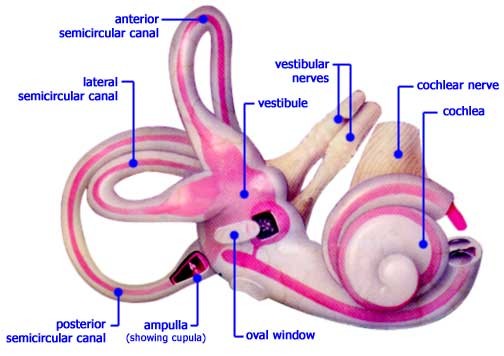
The Inner Ear http://drharris.ucsd.edu/Portals/0/inner%20ear%20detail.jpg

Another method of improving hearing is the surgical implantation of an artificial cochlea, also known as the bionic ear. The cochlea implant functions through skipping the component of the patient’s inner ear where the fully functional hair cells  used to be, and stimulating the cochlear nerves directly using electrical impulses sent by the implant.  This would allow the brain to be able to receive nerve impulses the same way hair cells would send nerve impulses.  The downside of the cochlear implant include risk of infection from the surgical procedure, and the high cost of the implant itself.

The last method that will be discussed was found recently by the University of Sheffield in England and involves an area of science that has been on the rise for the past twenty years: stem cell research.  This new discovery suggests embryonic stem cells can be modified such that it mimics the function of a hair cell, thus, allowing the ear to hear normally. Further research must be done to implement this method but researchers at the University believe this method, when paired with the cochlear implant, possesses the ability to treat people with  hearing impairment.

To demonstrate how life changing advances in science can be, here is a short video of a girl hearing herself for the first time after a cochlear implant.

YouTube Preview Image

The methods described are only a few ways science has advanced to treat those who are hearing impaired. Science still strives to discover new and innovative ways to give the same opportunities to the people who are hearing impaired as people who are not.

Submitted by: Elsie Ng

Hearing Loss is No Clowning Matter


http://julieamarxhausen.files.wordpress.com/
2011/03/finding-nemo.jpg

Everyone’s favourite clownfish is back, but this time, he’s in 3D!  With the beloved movie Finding Nemo returning to theatres this weekend, I thought it would be fun to do a little research on our friend, Nemo.

Everyone who has watched the movie knows that Dory is a forgetful fish, but few people know that Nemo, the clownfish, can potentially be a deaf fish. Recent studies have shown that clownfish are quickly losing their hearing due to ocean acidification caused by fuel emission. In fact, over half the CO2 emission is absorbed by the ocean, thus lowering its pH.  In this experiment, scientists performed a series of tests by increasing the amount of CO2 to what is predicted to be present in years 2050 and 2100, and then recorded the clown fish’s response to various predator-rich coral reef sounds.

Graph of CO2 consumption and pH levels of oceans as a function of time http://centerforoceansolutions.org/climate/wp-content/uploads/2009/12/Acid_pH_graph.jpg

Lead researcher Dr Steve Simpson from the University of Bristol explains: ‘We kept some of the baby clownfish in today’s conditions, bubbling in air, and then had three other treatments where we added extra CO2 based on the predictions from the Intergovernmental Panel on Climate Change for 2050 and 2100. We designed a totally new kind of experimental choice chamber that allowed us to play reef noise through an underwater speaker to fish in the lab, and watch how they responded. Fish reared in today’s conditions swam away from the predator noise, but those reared in the CO2 conditions of 2050 and 2100 showed no response.’

For baby clownfish such as Nemo, their ability to hear is one of their most important assets in ocean survival; with this component slowly being stripped from them, they are becoming increasingly vulnerable to predators. Not only is hearing a sense of protection, clownfish and other coral reef species also rely on their hearing to return home. To make matters worse, ocean acidification does not only affect external matters, it can damage the inside of the fish as well.

http://images.cdn.fotopedia.com/flickr-9201132-hd.jpg

The future of these clownfish’s hearing may be bleak , but scientists have yet to find out if they will adapt to the change in water pH. At the moment, this research is done one way; therefore there is a chance that clownfish can evolve and maintain their hearing.

Blog post submitted by:  Deborah Lo

References:

Daily Mail: “Finding deaf Nemos: Clownfish are growing up with impaired hearing ’caused by fossil fuel emissions.'” –  http://www.dailymail.co.uk/sciencetech/article-1393045/Finding-deaf-Nemos-Clownfish-growing-impaired-hearing-caused-fossil-fuel-emissions.html (accessed September 13, 2012)

University of Bristol: “Ocean acidification makes clownfish hard of hearing.” – http://cordis.europa.eu/fetch?CALLER=EN_NEWS&ACTION=D&RCN=33485  (accessed September 14, 2012)