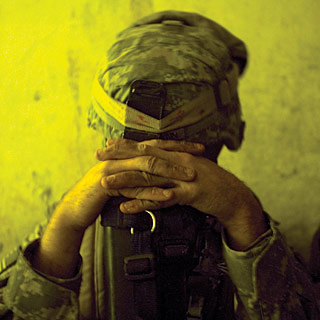
Early this year, tragic event happened in Kandahar, Afghanistan. The United State army Staff Sgt. Robert Bales stormed a small town at night and slaughtered 17 men, women, and children. Speculation swilled that post-traumatic stress disorder (PTSD), a psychological sickness that is caused by traumatic events, triggered Bales to execute such violent behavior. However, there are controversy arguments that not all PTSD patients show such extreme violent behavior as Bales. Therefore, this blog is created to assess how stress disorder affects daily lives of combat experienced veterans.

Picture from: GORAN TOMASEVIC/REUTERS
http://www2.macleans.ca/?attachment_id=25231
Concern is raised within U.S. military that soldiers who served in Iraq and Afghanistan may suffer from extreme stress like PTSD. This is because these soldiers are exposed to life-threatening events like terrorist attack and improvised explosive device (IED) that provokes development of PTSD. To understand the severity of mental health of the returning veterans from Iraq and Afghanistan, four U.S. combat infantry units (three Army unit and one Marine Corps unit) were studied. Sample of 2,530 armies were survey before deployment to Iraq and completely different sample of 3,671 military personnel was surveyed after their duty. The study showed that soldiers from Iraq were diagnosed more with PTSD than those from Afghanistan. About 15.6-17.1% of veterans from Iraq were diagnosed with PTSD; meanwhile only 11.2% of veterans from Afghanistan were diagnosed. Reason for such difference can be explained by looking at the casualties of U.S. troops in these two countries. Statistic shows that in year 2004, U.S. had 849 casualties in Iraq while only 52 casualties were reported in Afghanistan. Such difference in casualty numbers explains the relationship between combat experience and the development of PTSD. Therefore, we can claim that soldiers with more combat experience would develop more PTSD.
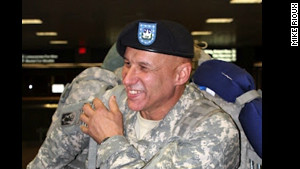
Image from: CNN
http://www.cnn.com/2012/09/29/health/delayed-veterans-benefits/index.html?hpt=hp_c1
To what extend the stress affect a person’s life can be understood by looking at the life of veteran Mike Rioux. Rioux was deployed to Afghanistan in 2010 and faced numerous life-threatening combat situations that led him to develop PTSD. Due to PTSD, Rioux suffers from headaches, insomnia and nightmares and he have extreme anxiousness that makes him difficult to comprehending questions. So based on Rioux’s case stress could make one’s life very miserable.
Recent research by Guido van Wingen states that human has the ability to recover from extensive stresses under sufficient amount of time. Wingen studied 33 Netherland soldiers who were deployed to Afghanistan and found that these soldiers had impairment in cognitive functions. But after 1.5 years under non-combat situation their cognitive function fully recovered. The drawback from this study is that sample size was relatively small to represent the true population. In addition, the study was based on Netherland soldiers so it cannot represent other NATO forces in Afghanistan.
In conclusion, many soldiers who served in Afghanistan or Iraq suffer from extreme stresses after their deployment. Such stresses promote PTSD or other psychological diseases that ruins veteran’s lives. However, human are capable of overcoming stresses when given sufficient time for recover.
By Young Ryu