Tag Archives: space

Mission Impossible: Red Bull Stratos

Felix Baumgartner moments before attempting his record breaking leap
(Courtesy of Extreme Tech)

Imagine staring down from the heavens and seeing that it could just be moments away. We can only speculate what’s going through the mind of Felix Baumgartner before his death-defying leap. Red Bull created this mission to “Advance scientific discoveries in aerospace for the benefit of mankind.” By doing so, Baumgartner and Red Bull broke three major world records; height reached in a balloon, highest skydive,  and being the first person to travel faster than the speed of sound without a vehicle. Furthermore, years of planning went into this event as some of the most brilliant minds on the planet collaborated to examine the scientific principles involved. Special suits, shuttles, and balloons were to designed to account for the extremities to be encountered.

Felix Baumgartner mid-flight
(Courtesy of Engadget)

“I wanna go fast,” is a quote uttered by almost every child, however Felix Baumgartner got to live this dream as he became the first person to break the sound barrier in free fall. The speed of sound is 1,255 km/h and Baumgartner’s top speed was 1,342 km/h. To put this in perspective, the majority of jets used in the army don’t reach this speed.

Capsule used in the space jump
(Courtesy of Wired)

Nevertheless, breaking the speed of sound is a great accomplishment, but the pressure that high in the atmosphere may have been the biggest threat to Baumgartner’s life. The atmosphere is broken down into multiple layers where the pressure decreases as you go higher. Not only that, the temperature also decreases decreases dramatically with height. Baumgartner was protected from changes in pressure and temperature by his specially designed suit and capsule. The suit and capsule were acclimatized to not allow a change in pressure. If the air pressure in space was equal to the pressure in the suit, all of the liquids in Baumgartner’s body would turn to gas killing him instantly.

A comparison of the balloon used vs the Statue of Liberty
(Courtesy of Geeky-Gadgets)

Now, how is it possible to get a balloon over 120,000 feet in the air? Well, it actually works the same way as when you release a balloon and it flies into the air. However, being 55 stories long, this helium balloon is much larger than anything you can buy at the dollar store.  Helium is able to rise in the air because of a principle called density. As a rule, denser objects fall and less dense objects rise. Since helium is much less dense than the surrounding air it rises. The amount of helium was specifically chosen as that amount will cause the capsule to float around 120, 000 feet.

Below is a video of the event

YouTube Preview Image


With all of this new information the only question is, what’s left. With humans constantly pushing change and technological advancement, there is no limit to what people can accomplish. This story should also serve as an inspiration to others as nothing is impossible.

Written by Arman Gill
 

The curiosity about Curiosity!

Curiosity is exactly what lead to the creation of Curiosity. That may sound strange if you haven’t been following NASA’s latest venture onto Mars!

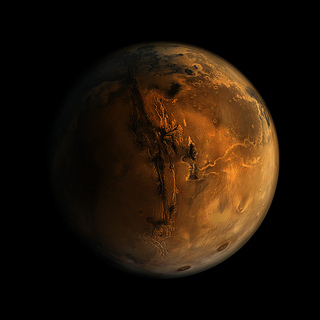
Planet Mars
from: http://www.flickr.com/photos/47738026@N05/6859874535/in/set-72157624037672337/


NASA and the Curiosity Rover:

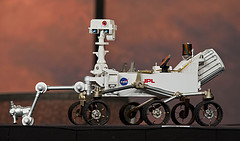
Curiosity Rover
from: http://www.flickr.com/photos/nasahqphoto/6332896370/in/set-72157627974209237/

NASA created the Curiosity Rover, a six-wheeled spacecraft that’s powered by a radioisotope power source and is equipped with mobile ability, computers, cameras, a robotic arm, and more. It was sent to determine if there’s places on Mars where the evolution of microbial organisms may have been possible. It will be looking out for water footprints that may be present on Mars. If these, or any other organic compounds are found, it could lead to conclusions that Mars has supporting factors for life.

Feeding our curiosity about the Curiosity Rover:

All around the world curiosity has risen about the $2.5 billion Rover and it’s activity on the fourth planet from the sun. People worldwide have been following the updates of the Rover since its landing.

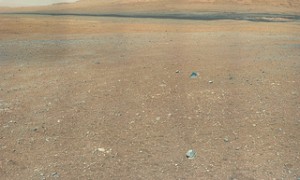
An image taken by Curiosity Rover of Mars
from: http://www.flickr.com/photos/30974264@N02/7795559728/

Since it’s landing on Aug. of 2012, Curiosity has been undergoing tests, such as checking the Robotic Arm and cameras. Up to now, the Rover has performed functions such as driving 82 metres on the planet and firing lasers. Notably, it has provided us with many images.

The Curiosity continues:

There’s been lots of discourse regarding whether the money spent on this mission was worth it. The internet, newsroom & media outlets have been buzzing with information, updates, and many debates. Much has scrutinized about the expenditures of the mission, however it’s undeniable that Curiosity’s journey is fascinating, and may lead to ground-breaking findings. NASA has gone under criticism for the budgeting of the project. However, NASA has been a front runner in developing much of the technology we use, and that makes me confident that the mission will ultimately prove useful.

It’s undeniable that an extremely large sum of money went towards funding this project, however scientists agree that if humanity wishes to continue to exist, space exploration could prove to be necessity. Furthermore, NASA’s come under fire for what some critics call careless spending on their missions. In NASA’s defence, through their space exploration and space programs, they’ve been able to enhance the technology that we use. For example, I’d like to point out to the critics the ever-useful creation of Solar Power Panels, which are indebted to the space program. Additionally, money funding Curiosity isn’t money that’s being taken away from any other programs.

Overall, NASA’s missions, including Curiosity, are all working towards advancing our technology and knowledge about things we know, as well as the things we do not yet know. And seeking out knowledge is never something that can be criticised.

The goals of Curiosity have been set and as it does it’s job, it will continually expand our knowledge about the spacecraft as well as Mars. Once it’s discovered soil that can be examined on the onboard chemistry lab, the mission will be accomplished. The world continues to curiously watch as Curiosity uncovers uncharted grounds!

References:

http://www.space.com/16385-curiosity-rover-mars-science-laboratory.html

Blog submitted by: Nadia Kari