Ebb and Flow

Playing around with Twine this week and reading about how our collective creation of knowledge has moved through periods of unfettered growth and also periods of concerted efforts to organize, has, to my surprise, made me think of the pulsing of a waveform, the seasonality of monsoons, and the regularity of waves breaking on a beach. It has reminded me of the cycles of nature, despite the interface through which I’ve consumed the information and the topics being covered being entirely electronic in nature.

Perhaps these metaphors are a reaction to my own understanding of our evolution of communication, similar to how a snake molts, or a rock weathers. But in reading, listening, and watching about the affordances of the digitization of print media, I observed a periodicity that reminded me – and brought me comfort – of being grounded in the physical world.

When I explored the Zoom function in the Twine desktop app, rather than simply looking at the page details and their immediate connections, I began to appreciate the outline of the narrative I was creating on the fly.

twine screenshotAnd although the interface invited me to just begin authoring, it wasn’t until I had zoomed out that I began to reflect on the structure and flow of the story. This is both powerful and liberating, because it facilitates an iterative workflow and capability that doesn’t exist for printed text. Case in point, in speaking about the “writing machine”, a reference to the word processor, Engelbart states:

This one innovation could trigger a rather extensive redesign of this hierarchy; your way of accomplishing many of your tasks would change considerably. Indeed this process characterizes the sort of evolution that our intellect-augmentation means have been undergoing since the first human brain appeared. (Engelbart, 1963)

While digitization frees readers from having to follow the path of authors (Bolter, 2001, p. 79), and information overload inspires the exploration of systems to organize (Nelson, 1999), I was most struck by something written by Bush (1945) because of its prescient relevance to generative AI:

The Encyclopædia Britannica could be reduced to the volume of a matchbox. A library of a million volumes could be compressed into one end of a desk. If the human race has produced since the invention of movable type a total record, in the form of magazines, newspapers, books, tracts, advertising blurbs, correspondence, having a volume corresponding to a billion books, the whole affair, assembled and compressed, could be lugged off in a moving van. (Bush, 1945).

Large language models are highly compressed representations of information, which, in contrast to the explosion of digitization that has happened over the past 30 years, generates imagery associated with contraction, concentration, the trough of a waveform, and the quiet anticipation of the interlude between waves crashing onto the shore.

Twine Game: Unzip and launch “Mornings.html”

References:

Bolter, J.D. (2001). Chapter 5: The electronic book. In Writing space: Computers, hypertext, and the remediation of print Links to an external site. (pp. 77-98). Lawrence Erlbaum Associates.
Bush, V. (1945, July 1). As We May Think. The Atlantic. https://www.theatlantic.com/magazine/archive/1945/07/as-we-may-think/303881/
Engelbart, D. (1963). A conceptual framework for the augmentation of man’s intellect Links to an external site.. In P. W. Hawerton & D. C. Weeks (Eds.), Vistas in information handling, Volume I: The augmentation of man’s intellect by machine. Spartan Books

Potato Movable Type

carving of a tree on top of a family growth chart

A carving that is part of our family’s growth chart.

Our task this week was to choose a five letter word and craft stamps for each of the letters in the word to produce two final prints as similar as possible to each other. After watching Danny Cooke’s YouTube video about the letterpress and movable type workshop at the University of Plymouth, I knew that achieving the level of quality I sought would not be easy, but I also knew that I could rely on my experience with wood carving as a guide. The key, I figured, would be to try to emulate the pieces that I saw in terms of their shape and structure, so that they could be positioned repeatedly to achieve the duplicate copies.

I started by ideating words composed of unique alphabetical characters while reflecting on some of the concepts in this week’s readings. One of the ideas that stood out was Marshall McLuhan’s elaboration of J. C. Carothers’s postulations about the senses, and how the advent of literacy (as in the adoption of a visual representation of oral language), impacts the “ratio” between the senses (McLuhan, 2011, p. 24-29). I selected the word “sound”, because I truly appreciate the sense of hearing above all other senses, even though sight is arguably the most valuable.

potato stamp pieces on a counter

Initial potato stamp preparation and creation

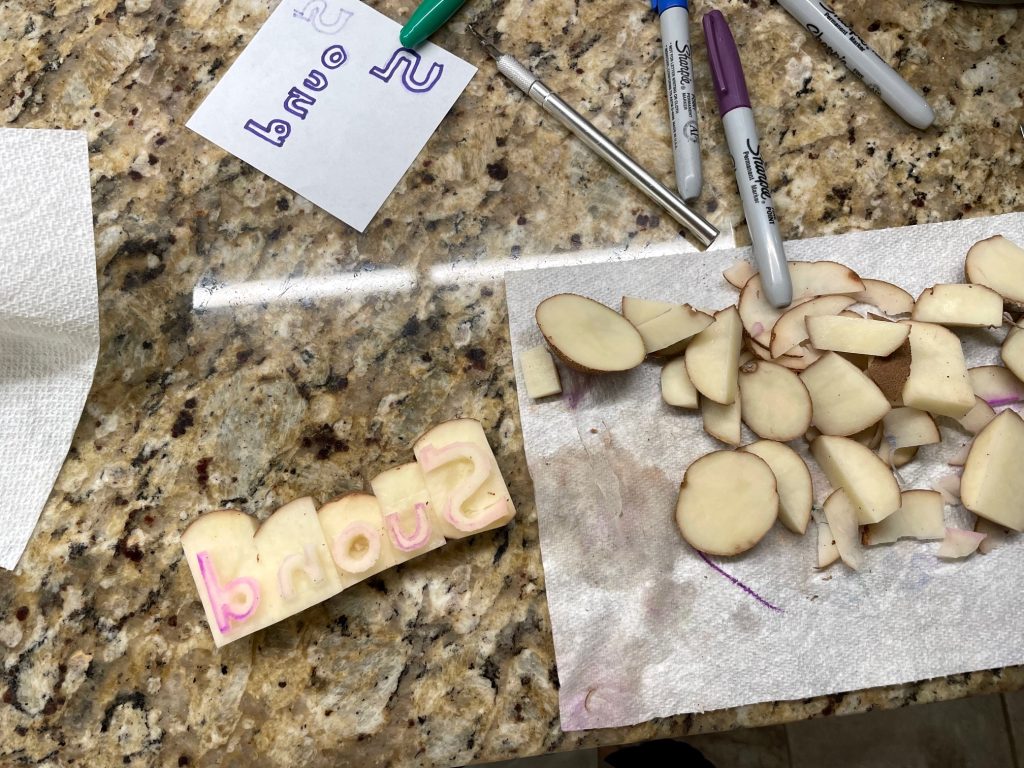
One mental note I had made while watching the video, was the squareness and depth of each of the letters. I surmised that it would be important for each piece to have edges that were proportionally similar so that the spacing and alignment were controlled. I also realized that the letters on the pieces were reflections, so I wrote the characters on a thin piece of paper so that the ink could be seen through to the other side.

After drawing the shapes of the reflections on halved potato pieces, I carefully carved the cut face using an Xacto and a kitchen knife. As I carved, I thought of the perseverance and patience that Gutenberg must have had in developing the system that he did, not to mention the ingenuity and foresight to make the work of copyists more economical. In Empire and Communications, Harold Innis describes industries like metallurgy and paper production – developing adjacent to block printing – as important for setting the stage for the invention of the printing press (Innis, 2007, p. 164), and the clear demand for increased production by ecclesiastics.

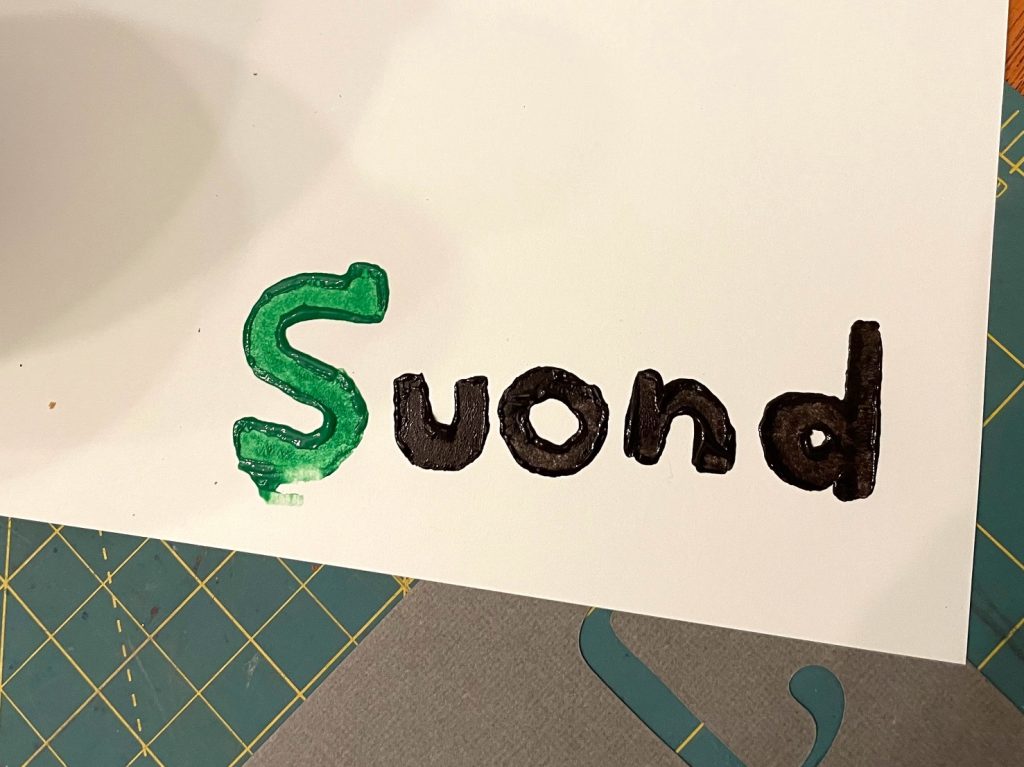
Because I had carefully focused on the width, depth, and surface angle of the potato pieces, it allowed me to use the knife blade as an alignment tool; using one hand, I squeezed the pieces together while using my other hand to lift and flip them into place. Although my first attempt at printing was aligned quite well, I didn’t pay attention to the character order: the word was misspelled :(.

potato stamp print of the word sound, misspelled

Oops!

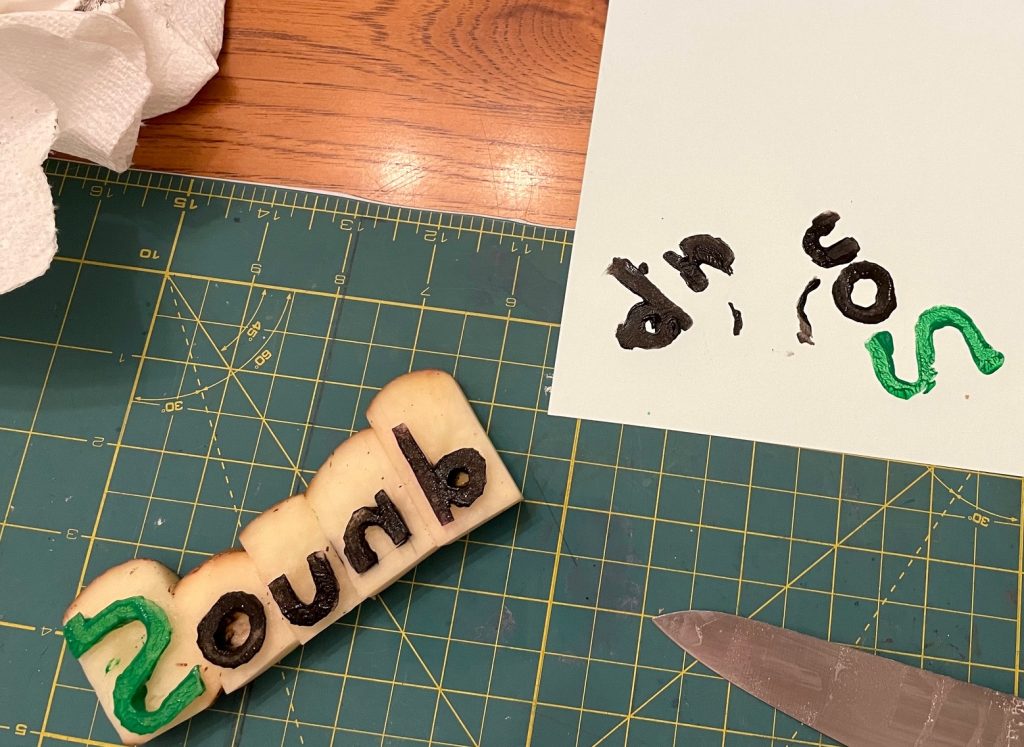
In my second attempt, when squeezing and lifting the pieces into place, the blocks slipped and fell onto the paper in a mess.

a cutting board and potato stamp pieces

Disaster during placement

I changed my approach in the third attempt, painting the ink and then placing each block individually, essentially casting all the effort for ensuring alignment out the window. Each piece was placed visually, but freehand, to form the first print.

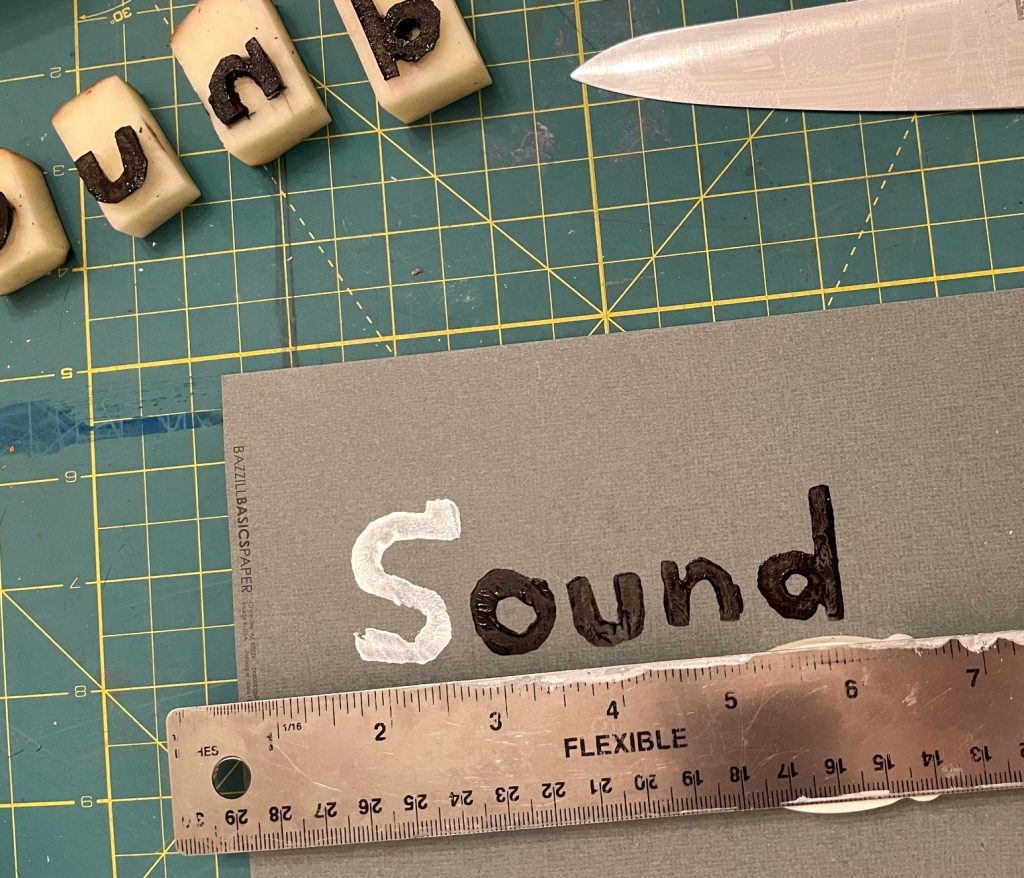
Happy with the result, but unhappy with the approach, I adjusted the process for the second print by using an elevated ruler as a guide. Although the kerning remained freehand, I was satisfied that the letters were controlled horizontally.

a picture of a piece of paper with a ruler

A better approach: one-by-one using a guide.

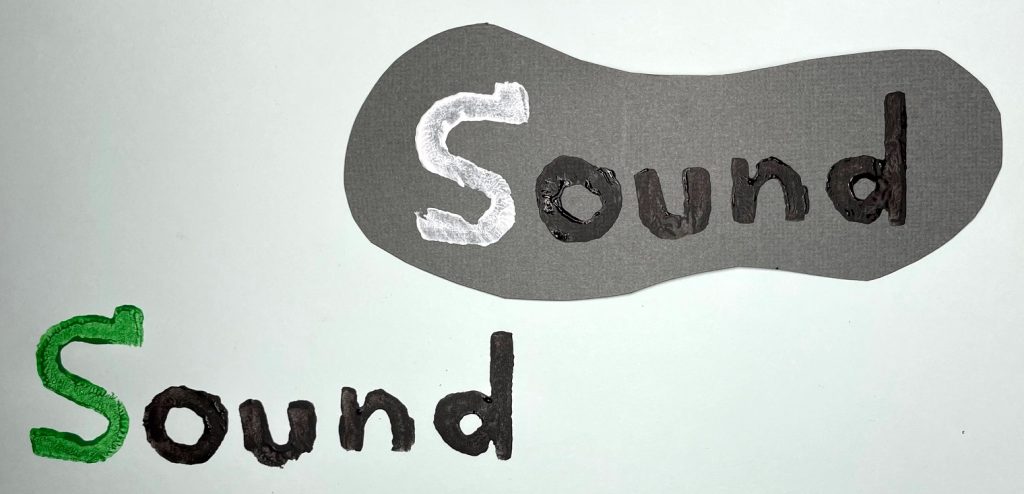
I wanted to experiment with different first letter colours because this appears to have been a common occurrence in medieval text.

the word sound, printed twice using potato stamps

Final print

My printing exercise took approximately two hours, and it is clearly a technical pursuit because of the importance of precision. Any mechanical systematization would have needed to consider the impact of temperature on the expansion or contraction of metal, the viscosity and drying time of ink, and the complexity of the operational labour. However, as Innis documents, the unbelievable explosion of print as a result of this technology (roughly 200 pages/hr to 768,000 pages/hr!) clearly demonstrates it value (Innis, 2007).

References

Innis, H. (2007). Empire and communications. Dundurn Press.

McLuhan, M. & ProQuest (Firm). (2011). The Gutenberg galaxy: The making of typographic man ([New];1;New;). University of Toronto Press. https://go.exlibris.link/tqv0cls4

What is text? What is technology?

A couple of years ago I watched a news report that described the findings of a study about crows; researchers had found that crows could put sticks and straws together to solve some kind of puzzle contraption to obtain food. This was a memorable report because apparently outside of humans and “great apes”, no other animal had been observed using “compound tools”, or tools that are made from multiple components. It piqued my interest in understanding the origin of human tools, and my exploration eventually led me to articles that philosophically questioned whether our hands and our bodies are merely “tools” for our brains. This argument can be made and debated in another post, but what is interesting and relevant to the topic in this post, is the evolution of humans’ tool use — whether this includes the development of appendages and opposable thumbs, or not.

Technology in this context, refers to the development of a capability (usually positive in nature) as a result of the use of a tool, whether that capability is realized or not. For example, if we examine early hominid life there are many examples of how tools were used to enhance living conditions, improve food gathering capabilities, or increase weapon effectiveness. Later, the development of the wheel made it possible for civilizations to move great quantities of materials and people, thereby increasing the efficiency of travel and the yield of harvest. Jump forward in time even further and consider the capabilities conferred by nuclear technology. Although only experienced twice, the atomic bomb shapes our existence even today because humanity collectively understands its destructive capabilities, and so those who possess this technology are conferred tactical latitude that is paired with increased vigilance. Tools (the objects themselves) and their use (and eventual mastery), together create a “technology” that affords newfound capabilities that can be communicated and shared for a common benefit or concealed and wielded as a power.

Text, as a specific form of literacy involving communicating ideas through written modalities, is a technology that helps persist communication beyond a synchronous experience. It forces the reader to conceptualize, internalize, and imagine the thoughts of the writer because it lacks the ability to convey meaning other than through the definitions of the words that are chosen and the sentences that are crafted. It has no ability to adjust pitch or intonation like aural artifacts; it cannot wave its arms in the air or sign meaning through movement like theatre; and it must take about one thousand words to capture the essence of a photograph. Despite this seeming constraint at one might call the “presentation layer”, humanity’s written history has proven that the depth and richness of the text’s language can bring the reader to tears or have them burst out in laughter. But it is text’s ability to outlast other forms of communication over time – with relative ease – that is its most celebrated affordance.

What’s in my bag?

Well, this is probably as good a place as any to get started… Hello. This is me and my bag.

I like to bike to work, so my bag is durable, rigid-on-one-side, and waterproof so that I can hook it onto a rack that is attached to the back part of my bike and be sure that its contents will arrive with me relatively unscathed. My bag is a type of bag called a “pannier”, whose etymology I had guessed was French but whose origin I had not associated with donkeys or oxen. I suppose it makes sense; my bike is the equivalent of a “beast of burden” and the saddlebags draped over its rump help me carry the things that I figure I need to be both prepared for my journey and the activities at my destination.

I wouldn’t say that any of the items in my bag are all that remarkable or surprising for someone who irregularly commutes by bike – I have the luxury of working remotely, so maybe what’s more surprising is what’s not in my bag. Ever since I can remember I have always prioritized weight, and so given that my journey is less than 20 minutes door to door, I choose not to include a tire repair kit or water or tools in my equipment list. I have rationalized the excessive weight of a U-lock as a necessary evil, but most everything else is purposely minimal:

  • writing implements – one of which is suitable for fabric or other atypical surfaces
  • keys and security dongles for physical access
  • emergency cash (albeit, what can $3 buy these days!)
  • personal care items like a handkerchief, throat lozenges (that one could argue double as breath fresheners)
  • wallet and cell phone
  • lunch provisions (and I can tell you that the Banana Guard has elicited snickers on more than one occasion!)
  • bungee and bendable fasteners in case extra cargo needs to be secured

In comparison to the subjects in Ellie Brown’s Bag project, I find my items’ “text” to be almost entirely limited to branding, with the exception of the critical health and financial information stored in my wallet and the (vast) digital information stored in my phone. The fact that the items in my bag don’t rely on text may be somewhat of a subconscious decision because my preference and inclination is to communicate visually. Whiteboards are my comfort zone, and despite all the positive affordances of remote work, I lament impromptu small-group ideation with a board and a dry-erase marker.

So what does it say about me when much of the text in my bag is obfuscated behind the shiny black screens of my laptop and phone? I suppose am comfortable with a variety of digital tools, and the multiliteracies they demand for their operation, but I acknowledge this facet with hesitation because I am weary of the omniscience of social media and the intents of its purveyors. It is a tension that has existed for almost twenty years; I recall being introduced to Facebook when it was being promoted by my cousin at UBC in 2008. And although many, many things have changed in the two decades since then, I believe the contents of my bag would largely be the same. And in some ways this provides relief for my apprehension that is instigated by our hyper-connected world, because I know that there are still physical artifacts that resist change.