Assignment 2:2 – My Sense of Home

It’s the late 17th century. A French woman boards a ship destined for Quebec, part of a program to increase French power in North America. There she will marry a young Frenchman and settle in Montreal.

It’s the late 18th century. The great-grandchildren of that woman have spread themselves across Canada, assimilating into the predominantly British settlements.

It’s the late 19th century. A man arrives on Ellis Island from Sweden. He is told that his last name, “Johannsson,” is relatively common, so he changes it to “Asp,” after his favorite tree. He lives in New England for a time before marrying and moving to English-speaking Canada.

It’s the late 20th century. My parents meet in Vancouver, BC. After marrying, my father joins the US Navy and the family emigrates to the US. The Navy sends them to San Diego, California, where I’m born. We stay there three months before moving to Pensicola, Florida.

After a year there, we move again to Corpus Christi, Texas.

Another year, another move, this time to Oak Harbor, Washington.

After two years in Washington, we move to San Antonio, Texas, where my sister is born.

After another year in Texas, we move to Jacksonville, Florida.

After living in Florida for the second and final time, we move back to Oak Harbor, Washington, for another two years.

My father gets the opportunity to stop being a pilot for a while and instead do a tour on an aircraft carrier, the USS Theodore Roosevelt. The family moves to Williamsburg, Virginia.

We stay in Virginia for two years. Here we get to experience what is essentially the birthplace of the US, with Colonial Williamsburg being maintained as a time capsule of what life was like during the 17th and 18th centuries.

After two years in Virginia, my father gets accepted to the Naval War College where he will work towards a Masters degree in “Surface and Sub-Surface Naval Warfare.” We stay in Portsmouth, Rhode Island, for a year and a half.

While in Rhode Island, we get to experience more of early American history. Not only is Rhode Island full of history in and of itself, but Boston and New York are both relatively nearby. For the year and a half we stay in New England we get to explore this area and learn it’s history.

After my father’s studies were finished, we moved back to Oak Harbor, Washington, the last move the family would have to make for the Navy. At this point we’ve moved, between states, a total of nine times. If moves between homes within the same state were included, it would be more like fifteen.

Upon turning eighteen, I travelled to Singapore, Malaysia, and Thailand for six months. When I came back I moved out of my family’s house and moved into my own apartment on the other side of the island. From there I moved to Bellingham, Washington. I left and travelled through Mexico for several months before returning and moving to Vancouver, BC, to attend UBC. I stayed in Vancouver until I couldn’t stand the city and it’s incredibly expensive rent and moved back to Oak Harbor for my final year of university.

I like to say I’ve moved twenty times in twenty-five years, and though I’m rounding up by one or two that’s essentially right. I don’t think I’ve ever experienced “home” in the usual sense, though I suppose I wouldn’t know if I had. I can only know what I’ve experienced, and what my experience has taught me is that home is somewhere between “what/where you choose” and “what you feel you have a connection to.”


Works Cited

Asp Family History. Ancestry. https://www.ancestry.com/name-origin?surname=asp. Accessed 24 Jan 2020.

Colonial Williamsburg. The Colonial Williamsburg Foundation. https://www.colonialwilliamsburg.org/. Accessed 24 Jan 2020.

Filles du Roi. The Canadian Encyclopedia. https://www.thecanadianencyclopedia.ca/en/article/filles-du-roi. Accessed 24 Jan 2020.
Assignment 1:5 – I Have a Great Story to Tell You

I have a great story to tell you

There once was a monastery high on a mountain. There monks lived, young and old, and they were all joined together in song under the leadership of the abbot, the eldest and most revered of the monks. This song was the song of life, and as they sang the story of the world was told.

One day, one of the younger monks was watching the birds outside his cell, and listening to them sing, for he was very fond of birds. Then he said, “I’m tired of singing the part the abbot has assigned me. These birds don’t all sing the same song and they are still beautiful. There are many of us here, we could be like the birds and make our own parts.” Then he began to sing a melody of his own making, and discord entered the song of the monastery. And as the discord entered the song, discord entered the story of the world around them. And the melody of the young monk caused the rivers to flood.

The abbot, hearing the song grow discordant, told the young monk to sing his appointed part. But the young monk was excited to hear his own melody and began to sing louder, and couldn’t hear the abbot. And some of the other monks, seeing how happy the young monk was, began to make their own parts as well. And one new melody brought a famine, and another brought a drought, and another brought an earthquake. And so on did the story of the world change, until finally the song had grown so out of tune that death entered the world.

Now the young monk was happy and caught up in the song he was singing. But then he saw his favorite bird lying still on the ledge of his cell’s window. The young monk grew concerned and brought the bird to the abbot. When he showed the bird to the abbot, the abbot saw that the bird had died. The abbot told the young monk the bird had died, but the young monk was confused, having never heard of death before. The abbot explained to the young monk what death was, and the young monk grew sad, and wanted to change the song back and remove death from the story of the world. But the other monks couldn’t hear him, they could only hear their own songs. And the young monk began to despair, not being able to do anything to help the bird. And the abbot said, “Once you have told a story, you can never take it back. So, be careful of the stories you tell, and the stories you listen to.”


I pretty blatantly stole parts of this story from a variety of places, mostly because creativity of this kind doesn’t come naturally to me.

As for commentary, I’m not sure I have any. But I can say I gained a new appreciation for the art of storytelling, because coming up with something that’s not too obviously derivative isn’t as easy as it sounds

Assignment 1:3 – Technology and Story

I chose to respond to question seven, as I’m probably addicted to social media by any reasonable definition of “addiction.” I think that people of our age, who were born in a time without social media and watched it develop, are acutely aware of what changes social media has made/continues to make to the way we communicate, the way we gather information, the stories we hear and share, and so on, almost ad infinitum.

The first major change I can point to is one touched on in the question itself, and that is the ability to publish without publishers. I see this as a bit of a double-edged sword. On the one hand, the lack of a physical medium on which one relies to disseminate the story means that the cost of entry has been radically reduced. It costs next to nothing to publish and spread one’s work. Sites like Medium allow aspiring writers, journalists, and political pundits to publish their thoughts and stories for free and without any editorial oversight. Platforms like Facebook help writers find an audience and build a community around their work, allowing projects that might not otherwise have been published to gain a potentially massive amount of attention. A perfect example of this is Humans of New York, a project dedicated solely to the spreading of stories and voices that would have gone unheard had it not been for the technology at our disposal (ironically enough, a collection of HoNY stories has recently been published the old school way, becoming a New York Times Best Seller). The low cost of entry, the ease to which stories can find audiences, the speed at which quality work can spread, all contribute to the growing number and diversity of stories that we are able to read/hear.

The other edge to this double-edged sword lies in the fact that there’s no need for one’s work to grace the editor’s desk. While this is one factor in the lowering of barriers to entry previously discussed, this also means that it’s never been easier for lies and fictions to spread, and it’s been shown that false information spreads faster than the truth. The widespread dissemination of false information is something that has only relatively recently begun to gain attention, therefore it’s difficult to say just what the ramifications of this will be. Speaking to my personal experience, among myself and my friends it’s lent itself to a feeling that nothing online can be trusted, that there are no longer any unbiased sources of information, that there is no ability to discern objective truth from falsehood online, and that everything seen and read on the internet should be treated as being false or being manipulated in some way. This attitude, even though it’s my own, strikes me as being almost as dangerous as believing everything you read on the internet. It introduces the possibility that, even though it’s never been easier to spread a story, allowing for voices that would have previously gone unheard to be heard, the fact that these voices are being heard through the medium of social media means that they won’t be believed.

The last aspect I want to touch on is the famous comments section. The optimistic among us might have thought that the unique structures of social media that allow for news outlets, writers, authors, etc. to publish their work essentially for free, and then to be able to interact with their audience in a way that resembles the Greek and Roman forums of antiquity, would have lent itself to a strengthening of what those same Greeks and Romans would have called “republican virtues.” That it might have allowed a more diverse, open, and honest communication between author and reader, between speaker and listener. That it would have allowed for the readers and listeners to challenge the authors and speakers in an open forum, inverting the relationship between author/speaker and reader/listener, blurring the distinctions between the two and creating opportunities for dialogue that allow greater truths to be revealed. Unfortunately, a cursory scroll through basically any comments section would leave anyone who held those optimistic views feeling a little naïve.

To summarize (or tl;dr, for the other social media addicts): social media, and the internet as a whole, has allowed for the widespread dissemination of stories and voices that would have gone otherwise unheard. This diversification and multiplicity of voices is almost certainly a positive thing. However, the low-to-nonexistent cost of entry has caused the widespread dissemination of false information as well, lending itself to a growing cynicism about what one encounters online, potentially leading to a silencing of those very same stories and voices. In addition, the unique structure of social media has blurred the lines between author/speaker and reader/listener and opened up opportunities for greater dialogue between the two. However, those opportunities often fall at the wayside to be replaced by trolling and arguing, with the participants shielded from the consequences of their actions by a veneer of anonymity.

Works Cited

Bogomilova, Alexandra. “How reading online comments affects us.” Social Media Psychology, https://socialmediapsychology.eu/2016/10/05/onlineandsocialmediacomments/. Accessed 16 Jan 2020.

Fox, Maggie. “Fake News: Lies spread faster on social media than truth does.” NBC News, https://www.nbcnews.com/health/health-news/fake-news-lies-spread-faster-social-media-truth-does-n854896. Accessed 16 Jan 2020.

Humans of New York, https://www.humansofnewyork.com/. Accessed 16 Jan 2020.

Assignment 1:1 – Introduction

Hello everyone! I’m excited to be starting a new term at UBC, and to be taking another class with a focus on Canadian history and Native cultures.

Who am I?

I’m a 4th year English major here at UBC. I was born and raised in the US and am still living in Washington, commuting to UBC three days a week. Thank goodness for dual citizenship and cheap Canadian tuition!

Why did I choose this class?

Having been born and raised in the US, and considering myself American first and foremost, my experience with these subjects is probably much different than that of students born and raised in Canada. This is exciting for me, as it means I get the opportunity to interact with a field of knowledge that’s completely new and fresh.

Also, it’s online. This means less walking around UBC campus in the rain. I consider this a plus.

What do I expect to gain from this course?

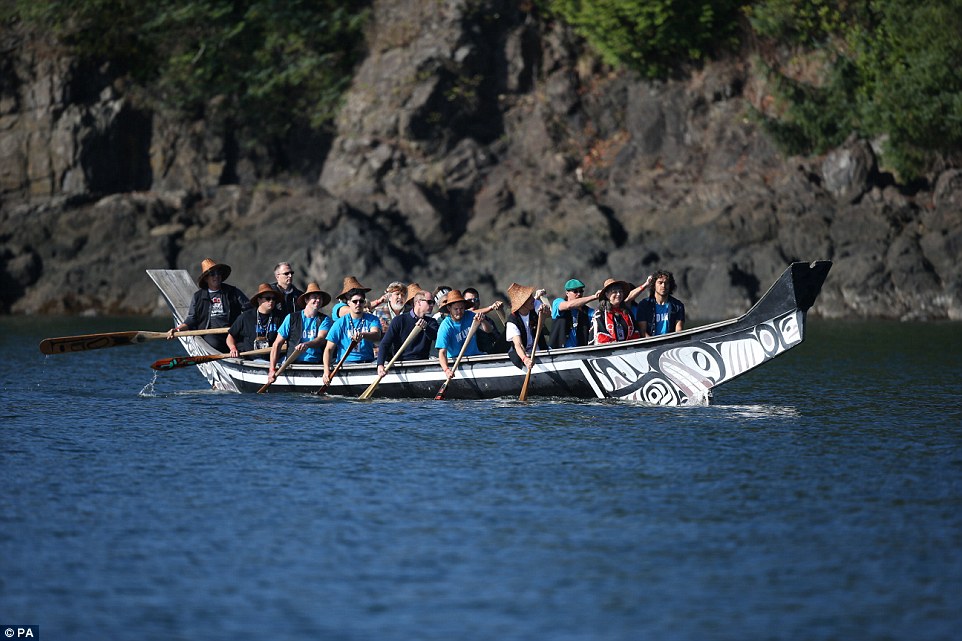
Primarily, I hope to gain a greater understanding of the history of the Canadian and Indigenous peoples and of their interactions. I’ve always been fascinated by the native peoples of North America, especially the Apache peoples of the American Southwest, the Sioux of the Great Plains, and the Haida peoples of the Pacific Northwest. I have a great love of military science and history, and have been interested in these peoples and their cultures ever since an old anthropology professor of mine (a member of the Salish people himself) called the Haida “the Vikings of the Pacific coast.” I’ve thoroughly enjoyed learning about native peoples and cultures through this lens, looking at the similarities and differences in warfare between the native peoples of North America and similar bronze-age/early iron-age peoples in Europe and Asia, and especially at the naval traditions of ocean-going peoples like the Haida and Salish. The fact that these peoples could travel from the Alaskan coast as far south as California in canoes carrying twenty to thirty people is remarkable and is a testament to their highly developed naval tradition.

However, I’m under no illusions that my personal interests haven’t left significant gaps in my knowledge of the indigenous peoples, especially in a Canadian context. I know next to nothing about Canadian history, and while I’ve heard things like the “residential school system” mentioned on more than a few occasions during my time at UBC my knowledge on these subjects rarely extends beyond a simple news article. I don’t even know when to capitalize words like “native” and “indigenous” and when not to, as I’m sure this and future blog posts will attest to (at least until one of my fellow students corrects me). Thus, I’m sure that almost everything we’ll be studying over the course of this term will be new to me, which I find exciting.

Thank you for reading, I’m looking forward to learning with you all!


Also, I know how much Canadians love the British royals, so I’ve attached an image of your beloved Prince and Princess in a traditional Haida canoe.


Works Cited

CBC News. “A History of Residential Schools in Canada.” CBC, 16 May 2008, https://www.cbc.ca/news/canada/a-history-of-residential-schools-in-canada-1.702280. Accessed 12 January 2020.

English, Rebecca. “Prince William and Kate Middleton Arrive on a Remote Island in a Traditional War Canoe.” Daily Mail, 30 Sept. 2016, https://www.dailymail.co.uk/news/article-3816426/Wills-Kate-arrive-remote-island-traditional-WAR-CANOE-British-Columbia-charm-locals-penultimate-day-tour-Canada.html. Accessed 12 January 2020.

“Warfare.” Canadian Museum of History, https://www.historymuseum.ca/cmc/exhibitions/aborig/haida/havwa01e.html. Accessed 12 January 2020.

Spam prevention powered by Akismet