In my exploration of story and math concepts, I found connects of the legend Raven Brings the Light and making Bentwood Boxes (bent from one piece of wood to store items) using ratio, 3D geometry and measurement to discover measurements based on the volume of the objects. In the activities I found, there were written version of the story, but I wondered how authentic that was. I also found a story book written in collaboration with indigenous people that was read out loud by a teacher. This satisfied me a little more, in that it was read out loud and had some images for students. However, in reading in this course, it talked about cadence, volume and speed being important factors of story telling. I then found a storyteller Nakoma Volkman who was videoed retelling the Lakota story of ‘Raven Brings Light’ and that was more appropriate. However, as I watched, it may not be engaging to all students. I then found the video below which belongs to a series (link to site below as well) of animated shorts that aim to educate and entertain students while teaching them First Nations legends. There are voices, music and sounds and the production is high quality.
Author Archives: ChelanHansen
M4P4 – First People’s Principles of Learning
Our district (SD #23) aspires to follow the First Peoples Principles of Learning, and I have the poster cited hanging on my wall. These principles have taken on a deeper meaning to me throughout this course. In particular, ‘learning recognizes the role of indigenous knowledge’ and ‘learning is embedded in memory, history, and story’ are two principles that I feel I am able to address better in my own teaching practice. By exploring indigenous knowledge I have gained a deeper understanding and confidence in using that knowledge in the classroom. Instead of just ‘shoving’ content in to satisfy our curriculum, I am better able to embed learning naturally into my every day lessons. Particularly in math, I am grounding indigenous stories with math, as well as other stories, to make math more relevant and interesting to students. While I have not mastered these two principles, and still have the rest to consider and endeavor to accomplish, it was a great jumping off point for me in my learning journey.
First Nations Education Steering Committee. (2015). First Peoples Principles of Learning Poster [PDF file]. Retrieved from http://www.fnesc.ca/wp/wp-content/uploads/2015/09/PUB-LFP-POSTER-Principles-of-Learning-First-Peoples-poster-11×17.pdf
M4P3 – Aboriginal Student Population
While exploring how to incorporate indigenous content into my math and science curriculum I came across the question of why. Why aboriginal and not other cultures? The Aboriginal Report found in the link below had many answers for me. It gave me achievement reports as well as population statistics that are as recent as last year. If it is of interest to you, you can also find this data broken down by school district as well. One caveat is that the numbers of Aboriginal people are only recorded if a person self identifies as Aboriginal. So there could be students who did not self identify that are uncounted in the data. I was not initially surprised at the ratio of Aboriginal to all other students, and the district data lines up with my school data which showed 10.5% across the district and 8.4% at my school this year. I did take a quick peek at the English Language Learners (ELL) student numbers to find them similar to Aboriginal students. In my class this year I had 16% of my student identify as aboriginal which is above the average. This data confirms my need to incorporate aboriginal content into my curriculum.
Aboriginal Report 2015/16 – 2019/20. How Are We Doing? (2020). Retrieved 9 June 2021 from
M4P2
I really enjoyed reading about the dimensions of learning framework (Parrish and Linder-VanBerschot, 2010) and much of it resonated with my teaching and experience. For example, when looking at individualism and collectivism, I see times for both. We as teachers are forced to report on individual learning, so assessment and tasks are sure to have that embedded and have specific content in it, but many tasks can be designed as a collective challenge to a group, working on communication skills, rather than content skills. While I encourage students to share their thinking, it is not forced upon them. However, the two areas that really struck me were the time dimensions. In my educational setting, we are forced to have instructional activities start and stop, however, my colleagues and I have now merely looked at these ‘subject blocks’ as blocks of time. The instructional activity can continue as far as we want, and the only thing stopping it would be scheduled break times of the school. As for linear/cyclical time, our curriculum is designed to be cyclical in that the same concepts come up in later years and are built upon, but we do work in a linear model with reports and deadlines. However, opportunities to show learning in my classes are plentiful. I do feel like having some repetition in learning is comforting and helpful to students, but it should never be so specific with everything that it becomes a rut. I found the contrast between these two time dimensions to be vast. I have included an image of a few dimensions of the framework to consider.
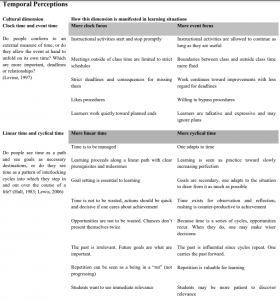
Parrish, P. & Linder-VanBerschot, J. A. (2010). Cultural dimensions of learning: Addressing the challenges of multicultural instruction. International Review of Research in Open and Distance Learning, 11(2), 1-19.
M4P1
Another curriculum tie was to teach probability through stick games by Danielle Vankoughnett. The author provides an in-depth explanation of different stick games (Drop stick and Blackfoot Confederacy Stick Game) with images to aid in understanding, a lesson plan and worksheets. She also provides teacher resource links to videos and readings for background information about the Blackfoot Confederacy and linking Pow Wow dances to drop stick designs). I find this invaluable as one barrier I face is feeling uneducated about the topics, and such links build that knowledge and confidence. By learning different indigenous stick games, students also unpack the concept of theoretical and experimental probability. I included an image to give a visual on how she included examples to scaffold teacher understanding.
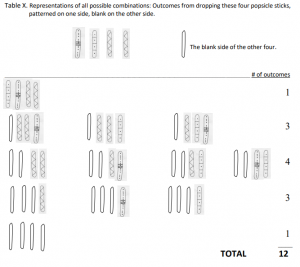
Vankoughnett, Danielle, (2019). Stick Games and Theoretical/Experimental Probability. Stirling McDowell Foundation. Retrieved from http://mcdowellfoundation.ca/research/culture-based-school-mathematics-for-reconciliation-and-professional-development/
M3P5 – Forests and Oceans for the Future
The Forests and Oceans for the Future is a research group at UBC that looks at ecological research and knowledge but they work with north coast BC communities. It intends to weave together indigenous and non-indigenous knowledge and look at sustainability of forests and oceans. While the group has goals to do research, create policies, it also aims to design educational materials while sharing knowledge with First Nations and other community stakeholders. The lesson plans are science based and have seven different units, created by different people. The one particular lesson that drew me is Unit 7 – Traditional Ecological Knowledge and Climate Change. Climate change is part of my Science 7 curriculum and this particular unit is unique as it actually provides students with interviews with elders and examples of traditional ecological knowledge. While this unit seemed great, I actually felt it was a bit mature for my grade 7 students and would require me to read most of it to them to ensure understanding. I also was a little disappointed to realize after the fact that the interviews were all from 2005 which could be quite dated.
https://ecoknow.ca/curriculum.html
M3P4 – Math First Peoples Teacher Resource Guide
This resources guide has a lot of lessons that connect with my grade level curriculum but also includes information on the how and why around the way to teacher such content. It also includes how to chose and develop a framework for designing more indigenous content. It includes a rubric on how to assess the resource based on indigenous voice, languages, diversity, protocols, relationship with the land, and ways of learning/teaching. This detailed rubric could serve as a guide for teachers to weave in indigenous knowledge into curriculum in a meaningful and respectful way, or as it calls it, ‘authentic integration of mathematical and cultural teaching’. As with the other FNES science resource, it provides a guide for having guests, but even more so, it has a math interview guide of potential mathematical questions that could be asked of guests. Within the resource, it has general lessons that could be done at any grade level that focus around a theme. This resource does not narrow down on one grade level specific activities, so work has to be done to dig into the thematic units to see how and what kind of math is involved. There is a section on the environment, as well as land and water, that connect to my science curriculum as well.
http://www.fnesc.ca/wp/wp-content/uploads/2020/09/PUBLICATION-Math-FP-TRG-2020-09-04.pdf
M3P3 – Great Bear Sea
This particular resource has 10 lessons related to the sea and salmon and includes completed lesson plans that are related to a film on the topic of the Great Bear Sea located in BC. I did not know anything about this area of BC so I felt enlightened myself in looking through this resource. The film is visually stunning and I feel it would be engaging to students. It is designed for my grade level and is hands on as well as inquiry based. It interweaves indigenous knowledge, research, marine plans, collaboration, as well as careers and the idea of stewardship. In terms of curricular content this is a cross curricular resource as it’s not focused on one subject. It includes math, as is one of my focuses, but also careers, Art, and English. I personally find students have more interest and ownership when their learning is more fluid between subjects and based more on real world situations. The lessons themselves are interactive and interesting, but also provide spots for differentiation and student interest. I also really appreciate that they include an area that is specifically for teachers to learn more about the background of the topics so that they can feel informed before starting.
M3P2 – Science First Peoples Teacher Resource Guide
This resource guide was a gold mind of ideas and First Peoples resources. It includes learner centred and inquiry based activities that are based on experiences. While the activities were of great interest to me, I also found the introduction really valuable. It highlights the certain aspects of indigenous knowledge and explains the significance of interconnectedness, sense of place, language, place names, and story. It also gives suggestions and considerations on how to make connections with the indigenous communities as well as what to consider if having a guest speaker come in. I found it very clearly laid out as well as very insightful. The specific lessons that I found most applicable to my practice is the climate change lesson. It includes a unit plan that has climate change over time, specifics of the salmon affected by climate change, and resilience during climate change. Within each subsection it includes an inquiry question, suggested resources and suggested activities. There is a large appendix including the resources which also has stories to be retold. I feel this makes teachers more comfortable as we are being given these stories that we can retell properly, and even have explicit permission to retell it.
M3P1 – Decolonizing Math with Stories
This paper is written by 5 math teachers from a variety of cultural and academic backgrounds hoping to explore understanding on how math and education include colonialist practices. The teachers met regularly and worked with a narrative inquiry aimed at decolonizing math through stories. This interested me as I was curious of the colonialist underpinnings specifically in math, but also the idea of learning and teaching through storytelling. They each told their stories of their teaching experiences and tried out new ways. So instead of teaching drills, they taught stories and taught math outside to connect it to place. Then the teachers shared their stories again in hopes of reliving them and shifting practice as well as recognizing colonists’ features.
Nicol, C., Gerofsky, S., Nolan, K. et al. Teacher Professional Learning with/in Place: Storying the Work of Decolonizing Mathematics Education from within a Colonial Structure. Can. J. Sci. Math. Techn. Educ. 20, 190–204 (2020).