Author Archives: ChelanHansen

M2P5 – Importance of Culture in Math

M2P5

While this paper is not sharing specific indigenous knowledge in connection with math, it seeks to prove the importance of culture within teaching and learning math. The cultural script for a ‘traditional math lesson’ is specific to each culture. In this way, the mainstream culture determines the teaching and learning of math in classrooms. Reading through this, I had to recognize that I must be following the mainstream culture in teaching math, and that would, and does not work, for all cultures. After reading this, I would be foolish to think that my way would be the right way for all students in my classroom. While this article summed up the research on the different cultural ways of teaching math, I am left to wonder, how do I teach math multi-culturally? Is that even possible? How do I teach ANYTHING multi-culturally?

Andrews, P. (2010). The importance of acknowledging the cultural dimension in mathematics teaching and learning research. Acta Didactica Naposencia, 3(2), 3-16.
M2P4 – Changing Teaching Math

M2P4 

This article digs deeper into the how behind incorporating indigenous content, but more importantly how to change teaching mathematics to indigenous students. As I have started to realize, the article says the process requires investment from the teachers, indigenous communities and takes time, planning and small steps. While the initiative took place at many schools, the article follows one school in particular, and notes that a benefit was that the school was more welcoming and had more warmth due to the strengthened relationship to the community. Teacher transformation was also needed for change. The teachers received teaching strategies and tools, but also teachings being responsive to students. This responsive teaching was scaffolded with consultation and mentoring with two way sharing of culture and intellectual knowledge with Indigenous peoples. I think about how I am worried about proceeding due to worry of offending, or ‘doing it wrong’. The level of collaboration and support these teachers received with ingidenous experts was astounding and something to aspire to.

Owens, K. (2015). Changing the teaching of mathematics for improved indigenous education in a rural Australian city. Journal of Mathematics Teacher Education, 18(1).

M2P3 – Numeracy In Haida Gwaii

While this resource is long, it includes deconstructing the layers of numeracy to create a shared understanding of what numeracy is. From there, it dives into epistemologies in learning math, and an overview of research methodology. While it is a valuable and interesting read, my interest peaked when I looked at Chapter 5 – Numeracy Practices in the Community of Haida Gwaii. This includes over a hundred pages of traditional ways of the Haida and their use of math in their cultural context. One example would be the Rythm of the Tides. It explains how it is important to Haida culture, including information from Haida, Parks Canada, as well as pictures and data. It connects the pattern to the sinusoidal function, and to sine function. That concept in math I would have never dreamed or guessed how to show a real world example, but it was all there, with cultural context to boot!  It also included actual activities to do within the appendix like blanket designs and meaning.

Neel, K. I. S. (2007). Numeracy in haida gwaii, BC: Connecting community, pedagogy, and epistemology Retrieved from https://peterliljedahl.com/wp-content/uploads/Thesis-Kanwal-Neel.pdf

M2P2 – Math Catcher

The site below was created out of a grant from 2011 with sponsorships from BC and it’s goal was to overcome challenges in teaching math to Aboriginal youth by teaching math in a cultural context and teaching basic skills and problem-solving early on. The particular part of the site that drew me in was the Stories/Movies section which includes a series of stories with mathematical themes including many different translations of each story, such as English, Cree and Blackfoot.  I also loved that it stayed true to the idea of oral storytelling, and the stories are oral, not written. There are moving pictures that assist in telling the story, and also background noises found in nature, such as birds chirping, and water running. One story, Small Number and the Basketball Tournament, described a boy and his day in school, and the basketball tournament. It explains the amount of hopes, the amount of players, and shifts using algebra but also the family connections and female empowerment. At the end, it repeats Small Numbers conclusions, and asks the audience how he figured it out. I could see this story being used as a good brain warm up in class, getting kids to talk it out, replay the story, and come up with the reasoning. I will be looking forward to trying that out in my own classroom.

Stories/Movies. Math Catcher. (n.d.). http://mathcatcher.irmacs.sfu.ca/stories

M2P1: Haida Legends and Math

This article followed a group of teachers from School District of Haida Gwaii Queen Charlotte Islands who collaboratively worked with local community members, educators and researchers from UBC. The goal was to create math experiences within the context and connection of Haida Gwaii culture. I really liked that the intent was not just to find connections between math and Haida culture, but they referred to it as math experiences – a naturally occurring connection making it relevant to lives and culture. The particular lesson they shared came from a Haida legend called “Raven Brings the Light’ and involves building bentwood boxes with students from grade 4-9, which is within my age range. They connected the legend and activity to curricular concepts in math, such as ratio, 3D geometry and measurement . I also enjoyed that the students would be presented on their graduation with their boxes, as well as other culturally created items. The article provides a lesson plan, including where to find the legend in an audio from CBC radio, which makes this resource very accessible for teachers.

Novakowski, Janice (2008). Haida Legends: Culturally Responsive Mathematics. Vector, 49(2) 20-24.  https://www.bcamt.ca/wp-content/uploads/vector/492-Summer-2008.pdf

Module 1 Post 5

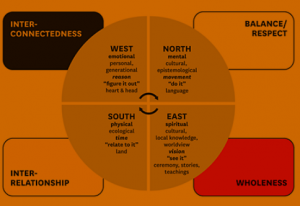
The Medicine Wheel was something I had seen before in terms of the four directions, but this article focuses on it as an anchor for teaching and learning. From there, it goes into more detail of what exactly the four directions represent, as seen below. The article also talks about the interconnectedness of the four directions and that that creates wholeness. In teaching holistically, students could start with circles to address their spirit, then, for the physical aspect, they would need to work with the land, the emotional aspect through healing circles, and finally the mental aspect in learning their people’s ways. The question lies on how to incorporate that authentically into non-indigenous classrooms.


https://www.lincdireproject.org/wp-content/uploads/ResearcherShareFolder/Readings/Teaching%20by%20the%20Medicine%20Wheel.pdf

Module 1 Post 4

This post is a graphic and a link to the site it originated at. This is from Centennial College (Toronto) and represents their approach to indigenous education. There are 5 pillars;

  1. Indigenous Nations and Communities
  2. Equitable Access Opportunities
  3. Indigenous Learning and Development for All
  4. Indigenous Spaces
  5. Student Services and Experiences

They also identify strategies within these. This struck me as I have been focusing on indigenous education in my classroom, but also need to consider that as a whole school structure. I can’t just incorporate some teachings into my curriculum, it is much bigger than that.

https://www.centennialcollege.ca/indigenous-education/indigenous-strategic-framework-pillars/

Module 1 Post 3

The link is to the McDowell Foundation for Research into Teaching. It is a charitable organization organized by Saskatchewan’s Teacher Federation. I really liked that the research is actually being done by teachers in the field. At this particular site it is only about ‘Culture Based Math for Reconciliation’ and it really excited me because it had a lot of the math concepts I am used to teaching, for example, positive and negative numbers, as well as probability. It includes an overview of what to do each day, as well as stories and knowledge required to teach the concept with ease. I will be looking into doing the probability one at the end of the year. Excited I found this.

http://mcdowellfoundation.ca/research/culture-based-school-mathematics-for-reconciliation-and-professional-development/

Module 1 Post 2

The University of Winnipeg had Edward Doolittle had an indigenous scholars series and he was one who spoke. I enjoyed this because not only is he indigenous, he also had a PhD in mathematics, so he is uniquely able to see and math connections between the two concepts. Even more valuable to my area of work, he has also taught math. He speaks about many stories (like the creation story) and explains the connections to mathematics within the story. He also talks about how science can be effective in it’s own domain, but the real world cannot be controlled the way science experiments demand

https://www.uwinnipeg.ca/indigenous/weweni/weweni-2018/what-is-indigenous-mathematics.html

Module 1 Post 1

I was surprised and excited to see this resource and then realize that it is from UBC Van! This resource includes math and indigenous content including articles, books, power points, lessons and PDF’s. I really liked it because it has a very easy navigation system to look for items. While there are not as many lessons as I had hoped, I will still be looking at this to answer my question of how to integrate math education and indigenous content.


Indigenous Math Resources