Author Archives: Laura Ulrich

I am a teacher from the Cariboo region of British Columbia. My background includes biology, art (digital and traditional), and programming.

Building Resiliency through the We Light the Fire Project (M2P5)

Fanian et al. (2015) evaluate the role art plays in building resiliency through the Kots’iìhtła (“We Light the Fire”) Project. The participants were Tłı˛cho˛ youth (of the Northwest Territories), facilitated by Indigenous youth artists/mentors. While the project’s original goal was suicide prevention among youth, participants steered its course by choosing issues that were important to them. During the workshops, “participants began to share about challenges such as alcohol use, cyber bullying and suicide and employment, as well as positive aspects of their community and visions for their own and collective future through the artwork and in conversations” (p. 7). Projects ranged from visual arts to music, film to photography. At the end of the project, the particpants’ creations were shared with the community. The project was deemed a success, as both participant self-reflections and mentor observations saw an increase in participant confidence and resiliency. Additionally, participation in art-making was found to have the potential for facilitating bonding and sparking conversations for change.
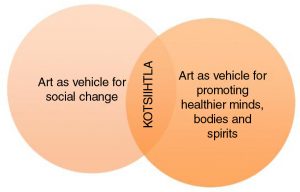
Art as a vehicle for social change + art as a vehicle for promoting healthier minds, bodies, and spirits = Kotshiihtla

Reference:

Fanian, S., Young, S. K., Mantla, M., Daniels, A., & Chatwood, S. (2015). Evaluation of the Kots’iìhtła (“We Light the Fire”) Project: building resiliency and connections through strengths-based creative arts programming for Indigenous youth. International Journal of Circumpolar Health, 74(1), 27672. https://doi.org/10.3402/ijch.v74.27672
Bridging Communities Through Murals (M2P4)

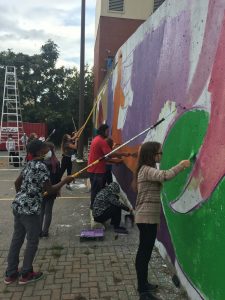
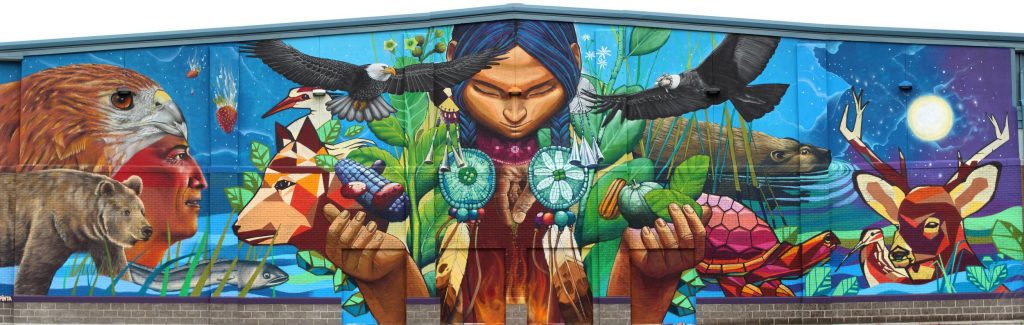
In their paper, Taonsayontenhroseri:ye’ne: the Power of art in Indigenous Research with Youth, Whitlow et al. (2019) report on their arts-based research project, Transformation, Action, Grafitti (#TAG). Participants were from Six Nations, the unceded territory of Brantford, Chili, and the Mapuche territory of Kompu Lof. The project’s goals were first, to nourish cultural pride for Indigenous youth, and second, to educate non-Indigenous youth “through a for-Indigenous-people-by-Indigenous-people framework” (p. 182). During the workshops, participants created doodles based on what they were seeing and hearing. Later, these doodles were collected by the Alapinta (Chilean) muralists, who tied them together into two sister murals. The murals were painted in prominent locations in Six Nations and the Brantford downtown-core. They sparked conversations about reconciliation that, thanks to the Internet and social media, reached globally.

Participants working on the Brantford mural

Participants working on the Brantford mural

The authors say this about the power of art:

“For this reason, art was even better medium for communication across the barriers of colonial languages. Haudenosaunee people often struggle to translate their stories from their original languages as English does not communicate the depth and complexity of their own morphology. The images that appear in the mural can be interpreted and valued regardless of spoken language. Indeed, art was the bridge between groups of people who spoke four different languages, often through a translator. Despite our struggles with language, symbolism and cultural imagery became a shared and complex form of communication” (p. 186).

the Six Nations mural

The #TAG’s completed Six Nations mural


Reference:

Whitlow, K. B., Oliver, V., Anderson, K., Brozowski, K., Tschirhart, S., Charles, D., & Ransom, K. (2019). Taonsayontenhroseri:ye’ne: the power of art in Indigenous research with youth. AlterNative: An International Journal of Indigenous Peoples, 15(2), 180–189. https://doi.org/10.1177/1177180119845915

Indigenous Youth Leadership: HIV-prevention and the Arts (M2P3)

In their paper, “Because we have really unique art”: Decolonizing
Research with Indigenous Youth Using the Arts, Flicker et al. (2014) outline the process and results of the project for Taking Action!, an Indigenous-youth-led project on using art for HIV prevention. The paper opens with the following quote by France Trépanier:

Art can be medicine, a survival tool, an antidote. Art is our identity, our place, a sign of our presence on this planet. It is medicine as it helps healing because we’ve been through so many things. Art is for the people. It can help build our communities.

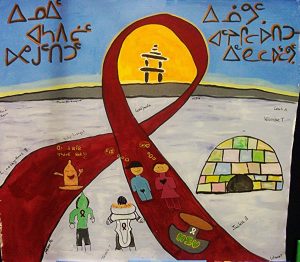
Mural Created by Inuit Youth Participants of Puvirnituq, Nunavik

Mural Created by Inuit Youth Participants of Puvirnituq, Nunavik

The goal of the project was to “explore the links between community, culture, colonization, and HIV” (p. 16). Twenty Indigenous artists and over one hundred youth (age 13-29) participated from six different communities across Canada. The project was guided by a committee of Indigenous youth. The paper is full of commentary from the participants, who found the workshops to be fun and helped them talk about HIV. The opportunity to learn ” traditional art forms, such as carving, throat singing, drumming, and painting, was an effective way to focus on the issues while learning about, and in some cases, reclaiming, parts of their heritage” (p. 22). The authors emphasize the importance of giving participants choice in what they did. As an educator, one comment particularly stood out to me: “You talk so much you don’t really remember, but if you do art you are going to remember it all” (p. 23).

At the end of the workshops, the participants had created pieces that they were proud of. These were shared with the community, such as paintings showcased locally and songs played on the radio. The project helped the participants challenge stereotypes about Indigenous youth. “Using the pieces as a springboard for discussion was suggested as a way to help people open up when talking about ‘hard things'” (p. 26).


Reference:

Flicker, S., Yee Danforth, J., Wilson, C., Oliver, V., Larkin, J., Restoule, J.-P., Mitchell, C., Konsmo, E., Jackson, R., & Prentice, T. (2014). “Because we have really unique art”: Decolonizing Research with Indigenous Youth Using the Arts. International Journal of Indigenous Health, 10(1), 16–34. https://doi.org/10.18357/ijih.101201513271

Aabijijiwan Media Lab (M2P2)

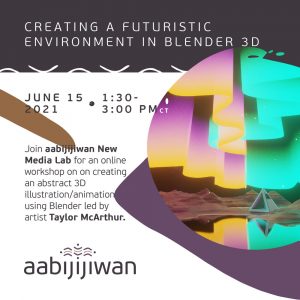
The new Aabijijiwan Media Lab is the first of its kind in Canada. Part of Winnipeg University, this space is a hub for new and established artists, housing four specialized labs as well as a collaborative studio space. These labs support community members through a range of digital maker equipment, from 3D printers and laser cutters to audio recording equipment and VR programming. The collaborative studio also serves as a space for intergenerational gatherings and working with physical-plane artforms, such as sewing, caribou hide tufting, and beading. They also run many online workshops, such as the one shown below, in both digital and traditional artforms. While these workshops are recorded, at the time of this post they do not appear to be accessible after the event has ended.

workshop with Aabijijiwan Media Lab

From CBC Indigenous:

Aabijijiwan’s first artist in residence is Scott Benesiinaabandan from Lac Seul First Nation in northern Ontario, who specializes in photography and is now focusing on augmented reality and virtual reality work.

“There’s going to be a lot of young artists with their first introduction to these sort of advanced technologies… It gives you that access, portability to technologies that we wouldn’t have otherwise and I think it’s going to be a very generative and fertile sort of place to burst new artists and new artistic ideas,” said Benesiinaabandan.


References:

Monkman, L. (2021, March 28). New Indigenous media lab at University of Winnipeg to help creators combine art and technology. CBC Indigenous. https://www.cbc.ca/news/indigenous/aabijijiwan-media-lab-winnipeg-1.5966433

Concordia’s Aboriginal Territories in Cyberspace (M2P1)

Concordia University’s Aboriginal Territories in Cyberspace (AbTeC) was established in 2005. It is a network of artists, academics, and technologists whose goal is to ensure Indigenous-populated spaces in Cyberspace. In 2017, Concordia shared a curated collection from AbTeC through an art show, Owerà:ke Non Aié:nahne / Combler les espaces vides / Filling in the Blank Spaces. This show “illustrate[ed] a multitude of ways in which Indigenous artists, researchers, educators, designers and community activists are creating and employing new media to strengthen and complement their cultures and communities” (Jason Edward Lewis, co-founder of AbTec, as cited by Dunk, 2017).
The AbTeC website includes a gallery of projects, both past and present. One of the projects, She Falls for Ages, was created by AbTeC’s other co-founder, Skawennati. The project’s website describes it as a “sci-fi retelling of the Haudenosaunee (Iroquois) creation story reimagines Sky World as a futuristic, utopic space and Sky Woman as a brave astronaut and world-builder.”
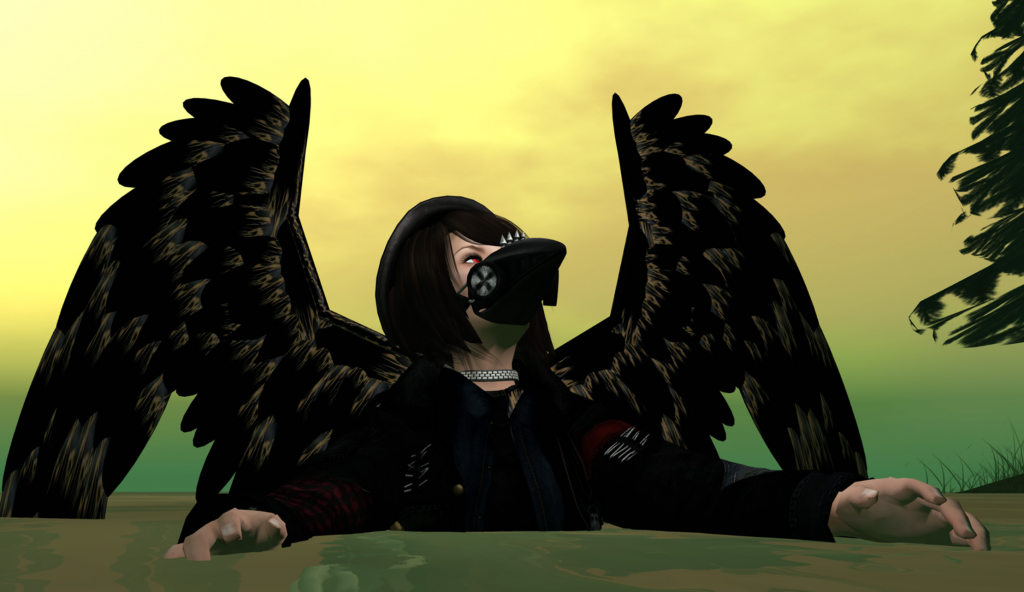
How the Loon Got Its Walk, created in a Skins machinima workshop

How the Loon Got Its Walk, created in a Skins machinima workshop at the MacKenzie Art Gallery

One of their ongoing projects is the Skins Workshop, which is part of their Indigenous Futures initiative:

The Skins Workshops teach Indigenous youth how to adapt stories from their community into experimental digital media, such as video games. One of our goals is to encourage our youth to envision themselves in the future while drawing from their heritage. We believe this helps to promote and preserve our stories, languages and cultures while also exposing our youth to the digital tools of today and tomorrow.

References:
Dunk, R. (2017, October 30). Indigenous digital art — past, present and future. Concordia University News. https://www.concordia.ca/cunews/main/stories/2017/10/30/indigenous-digital-art-leonard-bina-ellen-art-gallery.html


Decolonizing Teaching Indigenizing Learning (M1P5)

UBC has made a series of curriculum bundles for Indigenizing education. The subjects range from storytelling to STEAM.

These are not lesson-plans, but frameworks that could be adapted for your local community. Besides being an excellent toolkit, this resource can also serve as a model for curriculum design. Each resource includes clear connections to the First Peoples’ Principles of Learning and the BC Curriculum. They also provide important information for educators on how to use the frameworks in a respectful and humble manner.

Looking Back and Living Forward (M1P4)

I stumbled across this interesting book in UBC’s library database, Looking Back and Living Forward: Indigenous Research Rising Up (Markides & Forsythe, 2018). Grounded in pedagogy, this collection brings together a vast array of research done by and with Indigenous peoples from Canada and beyond. The book is available online, and you can download the PDF version.

Here is a short sampling of some of the chapters, and what curricular connections I can see them having:

  • History (Ch. 1: The Cold War, the Nuclear Arctic, and Inuit Resistance)
  • Culinary Arts (Ch. 7: Indigenous Food Sovereignty Is a Public Health Priority)
  • Computer Studies (Ch. 13: Channelling Indigenous Knowledge through Digital Transmission / The Opportunities and Limitations of Indigenous Computer Games)
  • Digital Citizenship & New Media (Ch 17: Canadian Cyber Stories on Indigenous Topics and White Fragility)
  • Art and Change-Making (Ch 26: Scaling Deep / Arts-Based Research Practices)

Bookcover


Reference:

Markides, J., & Forsythe, L. (2018). Looking back and living forward indigenous research rising up. Brill/Sense.

Art as Heritage Time-Capsules (M1P3)

In her short but poignant TED talk, Kayla Briët explains how she uses music and film to explore her identity and create artifacts of her multicultural heritage.

“I never felt I was enough — never Chinese, Dutch-Indonesia, or Native enough. Because I never felt I was a part of any community, I sought to learn the stories of my heritage and connect them together to rediscover my own.” [2:00]

It all started with a question: what happens when a story is forgotten?

An important aspect of Briët’s story is Hoop Dancing. Something I find fascinating about this tradition is how far it has travelled outside of the American Southwest, reaching youth across Turtle Island. In my hometown of Williams Lake (located on Secwepemc traditional territory, and close neighbours to both the T’exelcemc First Nations and the Xat’súll First Nation), Elder Francis Johnson teaches kids, both Indigenous and Non-Indigenous, the art of making and dancing with hoops. Meanwhile, a Potawatami and Cree teen is also keeping the dance alive with colourful LED hoops.

I bring this up because it makes me wonder about cultural remixing and appropriation, especially in regards to the Arts.

Here is the documentary that Briët made, Smoke that Travels:

For more on Briët’s work, here is a link to her official portfolio.


Reference:

Briët, K. (2016, October 28). Smoke That Travels (2016) [Video]. YouTube. https://youtu.be/jRJaCgMCohA

Briët, K. (2017, April). Why do I make art? To build time capsules for my heritage [Video]. TED. https://www.ted.com/talks/kayla_briet_why_do_i_make_art_to_build_time_capsules_for_my_heritage?utm_campaign=tedspread&utm_medium=referral&utm_source=tedcomshare.

CBC Kids News (2019, February 6). Rising Star: Hoop dancer glows in the dark I CBC Kids News [Video]. YouTube. https://youtu.be/mA5CPjOOqFo

CBC Kids News (2019, February 6). Rising Star: Hoop dancer glows in the dark I CBC Kids News [Video]. YouTube.

Williams Lake First Nations Hoop Dancer. (2016). YouTube. https://youtu.be/0wbRojVXF6Y.

Skateboards and Stories (M1P2)

An Albertan teacher made waves with his “sk8trepreneur” course in 2020. One of the class projects was on “Exploring Colonialism, Creativity and Reconciliation with Skateboards, [which] combines skateboard design with Indigenous history” (CBC).

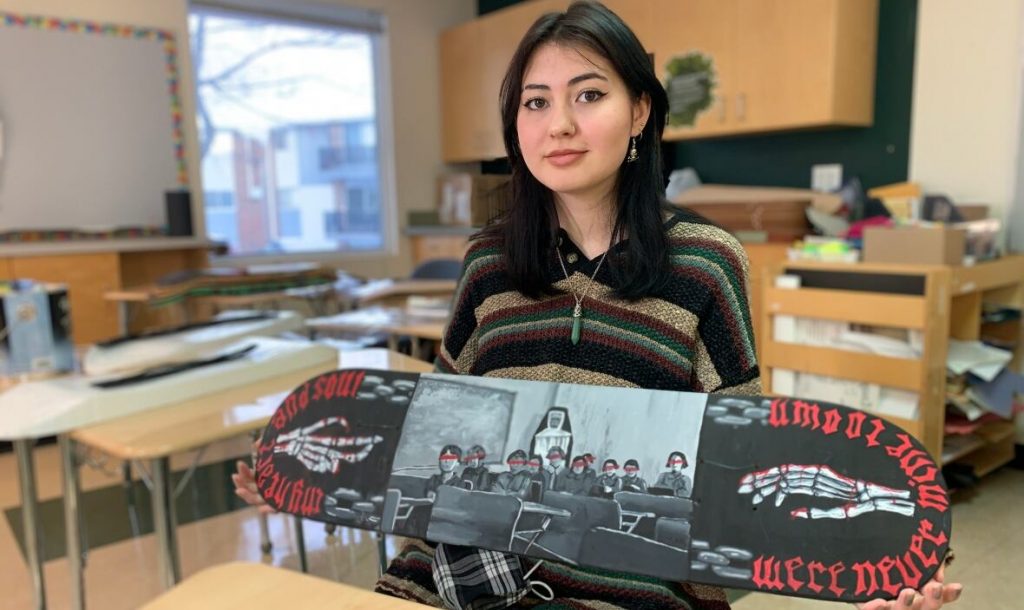
Kristian Basarada had his students create their own brands from the ground up, from defining their brand’s purpose to designing a logo. He teamed up with Cree artist Jon Cardinal and Cree professional skateboarder Joe Buffalo. Buffalo is also a residential school survivor and shared his experiences with the students. The project culminated in the students’ work being showcase at a local skateshop for over a month.

Grade 12 student Georgia Lantz displays her skateboard design. (CBC/Dave Bajer)

Grade 12 student Georgia Lantz displays her skateboard design. (CBC/Dave Bajer)

As a Digital Arts / Graphic Production teacher, I find Basarada’s project incredibly inspiring. He authentically ties together teen culture, history, maker-skills, and the community. Skateboards have a history of pushing the underrepresented out from under the rug of Mainstream Culture. Candian Dimension has an excellent interview with Micheal Langan, owner of Colonialism Skateboards. “Riding is resistance. Every kickflip, nose grind, or ollie in an occupied territory like Canada is an act of thrashing colonialism” (Sean Carleton, 2018).


References:

CBC/Radio Canada. (2020, November 29). Sherwood Park teacher wins GG award for course linking skateboard design, Indigenous history | CBC News. CBCnews. https://www.cbc.ca/news/canada/edmonton/sherwood-park-teacher-wins-gg-award-for-course-linking-skateboard-design-indigenous-history-1.5816784.

Sean Carleton. (2018, June 13). Thrashing colonialism: Skateboarding, history, and the power of education. Canadian Dimension. https://canadiandimension.com/articles/view/thrashing-colonialism-skateboarding-history-and-the-power-of-education.

– Laura Ulrich

Elders Gathering (M1P1)

In 2016, the annual Elders Gathering was held on the T’exelcemc traditional territory in Williams Lake. A live stream was recorded of the event. This gathering is especially important to me, as the speakers are Elders and leaders from my local community.

At [3:15:20] Chief Joe Alphonse speaks. He talks about his ancestral connections to the Chilcotin War in 1864, and about the monumental win of the Tŝilhqot’in Nation in gaining the first declaration of Aboriginal title in Canada. “It was not just a Chilcotin win, it was a win for all First Nation” [3:17:00].

I invited Chief Joe to my Career & Life class a couple of years ago. One of the most impactful pieces of wisdom he shared was the importance of being a warrior. Today’s weapons are different (education, words, and legislation), but the goal remains the same: to stand up for a better future.

I wish I had downloaded the second day’s video when it aired, as it was quickly taken down. I think the reason(s) why is an important point to discuss. YouTube said it was for “copyright infringement”. It was unclear if the algorithm flagged it, or if it was reported by an individual.

  • Was it because local Indigenous musicians shared their love of Elvis by singing his songs in their language?
  • Was it because some of the sacred dances’ origins are points of contention?
  • Was it because of protocols, or because someone disagreed with sacred wisdom being shared on a public platform?

To make matters worse, the file I had saved my favourite quotations on seems to have been lost in the ether. This just goes to show that while digital technology can be a boon (ex: allowing anyone to witness the Elders Gathering during/after it took place), our reliance on it can be dangerous, and lead to even greater losses of Indigenous Knowledge.

Note to self: backup MET notes as PDFs and print them, rather than leave them on the obscure mind-mapping program I have been using.

– Laura Ulrich