Author Archives: marwa kotb

Mod#4-post5: “Reimagine STEM” Podcast Episodes

Reimagine STEM is a four episodes podcast series discussing inter-disciplinary education and practice in engineering and computer science. It was created by a group of creative producers at the CoDesign Culture Lab, an event hosted by the ANU College of Engineering and Computer Science (CECS) in November 2019 as part of the CECS agenda to Reimagine how engineering and computer science serve the emerging needs of the middle of the next century. The episodes focus on four main themes:

  • Educational innovation
  • Computer science and engineering for social benefit
  • The need for diversity
  • Indigenous knowledge contributions

As I listened to the podcast episodes, particularly, episodes three and four, I realized more than ever the need to work collaboratively with Indigenous communities to widen our toolbox and integrate new knowledge as well as our need to develop with an eye on their local concerns. Below is the list of episodes and few notes on each. On the same page, you will find other podcasts interviewing each guest; some discuss work on the ground relevant to our coursework.

Episodes Key Highlights
Episode [01]: Engineering education for the future

-“Equity is we want to make sure that all different student populations are welcome, rigour as we want to teach something that has real content, scale is we want to make sure that we remove impediments that make us work at very large scales. “- Shriram Krishnamurthi

  • Discusses how to support the next generation of engineers and computer scientists and help them shape a better future.
  • Recommends educational approaches such as developing micro-credentials and using role playing games to tackle ethical issues in technology solutions.
Episode [02]: Engineering for social benefit

-“We don’t want to approach problems as engineering problems. We need to approach them as human problems.”  Cameron Tonkinwise-

  • Highlights that social benefit is at the heart of engineering and computer science.
  • Emphasizes the importance of understanding context, community needs, and actively consult and take a local direction in development processes.
Episode [03]: From diversity STEMs brilliance

-“There is a wealth of lived experiences and creativity that is either not invited in [the] fold in the first place or get squeezed out of the fold.” Cathy Ayres-

  • Explores the systemic barriers and stereotypes that stop minority groups including indigenous communities in computer science & engineering fields and how inclusion is key to creating a future we all want to live in.
Episode [04]: First Nations, first knowledge

– We need to start working together, in that two-way learning where Indigenous knowledges and knowledge systems and Western ways of engineering and computer science is an incredibly valuable collaboration.” Angie Abdilla-

  • Discusses how an effective, a holistic view, can cover a whole lifecycle of an intervention.
  • Provides a deep dive into Indigenous Knowledges and frameworks
  • Sheds the light on how society should learn to acknowledge and connect with some of the world earliest innovators, the Australian Indigenous people, to approach contemporary problems.

Reference:

Mod#4-Post4: The “Old Ways, New”

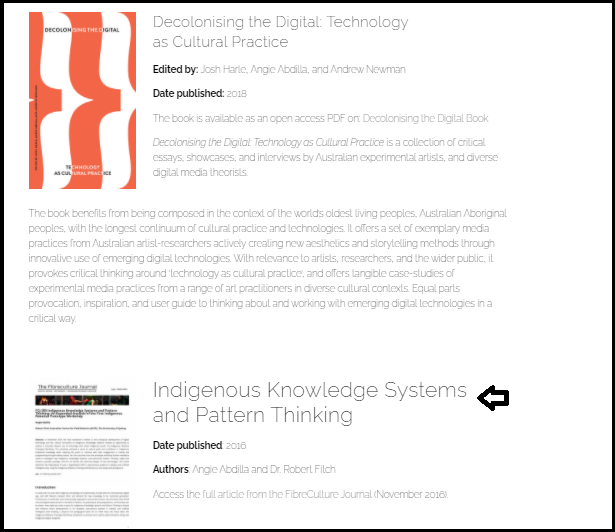
The “Old Ways, New” is a website for an Indigenous-owned and led social enterprise with a new vision and commitment to working with Indigenous cultural knowledge elders and communities to develop different ways of doing technologies. They are trying to find answers for: What can Indigenous Knowledge Systems teach us, and how can Indigenous and Western methods of knowing collaborate to shape how we adapt to and optimize technology solutions, particularly in robotics and artificial intelligence (AI)? Their work is informed by what they call the “country-based design” as well as the Indigenous pattern thinking. These concepts aren’t explained thoroughly on the site pages, but you can learn about them from the resources in their “publications and media” section. I found good resources for my final project such as “Indigenous Knowledge Systems and Pattern Thinking,” introducing Aboriginal youth to robotics using an Indigenous perspective and explaining “pattern thinking” as a possible paradigm for designing new technologies (See figure below). 

A Screen Capture of the “publications & media” resources in the “Old Ways, New” website

To get you more closer to the “Old Ways, New” vision, its goals, and their approach towards informing technological solutions. I am embedding an episode of the Social Lights Podcast (available also in the publications & media section), where Kate Vandervoort interviewed Angie Abdilla, the founder and CEO of the “Old Ways, New” about bringing indigenous wisdom into artificial intelligence. 

The following quote was exceptionally impactful for me as a technologist because I know how our work is inferior to such a prospect:“[The company] is not interested in sustainability in the Western sense, but from a very different perspective. From an indigenous perspective, it is the inherent interconnection of both social and environmental sustainability. [This belief] extends into how the company runs, in every decision made. If the relationships aren’t there, or aren’t strong in the first place, then nothing moves. [Ultimately], it always comes back to relationships. That’s really tricky because formulas and processing dominate [the technology] sector” (Social Mediology Pty Ltd, 2019, November 1st, 19:21).

References:

  • Social Mediology Pty Ltd.( 2019, November 1st). Indigenous Wisdom in Artificial Intelligence – Episode 4. Retrieved from https://www.youtube.com/watch?v=H7tJsFSBACg.

Mod#4-Post#3: Developing a native digital voice: Technology and Inclusivity in Museums

Link to the article: Developing a native digital voice: Technology and Inclusivity in Museums

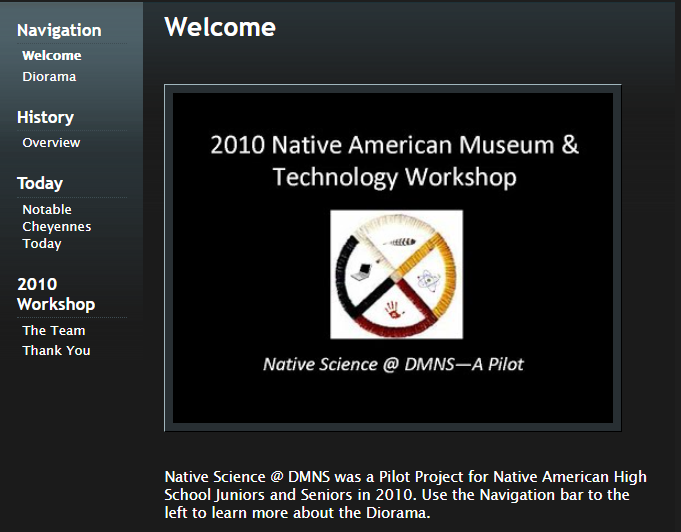
In 2010, at the Denver Museum of Nature and Science (DMNS), Pohawpatchoko, Colwell, Powell, and Lassos developed a two-week intensive workshop that brought 10 Native American high school students to create a working model for an interactive web interface to complement a diorama of a Cheyenne family in the early 1860s (Pohawpatchoko et al., 2017). At the end of the two weeks, the students created a working model, which they presented to their families and community members. Standing in front of their community was an act of bravery for many students and ultimately empowered them (Pohawpatchoko et al., 2017). Below is a capture of the student’s Google site (notice the students had no prior experience in web-based CS before the workshop). Even though the museum did not use the students’ digital model, still, the authors think that the experience was successful (Pohawpatchoko et al., 2017). They mentioned that the real point was that the project served Native community members: the project wasn’t about the museum; it was about the community. It provided “interns” with exposure to technical web skills, connectedness with their past towards their future goals, and a starting point for inclusivity to museum display approaches (Pohawpatchoko et al., 2017). Moreover, the workshop had positive outcomes on the educators who were learning along with their students. While reading about the educators’ experience, I thought it is connected the “Axe Handle Academy Model” expecting educators to become “the model of teaching and learning that the student studies” (Scollon & Scollon, 1986, p.92).

Screen Capture of Student’s Digital Model created in @DMNS Pilot workshop

For me, three significant aspects made the learning experience culturally responsive. Firstly,  the students were involved in “a real computing experience” (Pohawpatchoko et al., 2017, p.54) relevant to their lives; the project can be regarded as “a part of museum decolonization and reformation in the twenty-first century” (Pohawpatchoko et al., 2017, p.53). Secondly, the program features the importance of community connections. It was run by, for, and with Native American community members and involved elders, artists, scholars, and other knowledgeable tribal members. It also included cultural practices, such as talking circles, allowing the students and staff to share their experiences about living their Native American identities in today’s complex world. Thirdly, the program was grounded by cultural constructionism, which provides a framework for developing customized digital tools or curricula enabling marginalized groups to participate in technology. In the study, “Indigenous culture, museum studies, and computer science [were merged] under one umbrella” (Pohawpatchoko et al., 2017, p. 54). For my project work, I regard the article as an excellent example of  applying ethnocomputing. It also illustrates how the community connections are essential when applying culturally responsive approaches to broaden Indigenous youth participation in computing.

Reference:

  • Pohawpatchoko, C., Colwell, C., Powell, J., & Lassos, J. (2017). Developing a native digital voice: Technology and inclusivity in museums. Museum Anthropology, 40(1), 52-64. https://doi.org/10.1111/muan.12130
  • Scollon R.& Scollon, S.(1986). The Axe Handle Academy: A proposal for a bioreginal, thematic humanities education. Retrieved from https://www.uaf.edu/ankn/publications/index.php

Mod#4-Post 2: ancestral knowledge meets computer science education

Link to the e-book: Ancestral Knowledge Meets Computer Science Education | SpringerLink

I found about this book from our colleague Laura Ulrich. Thank you, Laura, for this outstanding resource. Sandoval (2019) presents a three-year research journey in which she worked closely with “Mr. Adams”, a teacher of European-descent, to explore intersections between computer science (CS) and ancestral knowledge across the school and non-school contexts. The introductory chapter introduces a new conception, “Ancestral Computing,” that investigates how to solve complex problems using socio-cultural and historical ecosystem approaches; thus, the connection was grounded in a robust and non-trivial community orientation. Sandoval (2019) argues thoroughly that computer science is one of the most segregated fields in education towards the experiences of Indigenous Peoples. She urges that Indigenous struggles must be at the center of knowledge production in computer science in order to create a sustainable and just world of producers and consumers. It key to note that Sandoval (2019) doesn’t reject technology in its totality; instead, she nurtures the interweaving of the two seemingly disparate worlds through Ancestral Computing. The formula is presented as follows:
Ancestral Praxis + Critical Computer Science Education Social Transformation” (Sandoval, 2019, p.61)

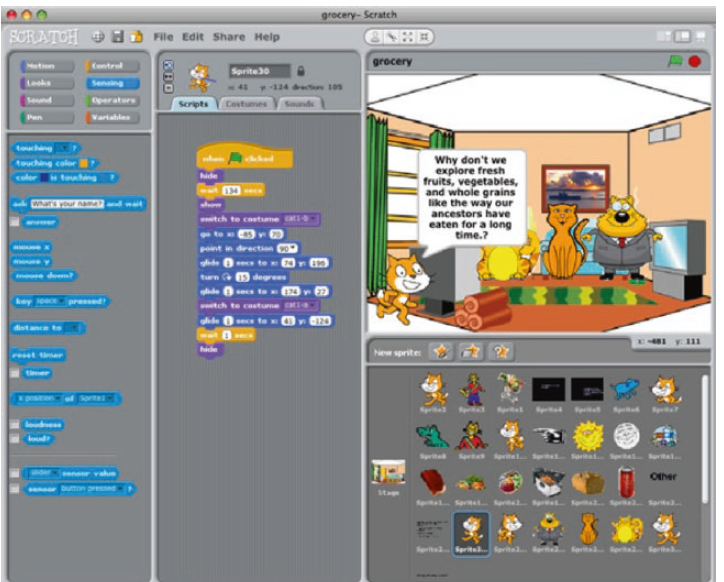
I was highly drawn to the learning journey of a high school student of Mesoamerican descent, Itzel, as she travels through the two worlds within the schooling spatial context of El Seren.  Chapter five details throughout Itzel’s participation how a student-led initiative can bring ancestral praxis with computing for social change (see the artifact that Izel and her partner Audrey did throughout the learning process). The journey continues as Itzel enrolled at the University of California and declares Communications as her major and Computer Science as her minor area of focus. When Itzel returned home, she decided to give back to her community and support Mr. Adams and his students to understand programming more (i.e., using the pre-existing cultural capital that exists within her local communities) (Sandoval, 2019).

A Screen capture of  the “Scratch final project, Itzel and her partner Audrey, ancestral foodways, DietSens, 2011” (Sandoval, 2019, p.144).

I will definitely employ this “healing” journey so -called in my final project as a space for resistance and hope; it successfully resists colonialism and bridges the persistent divide between ancestral knowledge systems and Eurocentric epistemologies towards dignity and imagining an equitable educational world in and for Indigenous communities (Sandoval, 2019).

Reference:

  • Sandoval, C. D. M., SpringerLink (Online service), & Springer Education eBooks 2019 English/International. (2019). Ancestral knowledge meets computer science education: Environmental change in community (1st 2019. ed.). Palgrave Macmillan US.

Mod#4-Post #1: Computing for all?: Examining critical biases in computational tools for learning

Article Link: Computing for all?: Examining critical biases in computational tools for learning

In the study, Litts et al. (2021) examined the affordances and constraints of a novice programming platform called Augmented Reality and Interactive Storytelling (ARIS) for community storytelling in a summer workshop with forty-seven Native American youth (38 fully consented to participate in the research). The indigenous youth built their place-based stories on a storyboard and then developed their games using ARIS. The researchers reported three cases underlying different narrative structures that youth used in their storyboards and the design process while using ARIS:

1- Branching narrative: In this structure, the students follow the linear flow where the player is guided from one element to the next. They were able to execute their game with ease as their structure aligned well with the logic embedded in the platform.

Screen capture of “Figure 2: group students work using the existing branching logic in the ARIS editor” ( Litts et al., 2021, p.850).

2- Sandbox narrative: In this narrative structure, the students desired to give the player a big open world populated with opportunities for exciting interactions. The player isn’t constrained to a rail-like linear plot but can interact with the world in any order that he/she chooses. While the idea is doable, however, it requires a certain level of familiarity with ARIS and computer science principles that the students lack. Thus, the students couldn’t work out their idea on the platform, and the result was a narrative that they didn’t initially intend.

Screen capture of “Figure 3: Visual representation of sandbox narrative structure” (Litts et al., 2021, p.851).

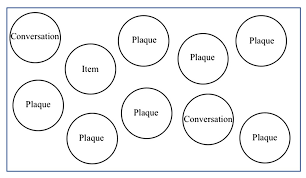
3- Hub-and-spoke narrative: it is a non-linear narrative tightly connected to the Indigenous culture. Also, here, the group of students couldn’t execute the game as desired (only completed one spoke) as the structure of the tool didn’t support the form of their narratives (Litts et al.,2021).

Screen capture of “Figure 4: Visual representation of hub-and-spoke narrative structure” (Litts et al., 2021, p.852).

The latter two cases explicate the epistemological tensions in this computational tool (its Western orientation), which negatively impacted these groups’ participation in computing. The message that stood out for me in the article is that “it is not enough just to broaden who participates in computing; we must also broaden the epistemologies and cultural practices that are valued within computing. As such, we must expand who designs tools in the first place” (Litts et al., 2021, p.853). The article is significant to my research project as it considers the design of learning tools as a core pillar in broadening the participation of Indigenous students in the computing field and reveals that more efforts are needed to design culturally responsive computational tools.

Reference:

  • Litts, B. K., Searle, K. A., Brayboy, B. M. J., & Kafai, Y. B. (2021). Computing for all?: Examining critical biases in computational tools for learning. British Journal of Educational Technology, 52(2), 842-857. https://doi.org/10.1111/bjet.13059

Mod#3-Post#5: Culturally Responsive Computing

Article link: Broadening Participation Toward Culturally Responsive Computing Education

“Improving academic success and social development by merging computational thinking with cultural practices.” (Eglash et al., 2013, p.33)

Culturally Responsive Computing (CRC) is a prominent framework in technology education that is based on the Culturally Responsive Teaching (CRT ) body of work and its three main pillars  : Asset building, reflection, and connectedness. Unlike Ethnocomputing, which I discussed in previous posts, CRC encourages participants to engage, reflect, and build together while challenging the status quo in computing..

In the given article, Eglash et al. (2013) claim that CRC can raise the interest of underrepresented groups in the technology field. They argue that cultural factors have a significant role in the underrepresentation problem of STEM and computing education and reject the cultural and genetic determinism myths. They stated, if children or teachers believe in these stereotypes, they can have real [negative] impact. Following this, they provided few approaches that are using the CRC framework and addressing the non-economic barriers to computing:

  1. The heritage culture of Indigenous knowledge: such as using patterns of the native American beam-loom tool.
  2. Vernacular culture: such as using music in the teaching of Python.
  3. Civic Culture in Computing education: such as using the cartesian structure of Navajo rugs to learn about coordinates in GIS.
  4. Hacking culture in computing education: such as designing new things with existing hardware, recycling motors from discarded printers, which in turn, raises the students’ awareness of the problem of “e-waste” (Eglash et al., 2013).

In their conclusion, Eglash et al. (2013) state that CRC is not only meant to enhance students’ achievements in tests but what is more vital is that it may help to develop a healthy self-identity in children “from devalued or disempowered ethnic groups” (p.36). Overall, the article complements several of Eglash and his associates’ work in ethnocomputing publications. However, with a new perspective (i.e., CRC) that encourages framing computing education into a social justice lens.

References:

  • Eglash, R., Gilbert, J. E., & Foster, E. (2013). Broadening participation toward culturally responsive computing education. Communications of the ACM, 56(7), 33-36.

Mod#3-Post #4: Culturally Situated Design Tools: Ethnocomputing from Field Site to Classroom

Link to the Article: Culturally Situated Design Tools: Ethnocomputing from Field Site to Classroom

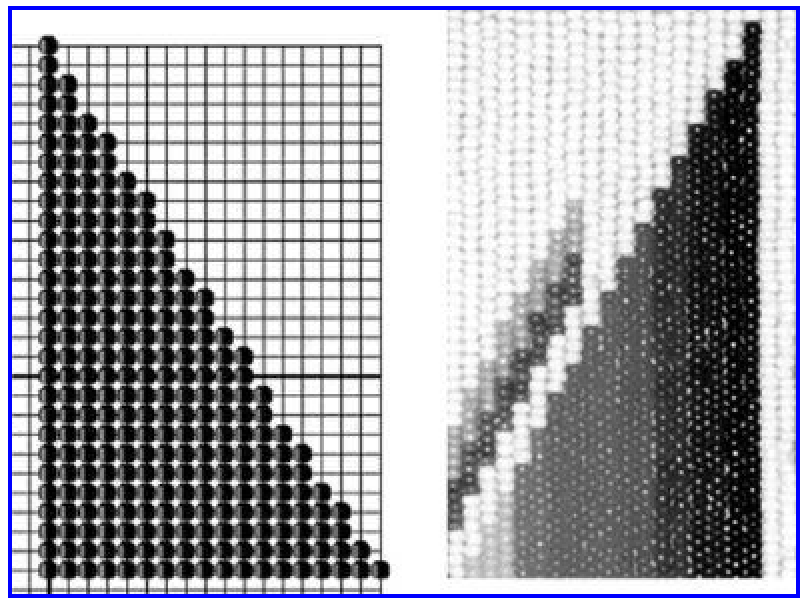
The article is one of the few empirical examples available in literature focusing on the design of culturally responsive computational tools and their impact on broadening the youth’s interest in computing. Eglash et al. (2006) commence their paper by challenging the myth that “we each have a specific culture, and that it is a given, static entity to which our personal identity is fused in a kind of mimetic relationship” (p. 348). They explain that the development of Culturally Situated Design Tools (CSDTs), their culturally responsive ethnocomputing software, is guided by four principles: “deep design themes,” “anti-primitivist representations,” “translation, not just modeling,” and “dynamic rather than static views of culture” (p.348-349). Their Native American design tools include “SimShoBan,” Yupik Navigation, Yupik Parka Patterns, Alaskan Basket Weaver, Navajo Rug Sim, and the Virtual Bead Loom (VBL). The authors describe the latter as a tool that connects contemporary vernacular culture and traditional heritage culture and at the same time it fulfills the curriculum requirements. They described several conflicts in the development process and the application of VBL in the classroom: Firstly, they reported a problem in the original program which was based on a standard “scanning algorithm,” as a result, they developed a second tool based on “Shoshone beadworkers” methods (see figure 1); they kept both designs for the sake of comparison between the approaches. Secondly, when VBL was introduced in Uintah-Ouray Reservation, the Ute group have recommended eliminating the black beads (i.e., regarded as bad luck in the community) from the VBL. As a result, they came up with a color mixer as a solution, which allowed users to create their bead colors. The authors regarded the tensions as “a two-way street, creating new hybrids in both machines and people” (p.356).

|Figure 1: “A comparison of uneven steps in a Virtual Bead Loom triangle (left) and even steps in Shoshone-Bannock beadwork (right).” (p.353)|

Following that, Eglash et al. (2006) reported statistically significant increases in students’ performance on math evaluations and their interests in IT careers. However, the most important outcome of their work was “the trialectic of computer media, math pedagogy, and culture [that] provides a meeting place in which the praxis of social change and the theory of cultural critique can generate new forms of hybridity and synthesis” (p.360).

Reference:

  • Eglash, R., Bennett, A., O’donnell, C., Jennings, S., & Cintorino, M. (2006). Culturally situated design tools: Ethnocomputing from field site to classroom. American Anthropologist, 108(2), 347-362. https://doi.org/10.1525/aa.2006.108.2.347

Mod#3-Post#3: Postcolonial Computing

Link to the article: Postcolonial Computing: A Lens on Design and Development

Research on broadening the participation in computing focuses mainly on culturally relevant teaching but rarely addresses the design and development of our tools. Postcolonial computing is a critical perspective asking questions about how technologies mirror the biases of humans that make or interact with them (Irani, Vertesi, Dourish, Philip, & Grinter, 2010). The authors consider it a mode of investigation in the process of design and analysis to expand the conversation around cross-cultural technology (Irani et al., 2010). The authors suggest four critical shifts in their HCI4D (Human-Computer Interaction for Development) approach that broaden the understandings of power, history, identity, and epistemologies. They present these fundamental shifts via cases of biases in technological design and development. Then, they suggest alternate formulations of design work, namely, engagement, articulation, and translation (Irani et al., 2010).

Some key points in the article that resonates well with my inquiry: 1- “Understanding the diverse forms design practice and contextual reasons for that diversity” (p.1319); 2- “embracing heterogeneity in design, rather than attempting to control or eliminate it” (p. 1319); 3- “staging of encounters amongst various stakeholders” (p.1319 ) rather than formulating the design as needs and outcomes.; 4- and recognizing that we aren’t designing “for static, nationally-bound cultures, but instead as interventions both in conversation with and transformative of existing cultural practices” (p. 1314). The key message I am taking from this article to my discussion of tools is that we need to dismantle the binary between technology and culture in the design and development process and investigate the intersections between them. Also, contexts and cultures need to be the starting point in design and development, rather than supplements to the initial model.

Few acronyms used in the article that haven’t been explained to the audience:- UCD (User-centered design), OLPC (One Laptop per Child), and ICT4D (Information and Communication Technology for Development).

Reference:

  • Irani, L., Vertesi, J., Dourish, P., Philip, K., & Grinter, R. (2010). Postcolonial computing: A lens on design and development. Paper presented at the 1311-1320. https://doi.org/10.1145/1753326.1753522

Mod #3-Post 2: Storywork, Making, Materiality and Robotics

Article Link: Storywork in STEM-Art: Making, Materiality and Robotics within Everyday Acts of Indigenous Presence and Resurgence

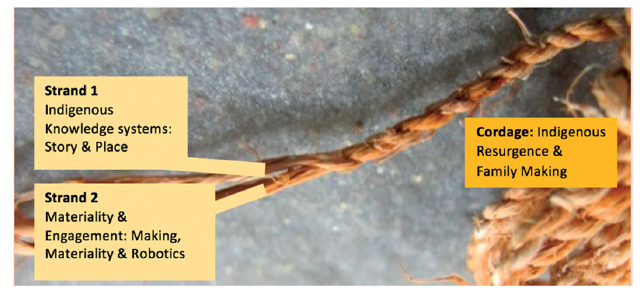
The family-based robotics workshop presented in the article is another recent example of integrating Indigenous approaches grounded in storytelling to enhance youth’s interest in the computing field. Also, after reading Kawagley and Barnhardt (1998) this week, I consider this article as exemplary of the merge between the Western and Indigenous system as the authors present Western technology and traditional knowledge as equal and complementary epistemologies. The figure below is the theoretical framework of their work; they conceptualized strand1 as the Indigenous knowledge systems and incorporated storytelling, teachings about identity, intergenerational place-based knowledge, and communal responsibilities. In the second strand (strand 2), they enacted making, materiality, robotics, and scratch founded by the constructionist view. They explain that as the strands twist and intertwine the cordage (used in the article to bring together these domains), each strand strengthens, and together, they enhance Indigenous resurgence, and the family and community end. The researchers reported that their approach allowed students to see computer programming and robotics as tools for creating, collaborating, and engaging in cultural practices (Tzou et al., 2019).

Theoretical Framework – The intertwining of Indigenous Knowledge Systems and Materiality and Engagement towards Indigenous resurgence (Tzou et ai., 2014, p.311).

Reference

Mod#3 -Post#1: Teaching Computer Science through storytelling

Manuscript: The Pathway to Achieving Classroom Equity: Computational and Critical Thinking through Storytelling and 3D Models

An example of a culturally relevant teaching (CRT) approach to introducing Indigenous youth to computer science education is the “Storytelling project” that is currently a work in progress by researchers at Montana University. The project aims to support equity in the classroom via a teaching approach that combines Indigenous narrative “Storytelling” with computer science (CS) components and the goal is to help increase the American Indian’s participation in CS majors (do Amaral & Windchief, 2019). The target audience is middle school students in Montana tribes. The tool is Alice, an object-oriented drag-and-drop programming environment that has already proven to be successful in engaging and retaining diverse and under-served groups in computer science (do Amaral & Windchief, 2019).

The authors state that the oral tradition has historically been the means by which tribal communities teach one another about the world around them, and it continues to play a significant role today (do Amaral & Windchief, 2019). There is considerable work with indigenous science (traditional ecological knowledge, for example) being done at tribal colleges and with indigenous scientists, but they haven’t found anything specific to computer science. Animation aligns well with storytelling, so with the young learners. Thus, it may promote the youth’s interest in CS while using the coding platform to construct their stories (do Amaral & Windchief, 2019). The researchers reported that they consider the messages and symbols of the American Indian stories and enact the seven essential requirements of the Indian Education for All Act (IEFA) in their analysis of the culturally charged material to avoid any unintentional bias in their lessons and activities (do Amaral & Windchief, 2019). Currently, they are developing several lesson plans and online modules to share with educators. Once they are finalized, the materials will be available on the website: http://www.montana.edu/storytelling/. Below is the project presentation:

Teaching Computer Science through Storytelling (Videohall.com, 2018, April 24)

References:

  • do Amaral, B., & Windchief, S. (2019). The pathway to achieving classroom equity: Computational and critical thinking through storytelling and 3D models. Educational Research: Theory and Practice, 30(1), 62.
  • VideoHall.com (2018, April 24). Teaching Computer Science through Storytelling

    . retrieved from https://vimeo.com/266368518