Author Archives: marwa kotb

Mod#2-Post#5:The Future Imaginary

After completing the first module I realized that the current technology productions are in conflict with Indigenous culture. The questions that I had in mind: How is it possible to change that? How can an Indigenous led-space exist? How can engines and system be coded from an Indigenous worldview? Here I came with the core idea of my project: There is an urgent need for Indigenous people to be part of the future of this industry. It’s a mission that’s crucial not only for Indigenous people, but for anyone who wants a better, more inclusive technology.

Inline with the aim of my project inquiry, in the following TEDX (2013, September 30) production, Jason Lewis talks about the future imaginary for Indigenous communities (see the Initiative for Indigenous Futures [IFF] if you wish to know what this talk relates to). He warns that the lack of representation in technology sector (i.e., design and development) would lead to future made for Indigenous people rather than with them (7:13) and he adds that Indigenous absence from the technology world “implies at best lack of importance and at worse lack of existence” (7:26). These threats made him to work in collaboration with his colleague Skawennati Tricia Fragnito to create Aboriginal Territories in Cyberspace (ABTEC), which hosts the Skins workshops, where indigenous youth engage with the technical and creative aspects of digital media so “they become creators of technology rather than just consumers” (8:35). He emphasized that the importance of such effort is to “seed” into the Indigenous youth minds that they are also capable “to bend complex technology to their own ends” (9:08). He draws the attention that technology structures and systems reflect their builders’ perspectives and “affect us all” (12:57), and that “native people need to get involved in the building of these structures” (13:05). By that, Indigenous participants can increase the assumptions (epistemological/ cultural) upon which the technology systems are based and also the involvement will enable the indigenous people to “colonize some that future imaginary for [themselves]” (13:16). He ends his talk by stating that he asks his students to keep in their minds three questions while designing the future: “Whose past? Whose Present? Whose future?”(14:46), which I believe a message for youth to enact the future with and through their own identities/histories/cultures.

Here is a link to publications of Jason Lewis: Jason Edward Lewis — publications (jasonlewis.org)

Reference:

Mod#2-Post# 4: Ethnocomputing with e-textiles for broadening Indigenous youth participation in Computing

Research title & link: Ethnocomputing with electronic textiles: Culturally responsive open design to broaden participation in computing in American Indian youth and communities

Kafai, Searle, Martinez, and Brayboy (2014) used Eglash’s ethnocomputing concept in an intervention using e-textiles, with the Lilypad Arduino sew-able electronic circuits, leveraging traditional sewing and decorative beading to learn about computing. They reported that while the activities were intended to be linked to Indigenous culture, not all the students were interested in these links, and sometimes students lacked the cultural knowledge that the activities were supposed to connect to. They note complex issues here: “Craft, like many other types of Indigenous knowledge, is rooted in particular places and connected to activities that extend beyond the space of a classroom and a computer screen. For instance, when we think about integrating community basket weaving practices with e-textiles materials, we know that there are certain times of the year during which reeds for making baskets can be collected. We also know that particular designs have cosmological significance, ties to origin stories, and are expressed within local aesthetic frameworks. Knowledges of these designs is not something that can be learned by anyone, but something that the learner must be prepared to know, coming to understand the responsibility that comes with such knowledge and the protocols for appropriate use.” (p. 245)

Kafai et al. (p.243-244)

In conclusion, the researchers advocated that Indigenous students be given agency in order to construct computational designs that are relevant to their interests and identities (Kafai et al., 2014). They added that it is crucial to place the computer science learning in the context of Indigenous knowledge, so students can connect what they are learning to their history and emergence of their communities in ways that can meaningfully broaden participation in computing (Kafai et al., 2014).

Reference

  • Kafai, Y., Searle, K., Martinez, C. & Brayboy, B. (2014). Ethnocomputing with electronic textiles: Culturally responsive open design to broaden participation in computing in American Indian youth and communities. SIGCSE 2014 – Proceedings of the 45th ACM Technical Symposium on Computer Science Education. 241-246. DOI:10.1145/2538862.2538903.


Mod#2-Post#3: IDMT-Indigenizing Computer Programming

While looking for programming environment developed with indigenous views or languages, I found the research paper ” Indigenizing computer programming for cultural maintenance” that I believe will innovate computer programming and Indigenous digital design. For his doctoral research, Corbett (2018) is working on the development of a toolkit that will unite Indigenous cultural components with natural programing language, an Indigenous Digital Media Toolkit (“IDMT”) he calls it. Corbett (2018) explains that IDMT is “a programming language with a specialized user interface that uses the Cree language and syllabic writing system to programmatically create digital artworks and provides a digital foundation for the maintenance and/or revitalization of Indigenous culture” (Corbett, 2018, p.243). He adds that IDMT also contributes to the reconciliation process (Corbett, 2018).

An important point that he mentioned about his development is that he considers the design of technology at a deeper level. I want to explain why this point is essential in computer science education for Indigenous students. Most of the modification done in culturally responsive programming tools (part of my investigation for my final project), whether visual platforms (e.g., CDSTs, Alice, Scratch) or the translated environments that are used in educational/ work contexts encounter surface changes such as modifying the language, the context the tool is presented in, or the design of the computing activities themselves. However, none of these developments have entirely escaped from the legacy of the industry and the Western-coded engines/system. In turn, Indigenous students’ self-determination in design and development and possibilities of self-expression are still very limited by the pre-existing system. IDMT is the first programming language that goes to the next level as it addresses the “underlying culture as an inherent component of the coding language itself” (p. 244).

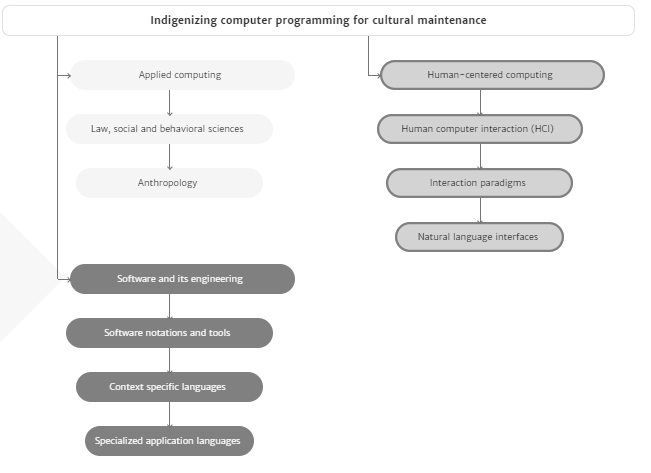
IDMT Model (Corbett, 2018)

Reference:

Mod#2-Post #2: Ethnocomputing

One of the main approaches to Culturally Relevant Teaching (CRE) in computing is called ethnocomputing. Tedre, Sutinen, and Kähkönen (2006) argued that computing is not culturally neutral (i.e., culturally informed by the Western ideals). Thus, computing should be taught using techniques that consider the cultural context of the user. Ethnocomputing was born from this premise and suggests that computing principles should relate to the learners’ cultural framework (Tedre et al., 2006).

In the following video, Dr. Ron Eglash one of the pioneering researchers in ethnocomputing and heritage algorithms and also one of the primary contributors in CDSTs (Culturally Situated Design Tools, there are interesting activities related to the Native American beading and quilting in CDST site) talks about his research in the field of ethnocomputing and algorithms found in Indigenous and ethnic communities through their arts and crafts, architecture, dance and cultural rituals.

One important quote that stood out for me is “Science and technology are done differently in these Indigenous traditions than they are in Europe. Europe is all about economies of extraction so science and technology are specifically created for the purpose of extracting value and carrying it off elsewhere to a corporation or a colonizing nation. In these Indigenous cultures, their science and technology were developed for the purpose of preventing extraction and emphasizing sharing and the circulation of value in this unalienated state.“(PreparationTech, 2020, November 21, 15.45)

Some important recommendations that Eglash stated about how ethnocomputing is applied in teaching Indigenous youth : 1) Use non-coding activities to introduce youth to computing: weaving, quilting, beading, etc. (11.19). 2) Teach youth how Indigenous knowledge has powered today’s science and technology (14.26). 3) Teach students about the cultural background (22:43) (i.e., there is historical background in CDSTs before commencing with related programming / mathematical activities). 4) Provide students both the opportunities and agency in a context of social justice (31:55) (PreparationTech, 2020, November 21)

References:

  • PreparationTech (2020, November). #PreparationTech: Teaching Kids how coding is in hair braiding, quilting, weaving and Latin Music

    . Retrieved from https://www.youtube.com/watch?v=mM3eMpgnjcE&t=54s

  • Tedre, M., Sutinen, E., Kähkönen, E., & Kommers, P. (2006). Ethnocomputing: ICT in cultural and social context. Communications of the ACM, 49(1), 126-130. https://doi.org/10.1145/1107458.1107466

Mod#2 post#1: “Giving back” motivates Native Students in Computer Science

While I was looking for resources for my final project, “computing and Indigenous Youth,” I found a recent article inside the AISES (The American Indian Society of Science and Engineering) 2021 Spring Edition entitled “What motivates Native computer science students”. The publication discusses ongoing research held by researchers from TERC to understand what promotes and what hinders Native women and two-spirit individuals’ persistence in computer science (CS) majors (Terc, 2020, June, 29).

When interviewing the Native students, all participants talked about the importance of giving back, even though they were never directly asked about this topic. Through their CS education, the students think they can build their nations and strengthen their communities (Aises, 2021, May 4). For example, by bringing their culture into new productions using their Native identity and scientific knowledge, reciprocating what they learned for cultural preservation, and teaching their Native community members about cyberbullying and ways to protect their identities (Aises, 2021, May 4). Also, several students discussed that they use their culture as a source of resilience and strength to stay in their CS majors and wanted to challenge stereotypes of Native individuals not being capable of being persistent in CS education (Terc, 2020, June 29). They suggested that early exposures and experiences are helpful; reaching out to Native students as early as middle school for on-and-off campus CS activities can promote Indigenous youth interest in computing (Aises, 2021, May 4). Though the study involved undergraduates’ students, I believe the idea of “giving back” might apply to motivating youth as well.

References


Mod#1-Post 5: Coders North: Online coding for Indigenous youth

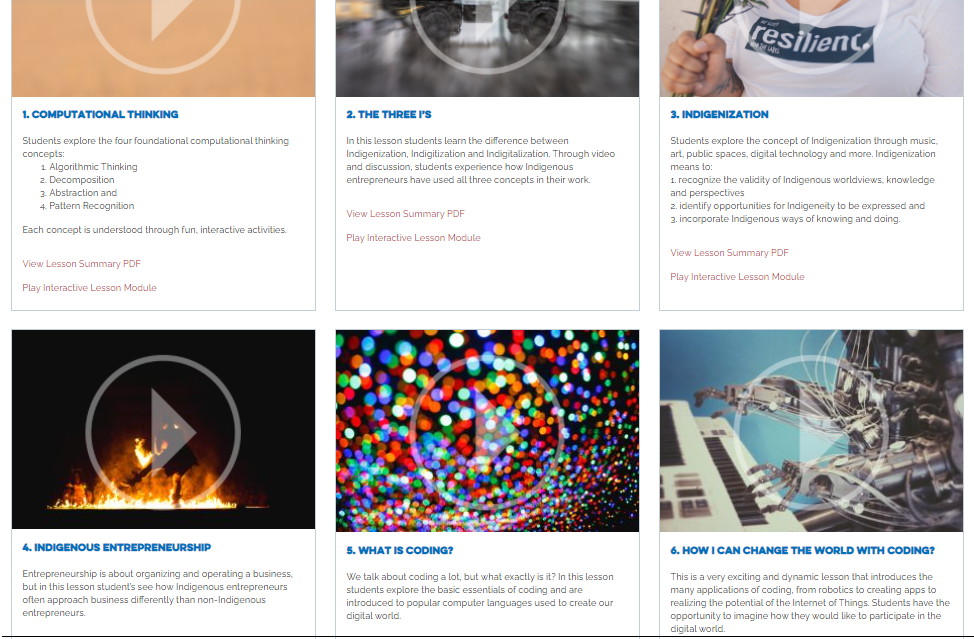
For my final project I am interested in researching means to attract and involve Indigenous students in computing education. Coders North is an online platform developed by Elephant Thought to empower mainly Indigenous youth with the knowledge and skills that help them to create the web and digital world with content that reflects their identities and cultures; It is part of the Government of Canada’s CanCode program. The website also serves as a resource for educators and their students to share, learn, collaborate, and celebrate coding and the digital world’s Indigenization. It includes three main links:

1- Learning Modules

A set of interactive lessons that speak to Indigenous entrepreneurship, successful role models, computational thinking, coding and much more. These lessons are designed for grades 8-12 and are free to use for any educator interested in incorporating them into their class.

Screen capture of learning modules (Coders North, n.d.).

2-Student Showcase

A multimedia showcase of Indigenous and non-Indigenous student-led projects exhibiting intriguing and innovative concepts ranging from music to storytelling to sports and beyond. You will notice that projects created by Indigenous adolescents, as well as youth from marginalized and at-risk communities and situations receives a lot of attention.

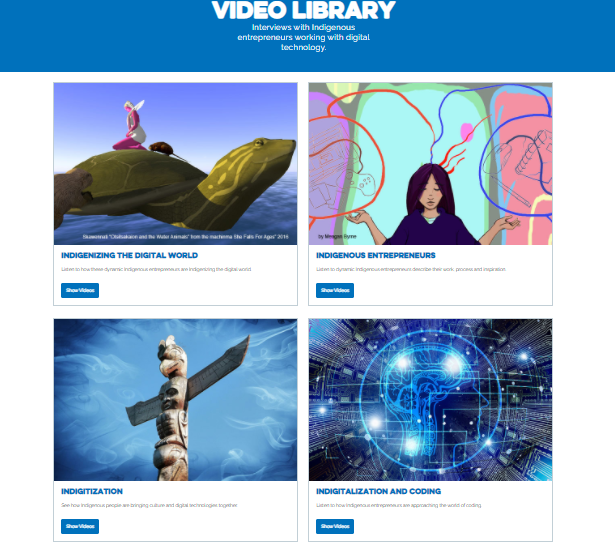
3- Video Library

It includes artists, web designers, coders, app designers, gamers and contributors on the Coders North site talking about how they participate on the cyberspace in purposeful way to support the Indigenization of computing field such as: a Métis game designer Meagan Byrne and Metis coder Jon Corbet (he is the presenter of Indigenizing computer programming for cultural maintenance , also the developer of a morphemic computer programming language “Cree#” based on the Cree language and syllabary). I would like to note that the video content is not technical.

Screen capture of Video Library (Coders North, n.d.).

Reference

Mod#1-Post#4: Two-eyed Seeing Approach

One key insight that I gained throughout this first module is that culture matters. As such, I am curious to learn more about the integration of indigenous culture in instruction design and the classroom practices. While exploring this topic, I came across “Two-eyed seeing” concept, developed by Mi’kmaw Elder Albert Marshall. It is a culturally responsive approach to learning in which students learn to see from one eye with the strengths of Indigenous knowledge and methods of knowing, and from the other eye with the strengths of Western knowledge and methods of knowing (The Green Interview, 2019, January). In his interview with Silver Donald Cameron, Marshall says the concept was initially used with the youth in his community, “to look at everything from another perspective” and constantly learn from one other. He adds: “The fundamental principles of two-eyed seeing are not meant to question the integrity of something, of an action, of a word but rather to encourage you to put your curiosity in a higher gear, invoke that curiosity so that you can fine-tune this action or this word to be much more reflective so you will be that much more effective as a community member or a nation.” (The Green Interview, 2019, January, para.6). I believe the incorporation of approaches like this may help all students, educators, and professionals better understand and appreciate Indigenous values, learning styles, and traditional ways of knowing. Below is the YouTube video of the interview.

References

Mod#1-Post#3: Using the Medicine Wheel for Curriculum Design

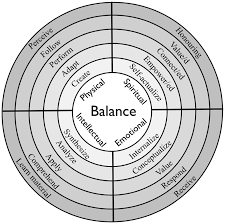
After listening to Dr. Lee Brown’s thoughts about the Native medicine wheel and emotions, I searched for publications about the incorporation of the medicine wheel in education. I found an interesting article entitled “Switching from Bloom to the Medicine Wheel: creating learning outcomes that support Indigenous ways of knowing in post-secondary education,” through which the author, Marcella LaFever (2016), suggests a new framework that expands Bloom’s three domains of learning to a four-domain structure based on the Medicine Wheel’s four quadrants. The proposed model has the fourth quadrant, spiritual, deemed as essential for balance in curricular design that supports students’ learning goals (see figure 1).

Four-domain framework from (LaFever, 2016, p.417)

According to LaFever (2016), the four-domain model is a good place to start when responding to Canada’s Truth and Reconciliation Commission’s call to action (i.e., call to action number 62 [ii] asks educational institutions to educate teachers on how to integrate Indigenous knowledge and teaching methods into classrooms and to utilize Indigenous knowledge and teaching methods in classrooms (Truth and Reconciliation Commission of Canada, 2015, p.7)). Also using the Medicine Wheel for curriculum design in education is a step that every educator, across all disciplines, can take to indigenize their teaching practice (LaFever, 2016).

References:

Mod#1-Post #2: Issues in Indigenous Digital Heritage Projects

Digital technologies offer avenues for preserving Indigenous knowledge and making it accessible to future generations of Indigenous people. Besides, documenting Indigenous knowledge in digital form may encourage native-language education, universal literacy, and open up possibilities for online education, study, and publication. With such prospects, several educational institutions and university researchers had stepped to collaborate with Indigenous communities to create digital heritage projects. However, as noted in the Returning to Gitxaala video we came across in our second discussion, some researchers were inconsiderate of the Indigenous people who supported them along the way with their project/ research work. A statement that captured my attention in the production is that “people come to ask for things…and then leave” (Menzies, 2020, February 28); a resentment of Indigenous people who opened their homes and provided their time, resources, and stories, yet their efforts were not valued.

In line with this issue, in this post, I am sharing a recent publication entitled “Digitizing the Ancestors: Issues in Indigenous Digital Heritage Projects” citing five digital projects that failed to adhere to Indigenous cultural protocols. The author stated that these digital cultural heritage projects were held by university researchers (Christen, Ridington, and Hennessy; Shorter, Srinivasan, Verran, and Christie) between 2002 and 2007 in collaboration with Indigenous communities in Australia, Mexico, USA, and Canada (Stratham, 2019). Despite scholars are citing this work focus on the perceived benefits of the collaborative design process, yet, currently, these projects aren’t functioning as designed. They became software pieces that are “unusable to the community” (Stratham, 2019, p.3732) due to problems related to software security (i.e., Adobe Flash) and financial sustainability. The author warns that such situation is incongruent with the respectful research protocols and may lead to an unwillingness among many Indigenous people to allow their traditional knowledge to be accessible in the digital spaces. In her conclusion, Stratham (2019) called that the sacred cultural heritage of indigenous communities should not be left with stewards who aren’t committed to ensuring its survival. Until there are international standards that ensure that such projects will be safeguarded against the frequent technological changes, researchers working with Indigenous communities should have a digital maintenance plan for digital heritage projects before setting off their new research work.

References:

  • Strathman, N. (2019). Digitizing the ancestors: Issues in indigenous digital heritage projects. International Journal of Communication, 13, 3721-3737.

Mod#1-Post#1: Reversing the Trend-A glimpse at Pioneering Indigenous Technologies

The readings in this module demonstrate that the mainstream technologies are not culturally neutral. It has been argued that the web’s values reflect its builders — primarily Western and do not represent Indigenous perspective. As such, I desired to research innovations that reverse the trend.  Below are three notable developments representing local contexts and addressing the specific needs of  Indigenous cultures. One keynote the development process has Indigenous communities’ involvement at every stage of the technologies production (i.e., check the references for more information).


[1] #thisismymob

It is a smartphone application developed by researchers in the Engineering and Information Technology faculty at the University of Technology Sydney. According to the project’s director, Christopher Lawrence (2018, August 1), the project was inspired by the idea of “postcolonial computing.” It employs participatory design to grant the technology design is culturally relevant and accessible to the Australian local context.

(NITV News, June 19, 2018)


[2] SIKU

It is an Indigenous Knowledge Social Network (SIKU) smartphone application released in December 2019. The app was created by the Nunavut civil society group Arctic Eider Society with funding from the 2017 Google.org Impact Challenge. It is named after the Inuktitut word for sea ice (UNESCO Courier, 2019). The app aims to keep Inuit communities updated about sea ice conditions while hunting or traveling and recording and exchanging comprehensive traditional information and language amongst community members in a way that engages the younger generation (Arctic Eider Society, 2019, December 4). One important note about this app is the specialized privacy setting that ensures that Indigenous knowledge of its Indigenous users remains protected (Arctic Eider Society, 2019, December 4).

(Arctic Eider Society, 2019, December 4)


[3] When Rivers Were Trails

It is a 2D adventure educational game focusing on the impact of assimilationist allotment acts of the 1890s on the Anishinaabe community. The game is developed by Elizbeth LaPensée in collaboration with Games for Entertainment and Learning (GEL) Lab at Michigan State University and officially released in 2019. According to LaPensée (2021), “games can [be used to] express Indigenous cultures through self-determined representations” (p.293). The production combines indigenous ways of knowing, themes, and story-telling formats, such as non-linear paths that mimic conventional story-telling systems, utilizes indigenous characters, and places games in historical contexts.

(SGSChallenge, 2019, November 6)


References