Author Archives: SASHA PASSAGLIA

M2. P5.

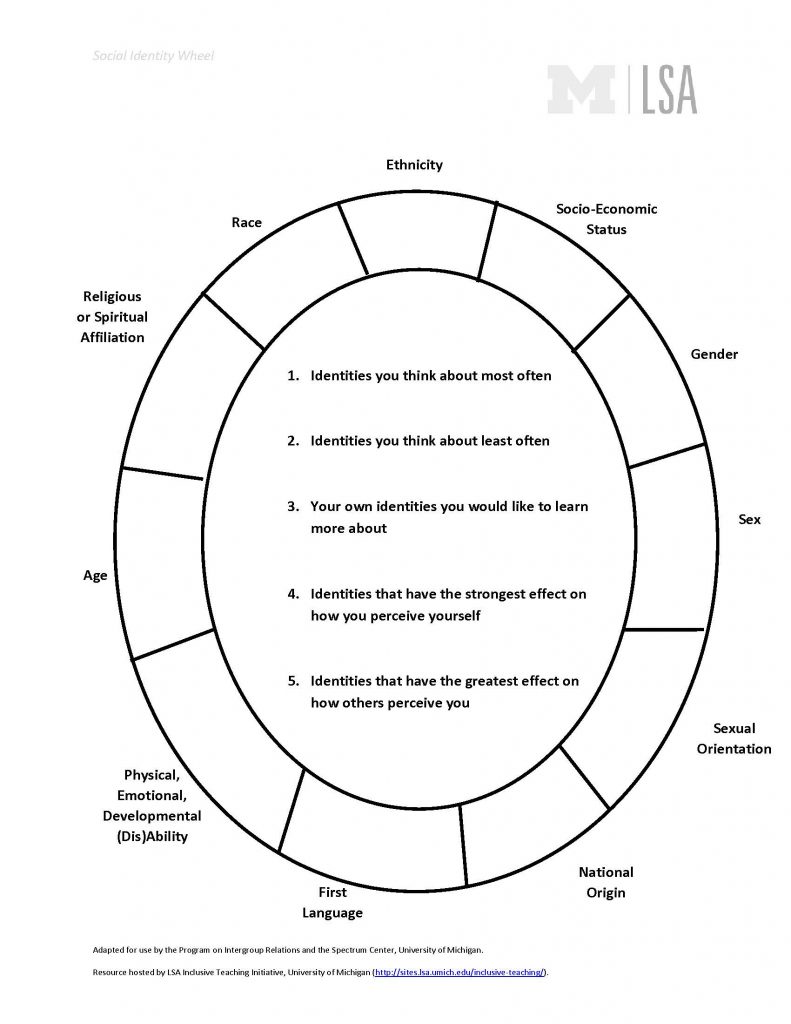
The following are Identity-based activities from the University of Michigan’s Inclusive Teaching site. Although not developed based on the FPPL, I believe that they would be valuable activities to do with students to begin the conversation surrounding who they are and how they see themselves. Even though the site doesn’t state any relation to FPPL, these activities are labelled as “Personal Identity Wheel,” and “Social Identity Wheel.” It immediately creates this connection to Indigenous ways of knowing and learning from the term “wheel” which I can connect to circles, which we know are incredibly important to Indigenous culture as they relate to the cycles of the natural world.

A note on the last image here – there is language and terms that I would absolutely refrain from using as they are negative in nature. I would even remove the “body size” category and ensure that Gender/Sex had appropriate examples that were inclusive of all.

M2. P4

The FNESC which stands for First Nations Education Steering Committee has an incredible website with tons of valuable knowledge and resources for Educators. If you click on the image below, you will be taken to a PDF of authenticated First Peoples resources along with documents to help you or your school evaluate the authenticity of resources you find or bring into your building. As I’m focussing on Identity, I loved how each resource is annotated in-depth with information about all the authors, the retelling, Indigenous Language used, and features of the resource such as if it includes a teacher guide.

M2. P3

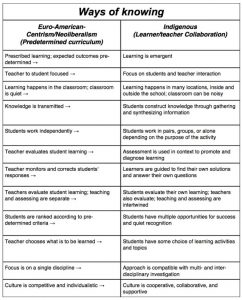
Whenever I develop Units, I’m always thinking about the end goal first. What is it that I want my students to know and what should they be able to do. However, after viewing the Ways of Knowing chart in my previous post, I can see that part of the assessment is also student-focused (and I do currently include my students in their assessment) where they evaluate their own learning.

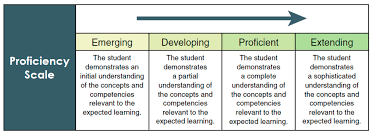
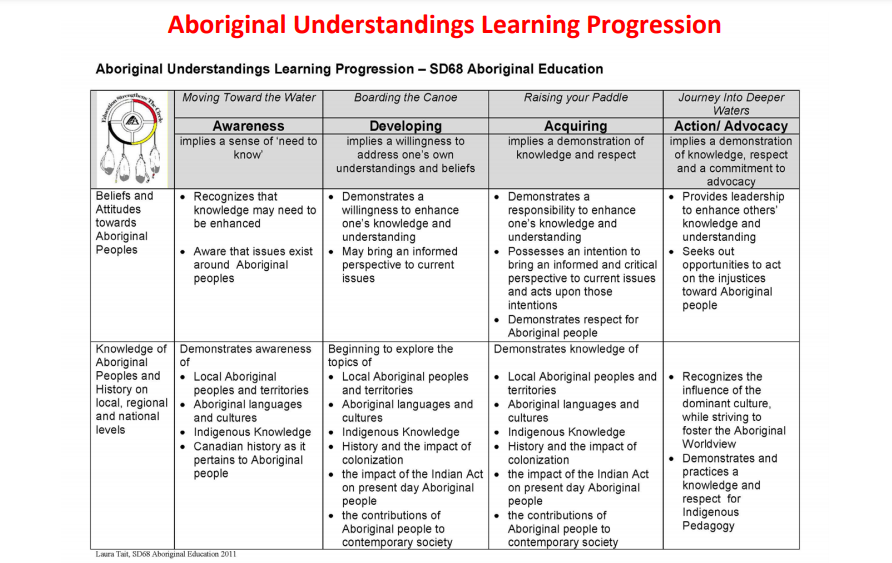
As I was researching Indigenous ways of knowing, I came across a rubric developed in SD68 along with input from FNESC and their Aboriginal Department. It speaks to beliefs, attitudes, and knowledge towards and of Aboriginal Peoples. What I love the most is how this isn’t labelled a scale but instead, a progression as one of the FPPL is that learning involves patience and time and is not about expected learning, but instead focused on experiential learning. In my district, we have a Proficiency Scale for assessment for reporting which, after reading the differences in Euro-centric views vs Indigenous in my last post I can see clearly how they do not align for Indigenous Understandings of learning.


M2. P2

In a video that I watched recently titled, “If not here, where?” the speaker said, “Success for me is when we don’t need Aboriginal Education, we just have Education.” This reminded me of how we decide assessment or the “how will we know they get it” part of our lessons and units. It speaks to the future date of how will we know the Government gets it in terms of reconciliation and I think it’s a powerful phrase that needs to be shared.

The image below is something I came across while reading the Aboriginal Resources Guide from the Surrey School District. I think this visual is really important for us and our students to see the differences and begin to practice them within our everyday lives.

Surrey Schools

Link to video here

M2. P1

I’ve been spending a lot of time reframing my final project platform and topic to focus solely on developing a Unit that speaks to the First People’s Principle of Learning; How learning requires exploration of one’s identity

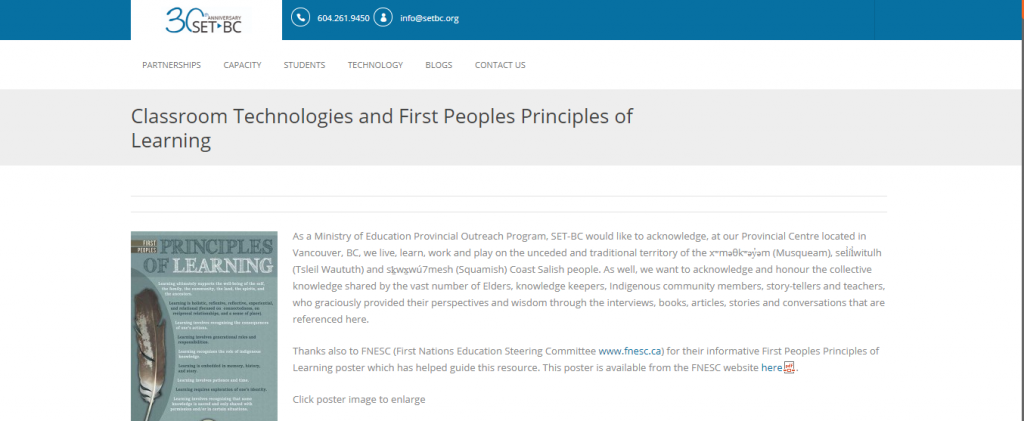
On my search for resources into how best to develop education around this principle, I came across a number of fantastic readings/videos, and sites. The first is from SET-BC which is a Ministry of Education Provincial Outreach Program which was created to “assist school districts in educating students who require or would benefit from using technology to access the curriculum.”

What I was most interested in was their Blog page which is where I found a post titled, “Classroom Technologies and First People’s Principles of Learning.” On this page, it provided a series of Modules that focussed on one particular principle. Each module includes audio, video, resources, and a breakdown of the content which can be used to fit your classroom. You can view the page by either clicking HERE or you can scroll through it below – EDIT (apparently iframes are not supported on this blog although I have used them many times before…so you can just see what the front page looks like instead or click above!)


M1. P5

The following question was posed under the Theme of Decolonization, Intellectual Property Rights, Virtual and Actual Reality:

Indigenous peoples are diverse, but they share the common experience of being colonized by western and imperialist powers. Can technology be useful in supporting Indigenous communities’ efforts to de-colonize values and thoughts?

This is a topic that I am most interested in, especially how oral tradition and story can be integrated with technology so that it doesn’t lose the authenticity and voice of a face-to-face sharing of lived experiences.

The paper below is one that I have found invaluable in this endeavor and spoke to an interactive mapping tool. This made me connect back with an introduction to Thinglink from Jorden Habib in her Introduction Post on Canvas.

You can read the paper HERE and learn more about Thinglink HERE – or you can watch the video below.

– Sasha Passaglia

M1. P4.

InStem: Indigenous Youth in Stem. I came across this program a while back when I was researching Women in Stem opportunities and organizations. I quickly realized that if women are being challenged with finding opportunities in STEM careers, that Indigenous Women are probably having an even harder time.

This particular program focusses on Indigenous Youth and provide a for-CREDIT land camp where instructors integrate STEM content with land-based learning. Through this program, Indigenous Youth have been able to work towards graduation while also learning about their identity and connection to place. Furthermore, after graduation, students can come back and become instructors as their first jobs.

You can visit the program HERE – which can also be done at schools. The video below is an introduction to the InStem model.

– Sasha Passaglia

M1. P3.

The First Peoples Principles of Learning are deeply engrained in the curriculum for me. This particular site is a blog created by Jo Chrona di waayu. Kitsumkalum di wil’waatgu. Ganhada di pdeegu. She has over 20 years of experience in K-12 and post-secondary systems in BC and among many other degrees, she holds a Masters of Education Technology too. Her blog has invaluable knowledge of the FPPL, authentic resources, professional development, and experiences. Of note, which is a crucial part of our discussions lately, is the last paragraph on her Home page:

A final note – while the words are mine (except for the Principles themselves, and where referenced otherwise) the ideas shared on this site are built upon the knowledge gained from a vast number of Indigenous peoples including Elders, knowledge-keepers, formal and informal teachers, scholars, and story-tellers (oral and written) from whom I have learned during the journey of my life. This work is for them and for the learners yet to come.

You can visit and explore the blog HERE

– Sasha Passaglia

M1. P2.

Indigeneity is tied to land and place. I’m very interested in learning more about the importance of place and identity and how technology can be integrated in a meaningful way to support this. I came across an incredible program from Pirurvik, which is an Inuit-owned center of learning based in Nunavut’s capital, Iqualuit. Through this program, there is an online free opportunity called Tusaalanga which allows anyone to learn Inuktut in seven different dialects and with thousands of sound files. This can be accessed anywhere you have wifi or internet. Furthermore, Pirurvik has launched a packet of 3 keyboards for use on Apple’s iPhone for free so that it can be converted into syllabics on screen. This was really exciting to see because the people who identify with this land, have not only created a holistic space where Inuit language, cultural expression, and wellbeing would be fully integrated but have also done so with various technologies.

You can visit Pirurvik by clicking HERE

You can visit Tusaalanga by clicking HERE

– Sasha Passaglia

M1. P1.

In this first module, a guiding question we had was, “How might Indigenous education and use of technology have different goals than “mainstream” educational goals and purposes?” Keeping this in mind, I began my dive into the web looking for current opportunities for Indigenous Youth when it comes to technology and what the impact of mainstream education on those opportunities looks like.

I first came across a site created by June Kaminski and Sylvia Currie who at the time were from Kwantlen Polytechnic and the Nicola Valley Institute of Technology. The site is called First Nations Pedagogy Online which you can access HERE. The purpose of the site is to provide “best practices and support for online learning initiatives that are intended for Indigenous students, Elders, educators, curriculum developers, and educational leaders.” This particular resource is extremely beneficial for developing an understanding of First Nations Pedagogy and all that it encompasses, including culture.

Ultimately, to the indigenous peoples of this planet, culture is living, growing, and ever evolving.

I created a screencast of the website focussing on how mainstream culture has impacted Indigenous Education and Peoples as well as a brief explanation of all the opportunities for learning within the site.

– Sasha Passaglia