Author Archives: TanyaGroetchen

Mod 2 P. 5

WEAVING WAYS

“Learn to see from your one eye with the best or the strengths in the Indigenous knowledges and ways of knowing … and learn to see from your other eye with the best or the strengths in the (Western) knowledges and ways of knowing … but most importantly, learn to see with both these eyes together, for the benefit of all”. –Albert Marshall

Weaving Ways is an Albertan resource that was developed through a grant from Alberta Education. It is organized into four quadrants – Cultures of Belonging, Instructional Design, Sharing Through Story, and Pedagogy. As an educator, I really appreciated how the resource was organized. I found so many amazing quotes and pieces of information and it just made sense in the order and way the information was presented. I can’t sum it up any better than they already did:

“The structure supports teachers in designing meaningful teaching and learning opportunities that weave together Indigenous ways of knowing with Western pedagogical practices for the benefit of all students and our collective journey towards reconciliation. The four quadrants are interconnected and encourage teachers to consider how Indigenous knowledge systems can support a rich experience for students in their classrooms. Effective education that includes Indigenous knowledge systems does not exclude or discredit other cultures, but instead ensures that both non-Indigenous students and Indigenous students alike are given the opportunity to see Indigenous perspectives, and the strengths and gifts of the First Peoples reflected in the schools they attend. The weaving together of Indigenous knowledge with Western pedagogical practices is coined by scholars as trans-systemic synthesis. (Battiste, M. & Henderson 2000)”

Mod 2 P.4

https://docs.google.com/presentation/d/12tqwl1ASDEaotz5DNcqriiwiQCAGobLgjzXbZwXBJX4/edit?usp=sharing

This is a slide deck titled “Ethnobotany – Indigenous Plants in the Central Okanagan” that was created by the Instructional Leadership Team in my school district. It has a ton of information on indigenous plants, including the characteristics, cultural uses, other information, as well as videos and images. The presentation also includes ways to use the plant species, such as for dye, making rope, or to make jam, tea, or even ice cream! There are so many ways that students could learn about indigenous plants in the Central Okanagan and how they were used. You could even take students on a hike in the area and have them locate many of these plants. Lastly, the slide deck also contains a ton of links to resources, videos, books, and local workshops!

Mod 2 P.3

https://www.indigenousdaylive.ca/

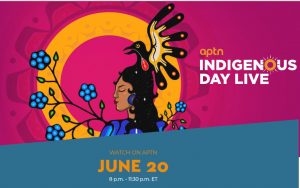
Next week is National Indigenous Peoples Day. With different provinces and territories under different restrictions due to the pandemic, this years celebration is being held online so that everyone can safely attend. While this isn’t directly tied to my project research, I do see this opportunity as a way to celebrate the “unique heritage, diverse cultures, and outstanding achievements and contributions of First Nations, Inuit and Métis Peoples.” 

APTN Indigenous Day Live will take place on Sunday June 20th 8:00-11:30 pm ET and an encore presentation on Monday June 21st 2:30-6:00 pm ET.

The APTN (Aboriginal Peoples Television Network) website is also a great resource full of shows and programs!

Mod 2 P.2

https://www.setbc.org/2018/07/classroom-technologies-and-first-peoples-principles-of-learning/#1532551113031-acdec398-0100

Part of my project goal is to look into how I can incorporate Indigenous ways of knowing/learning and worldviews into my own teaching and classroom. This website: Classroom Technologies and First Peoples Principles of Learning – SET-BC provides information on just that. It is a course that allows teachers to gain background knowledge about the First People’s Principles of Learning and then provides examples that show how Indigenous perspectives can be integrated into the classroom and with the curriculum. A bonus is that many of the suggestions include technology-based projects that align with with First People’s Principles of Learning!

Mod 2 P.1

https://curriculum.gov.bc.ca/curriculum/indigenous-education-resources

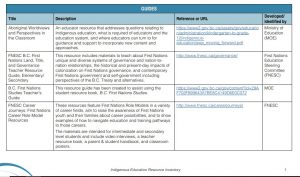
Just as we are gathering and compiling resources, the BC Ministry of Education also gathered together a list of Indigenous education resources. The resource inventory includes guides, books, e-books, articles, websites, videos, and other materials. I think part of the value in this particular inventory of resources is that the resources were compiled in collaboration with the British Columbia Teacher’s Federation, the First Nations Education Steering Committee, and Métis Nation British Columbia. This allowed many voices to be heard in the gathering of these resources.

Mod 1 P.5

https://empoweringthespirit.ca/cultures-of-belonging/

Empowering the Spirit is a website designed as an educational resource to support reconciliation. It is a collection of resources, such as tools, videos and links, which allows educators and school leaders to weave Indigenous knowledge systems into their current practice. The resources have been “curated to increase awareness and understanding of First Nations, Métis and Inuit histories, perspectives and ways of knowing.”

The school curricula should be one that honours the “perspectives, histories, languages and cultures” of the Indigenous. Empowering the Spirit is a website that will support educators and school leaders in doing this. The website is designed with 3 sections: foundational knowledge, leading the learning, and classroom supports, allowing multiple access points for educators and schools leaders.

Mod 1 P.4

https://www.cbc.ca/news/canada/british-columbia/dekelh-language-curriculum-pg-1.5989336

Northern BC school districts are collaborating to create an Indigenous language curriculum that can be taken for credits. The proposal, based on the Dakelh language, hopes to help revitalize the language as “language gives students a sense of belonging and helps them understand the world around them.” The proposal is currently waiting to be approved by the Ministry of Education.

This isn’t really a resource, but instead an idea of an action plan that could be taken to support languages facing extinction. “Like the Thunderbird of old I shall rise again out of the sea; I shall grab the instruments of the white man’s success – his education, his skills, and with these new tools I shall build my race into the proudest segment of your society.”-Chief Dan George. A colleague shared this quote with me, and I feel it applies to this context. Once the language is gone, it will be gone forever unless there is a way of revitalizing the language again.

Mod 1 P.3

https://www.facinghistory.org/stolen-lives-indigenous-peoples-canada-and-indian-residential-schools

I recently came across the website Facing History, with the mission to use “lesson of history to challenge teachers and their students to stand up to bigotry and hate”. There are many issues from the past that are avoided in classroom as educators do not feel comfortable talking about things, or simply don’t know how to start and guide the conversation. Facing History has a number of resources to empower both teachers and students to critically think about pivotal moments in history, such as global immigration, bullying & ostracism, genocide & mass violence and more.

While the website is primarily American based, there is a section on residential schools and their long-lasting effects on the Indigenous Peoples of Canada. The resource includes a link to a book that can be purchased, or downloaded in PDF form to use in classrooms. There are also videos, pictures and more that can support the conversation about residential schools and reconciliation.

Mod 1 P.2

https://enowkincentre.ca/index.html

The En’owkin Centre, pronounced Eh-now-kehn, is located on the Penticton Indian Band reserve. It is an “indigenous cultural, education, ecological and creative arts organization that develops and implements Indigenous knowledge and systems at the community and international levels.” The En’owkin centre hosts art workshops and exhibitions, as well as international conferences and forums related to Indigenous education, arts and culture, as well as environmental concerns.

The En’owkin mandate is:

In consideration of sacred responsibilities given to us by the Creator, upheld through our culture and continues nsyilxcen Language class through our Elders,
we are committed to:
PROVIDE the educational needs and programs of the Indigenous people with full participation by the Elders, the parents and the community.
ENHANCE the mental, physical, emotional, spiritual and social needs of our people by preserving and reinforcing Indigenous culture, practice and teachings.
DEVELOP and implement community based education programs, which focus on the needs of the Indigenous community and are controlled and monitored at the community level.
RESTORE the Okanagan language to its rightful place as the communicator of the culture, under the guidance of the Elders.

I had the opportunity to visit the En’owkin centre with my students a couple years ago. We spent time listening to stories shared by Elders, having a guided tour of the native plants, and putting out hands in the soil to help replant and populate native species of plants. If you live in the Okanagan, the En’owkin centre is a wonderful resource!

Mod 1 P.1

https://www.collectionscanada.gc.ca/stories/index-e.html

While museums can share artifacts and primary sources with us, they are not always something educators have access to or can bring students to. Collections Canada has put together and archive called “Our Voices, Our Stories” celebrating the Inuit, Métis and First Nations peoples, from the past to the present. The website has educational resources, stories, images with captions, and primary sources that can be used in the classroom, or just to gain a deeper understanding. It is one thing to talk about something with students, but to be able to show students images and to read primary sources together has so much power.