Author Archives: VictoriaCameron

M2P5: Tua’ll (and then) I used math to tell a story

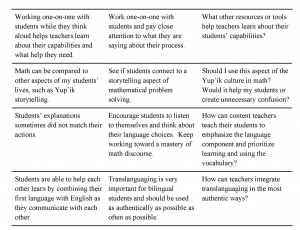
Tua’ll (and then) I used math to tell a story: Using think alouds to enhance agency and problem solving in an indigenous high school mathematics class

This thesis is an action-research project in a high school math classroom that focuses on student discourse and agency. I am excited that I found such a detailed and extensive account of someone’s journey of incorporating Indigenous culture into an Indigenous high school mathematics class.

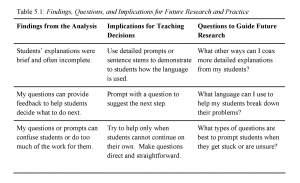
Below are some findings, implications, and questions from the report.

M2P4: Indigenous Learning Preferences and Interactive Technologies

A research study conducted in BC that studied the impact of interactive technologies on math achievement of Indigenous students in Grades 4-7.

Kitchenham, A. (2017). Indigenous Learning Preferences and Interactive Technologies. The Australian Journal of Indigenous Education, 46(1), 71-79. doi:10.1017/jie.2016.12

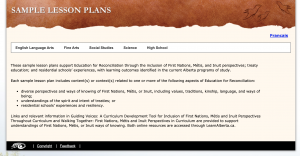
M2P3: Alberta Ed Sample Lesson Plans

These sample lesson plans support Education for Reconciliation through the inclusion of First Nations, Métis, and Inuit perspectives; treaty education; and residential schools’ experiences, with learning outcomes identified in the current Alberta programs of study.

Each sample lesson plan includes content(s) or context(s) related to one or more of the following aspects of Education for Reconciliation:

  • diverse perspectives and ways of knowing of First Nations, Métis, or Inuit, including values, traditions, kinship, language, and ways of being;
  • understandings of the spirit and intent of treaties; or
  • residential schools’ experiences and resiliency.”

I was excited to find this resource, but then noticed that Mathematics was not a subject included, which makes me eager to try to gather resources for teaching math in the K-12 classroom, but also makes me question why?

M2P2: Indspire Online Resource Centre

“Indspire is a national Indigenous registered charity that invests in the education of First Nations, Inuit and Métis people for the long term benefit of these individuals, their families and communities, and Canada.”

Within the Online Resource Centre contains documentation and evaluation of various projects that Indspire has completed. Some that interested me are:

M2P1: Stepping Stones

Stepping Stones is a publication of the Alberta Teachers’ Association Walking Together: Education for Reconciliation and is intended to support certificated teachers on their learning journey to meet the First Nations, Métis and Inuit Foundational Knowledge competency in the Teaching Quality Standard.”

This resource is helpful in providing a detailed overview of various topics including, but not limited to, terminology, Treaties, Canada’s history, First Nations Traditions and culture, and residential schools.

M1P5: Indigenous Education Resources

This website houses some amazing information for Indigenous Education.

A school is also highlighted on this website:

“Nala’atsi is a school based in Courtenay, British Columbia for students with Indigenous ancestry in grades 10 to 12. It is a 10 month program that provides individualized support for students whose needs have not been met in a mainstream classroom setting. Nala’atsi aims to give students a sense of community and belonging, a safe and compassionate learning environment, as well as access to a variety of exciting cultural activities within the community and beyond.”

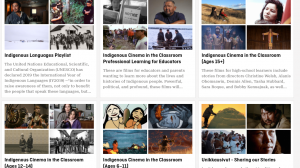
M1P4: Indigenous Cinema in the Classroom

“Our educational playlists are selections of films on themes that tie in with Canadian curricula and address the important issues of the day. Many of the playlists are also linked to our study guides.”

Within the “Indigenous Voices and Reconciliation” tab, some playlists that I have flagged for review are:

  • Indigenous Cinema in the Classroom Professional Learning for Educators
  • Indigenous Cinema in the Classroom (Ages 15+)
  • Indigenous Cinema in the Classroom (Ages 12-14)
  • Indigenous Cinema in the Classroom (Ages 6-11)

https://www.nfb.ca/education/educational-playlists/#indigenous-voices-and-reconciliation

M1P3: Indigenous Culture-Based School Mathematics in Action

Indigenous Culture-Based School Mathematics in Action: Part I: Professional Development for Creating Teaching Materials

  • This first of a pair of articles describes a professional development project that prepared
    four non-Indigenous mathematics teachers (Grades 5-12) to implement Canada’s Truth and
    Reconciliation Commission’s (TRC, 2016) notion of reconciliation: cross-cultural respect through
    mutual understanding

https://scholarworks.umt.edu/tme/vol18/iss1/9/

Meyer, Sharon and Aikenhead, Glen (2021) “Indigenous Culture-Based School Mathematics in Action: Part I: Professional Development for Creating Teaching Materials,” The Mathematics Enthusiast: Vol. 18 : No. 1 , Article 9.

__________

Indigenous Culture-Based School Mathematics in Action Part II: The Study’s Results: What Support Do Teachers Need?

  • The research question: What precise supports must be in place for Grades 5 to 12 teachers to enhance their mathematics classes in a sustainable way with Indigenous mathematizing and Indigenous worldview
    perspectives?

https://scholarworks.umt.edu/tme/vol18/iss1/10

Meyer, Sharon and Aikenhead, Glen (2021) “Indigenous Culture-Based School Mathematics in Action Part II: The Study’s Results: What Support Do Teachers Need?,” The Mathematics Enthusiast: Vol. 18 : No. 1 , Article 10.

_______

*June 20 – Edit*

I came across this resource that pulls together the above two pieces of research. It is from the McDowell Foundation, which provides grants for teacher-led research projects in Saskatchewan.

Culture-Based School Mathematics for Reconciliation and Professional Development
M1P2: British Columbia’s FPPL

First People’s Principles of Learning

  • Looking forward to referencing this document and incorporating these principles into my classroom, and seeing how they can align with Alberta curriculum.
  • I also found this link as an “informational URL” on the BC Government’s website, offering suggestions for how teachers can include the FPPL in their classrooms.

M1P1: The Alberta TQS

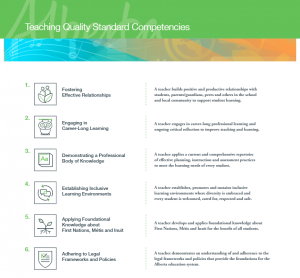
“The professional practice of all Alberta teachers is guided by the Teaching Quality Standard (TQS). This standard is the basis for certification of all Alberta teachers and holds them accountable to the profession and to the Minister of Education.”

In 2008, a sixth competency was added: Applying Foundational Knowledge about First Nations, Métis and Inuit. As it is important for all teachers to keep up to date with their professional practice, the TQS is an important document that I will be referencing throughout this course.

Alberta Teaching Quality Standard infographic