Author Archives: WhitneyLafleur

Module 4- Post 5- Looking at the myth Why Aboriginal Peoples Can’t Just “Get Over It”

https://www.aptnnews.ca/featured/understanding-inter-generational-trauma-and-how-to-stop-it-infocus/

This video on APTN’s show “In Focus” describes what intergenerational trauma is and how Indigenous Peoples in Canada are affected.  A speaker on the show, Dr.Gabor Mate shares his research where he found how childhood traumatic experiences can result in addictions which can become normalized responses. I feel as though this concept is important for students to understand in terms of learning why the trauma of Indigenous Peoples still exists today.  The closing of the last residential school in 1997 was not that long ago. However, for the students going through our school system today, it might seem like a long time ago. It is essential that students understand that the trauma does not go away and it is going to take several generations before the trauma goes away.  As I read this article I reflected back on how well understanding this concept fits into my science 10 lesson on Epigenetics.  This is the study of how genetic markers, created from environmental conditions, can be passed on from generation to generation. This is a great connection I can make in my lessons.

Extra resources:

If I were to try and explain this to my class the following is a Youtube video I also found that brings some light to intergeneration trauma.  https://www.youtube.com/watch?v=IWeH_SDhEYU&t=97s

As well, a recent news clip I found also has John Langan discuss a first hand account about how his parents attending residential schools impacts him.

https://globalnews.ca/video/8030529/residential-schools-source-of-intergenerational-trauma-for-indigenous-people
Module 4- Post 4- Pan-Indigenous Views or the the myth that ” All Indigenous People are the same”

https://livelearn.ca/article/about-canada/5-facts-about-the-diversity-of-indigenous-peoples/

As an educator I think it is important, when possible, to use local Indigenous knowledge. When providing students with local contexts I believe they will better connect with the content being taught.  On my journey to find research to help educate about the diversity of Indigenous peoples I found this website by livelearn.ca that describes the differences in Indigenous territories and even provides a description of the seven bands or tribes that make up the territory that I live on. The 5 facts about the diversity of Indigenous Peoples include:

  1. Indigenous cultural traditions in Canada existed as far back as 400 years ago

  2. There are more than 634 First Nations communities all over Canada living in traditional territories and in urban centres

  3. There are more than 60 Indigenous languages

  4. 10 Indigenous cultural areas in North America, six are in Canada

  5. Residential schools contributed much to the decline of Indigenous language and culture

It’s important that students understand that even if we explore Indigenous worldviews in our class, these views or traditions come from a specific territory. All Indigenous cultures and territories  differ from nation to nation across Canada.

Module 4- Post 3- Colorblindness

https://www.ted.com/talks/mellody_hobson_color_blind_or_color_brave?language=en


Racial issues can be difficult to talk about in class.  If we are to discuss Indigenous ways of knowing and their importance and value in the education system it will be important to be able to address comments made surrounding the idea that “we are all the same”. “Lets treat everyone the same”.  Colorblindess is the idea that one does not see race, color, ethnicity. We are all uniquely different and need to celebrate that diversity (not pretend it doesn’t exist). We need to seek to understand the historical past of minority groups and how each person’s history or differences, specifically oppressive differences, impacts people’s lives today. The TED talk I posted is a good resource to use to explain this concept to students.  In the video, Mellody Hobson describes the need to start talking about race and ethnicity and not hide from it. As an educator, I need to do this.


Module 4- Post 2- Debunking the myth “Indigenous Peoples get a free ride”

https://www.ryerson.ca/news-events/news/2021/05/how-much-does-canada-owe-indigenous-communities-for-stolen-land/


This article references how the Yellowhead Institute addresses, in its second Red Paper – Cash Back, where money that was given to the Indian Trust fund previously went and where it is now. (This article follows Yellowhead Institutes first paper- Land back).  The review of the article also looks to clarify the myth of Indigenous Peoples getting “free money”. A quote from the article states “[t]he systemic underfunding of First Nations is one of the most central and violent forms of colonization in Canada today, yet it is rarely historicized or explained”.  This website also includes a link to a YouTube video that describes the historical context of the Indian Trust Fund. For those students who question (or believe in the myth of free money for First Nations Peoples), this would be a good start to explain the history of why the settlers of Canada, and their governments, are actually the ones in debt due to the theft of Indigenous lands and resources. 


Further resources: https://cashback.yellowheadinstitute.org/ (the original “Cash Back report)

Module 4- Post 1- Definition and explanation of Genocide of Indigenous Peoples

https://www.thecanadianencyclopedia.ca/en/article/genocide-and-indigenous-peoples-in-canada

For my last set of module posts I plan to explore developing knowledge surrounding the racist Canadian colonial history. The reason for this is in order to authentically incorporate Indigenous ways of knowing into my classroom, I think I must explain to students the reasons why I think it is important. Discussing the racist historical past of Indigenous Peoples and the path to truth and reconciliation helps bring to light why it is important and why we should value incorporating Indigenous perspectives in education. We are all connected to Indigenous Peoples, as we live on their land, and it is important to understand, respect, and value that worldview.

The above being mentioned, I set out on a search to find a solid explanation to explain the genocide of Indigenous Peoples of Canada.  I wanted to ensure I found an explanation that defined genocide and provided evidence to support the idea. I found the Canadian Encyclopedia website describes the Canadian Genocide quite clearly.

Module 3- Post 5- What stops us from Indigenizing

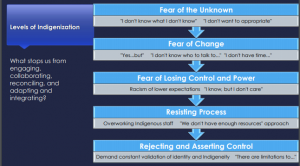
The link above is a PowerPoint presentation from Dianne Binn from Camosun College on Indigenizing Curriculum in post secondary systems.  One particular slide drew my attention which was focused on “what stops us from engaging, collaborating, reconciling and adapting and integrating” Indigenous ways of knowing in our classroom.

  There will always be reasons to not try something new or be open to new ways of learning.  I know I am ready and open to change but many of my colleagues are not.  This PowerPoint provides explanations of their fears and ways to approach them.  In the slides to follow Binn describes what should be incorporated into our ways of teaching to include Indigenous ways of knowing. She provides a curriculum framework that can be incorporated as a way to Indigenize our pedagogy.  Binn explain that some educators turn to learning activities as a way to Indigenize their course, however,  “including or adapting learning activities without changing other aspects of the curriculum is not a holistic approach to Indigenization, and in some cases can result in trivializing and misappropriating those activities”. This website will prove useful in my final project as an important description and note that we cannot just change activities in our classrooms.  It is a pedological  shift in the importance of teaching to the learner as a whole that needs to happen.

Module 3- Post 4- Indigenous Education Video Series

https://www.lakeheadu.ca/teaching-commons/indigenous-pedagogies-epistemologies/exploring-indigenous-education-a-video-series

This video series on Indigenous Education has been posted by Lakehead University. The website includes a variety of different sources of information including “Why Indigenizing Curriculum and Pedagogy is Vital for Our Survival”, “decolonizing Teaching Indigenizing Learning Resources” and a video service on “Exploring indigenous Education.  I looked specifically at the video series where Professor of Aboriginal Education Susan Dion spoke to current changes in the education system with regards to Indigenous ways of knowing, how educators can have the greatest impact for students, and what educators can do to support the learning for all students.  Her words and her stories are impactful.  The are a good reflection of current issues in education today with regards to incorporating Indigenous education in schools. She specifically describes the story of a student who needs help, needs her teacher to be an ally. Instead of helping the Indigenous student to navigate a tricky and somewhat racist remark by another child the teacher turns away.  Teachers cannot turn away, teacher must be allies.  We must help students Indigenous students to express who they are and we must encourage non-Indigenous peoples to be open to listening to perspectives they might not be accustomed to.  These stories and perspectives are vital to my final project as they provide the context to WHY we need to Indigenize our curriculum and the support that it provides for Indigenous  students and all students.

Module 3- Post 3- First Peoples Principles of Learning linked to BC curriculum

https://learn.sd61.bc.ca/wp-content/uploads/sites/96/2017/09/First-Peoples-Principles-of-Learning-for-Teachers.pdf

This document does a great job connecting the core competencies of the bc curriculum to each First Peoples Principle.  It also describes each principle in terms of perspective and worldview.  The most useful part of this document is it describes what each principle can look like in the classroom.  Sometimes it’s easy to read about the principles and not quite understand how you might fit it into the context of your classroom.  This document provides tangible teaching and learning strategies that connect to each principle.  My final project is a journey in exporting these principles of learning and so this resource should prove useful as a starting point for myself and anyone looking to do the same.

Module 3- Post 2- Residential school summary

https://indigenousfoundations.arts.ubc.ca/the_residential_school_system/#ongoing-impacts

This website/article provides a very good summary of residential schools, how they were formed, the impact over generations and the systematic impacts they created.  This article also points to the fact that the Canadian government, through the “Sixties Scoop” abducted children, through social services. Children were removed from their families. This problem still persists today and this article describes the ongoing problems.  This genocide of Indigenous People is not complete.  It continues today through the systems that are still in place like the disproportionate amount of Indigenous children that are removed from their homes by social services. Highly recommend this read to provide a brief history and context of impacts related to residential schools. This website also has information written on the “Sixties Scoop” and “The White Paper of 1969”. This brief synopsis of a dark Canadian history will be important in my project to provide context to the  importance of Indigenizing our curriculum.  It describes how the past is impacting the future.  Multigenerational trauma impacts our learners today and we must understand our history in order to help our future students.

Module 3- Post 1- Mumilaaq Qaqqaq Speech

https://www.youtube.com/watch?v=-vQnzQIQn48

If you haven’t seen this video in its entirety it is a must see. Mumilaaq Qaqqaq, a Canadian MP gives a farewell speech to Parliament. She describes the systematic problems still faced by Indigenous Peoples today.  She discusses her Peoples “not two generation ago, survival mode meant endurance of extreme temperatures and finding food throughout the winter”. She continues to explain how today they must learn how to survive the government’s unwillingness to support them with basic needs (shelter, water) and systemic problems that create a lack of safety when going to work. I get chills every time I watch this video. Mumilaaq Qaqqaq makes you want to stand up and do something about what is going on.  An emotional, motivational speech. This video can be used as evidence in my final project as to why it is so important to embrace Indigenous ways of knowing into our classroom.  We must enable and encourage all learners in our classrooms to ensure they are supported in their learning journeys.