Category Archives: MODULE 1

M1P5 – Indigenous Peoples and Connectivity: Bridging the Digital Divide

There was a recent event discussing the challenge of utilizing ICT in Indigenous communities, particularly during the COVID-19 Pandemic.

I found this to be very relevant, as I think it emphasizes the issues we are learning about are current and ongoing, and particularly the differences between how mainstream society was able to adapt to strict social distancing measures by shifting to online shopping, online meetings, etc. While Indigenous communities, many of which are built around a market culture, rely so heavily on in person interactions. Before hearing this, I hadn’t considered how disproportionately this has been impacting many Indigenous communities.

In particular I found Ms. Hindou Oumarou Ibrahim’s section (24:00) very powerful as she emphasized how difficult it is for Indigenous people to participate in decision making during the COVID-19 Pandemic. The issue relates to challenges the UN faces in being flexible with providing support (even small amounts of money) in ways outside of mainstream measures. She stressed how communities are innovative in finding their own solutions, but that voices of African Indigenous peoples are being silenced by the digital divide as well as time zone problems. The system was built around in-person collaboration, but that has been entirely disrupted.

I heard Mr. Roberto Múkaro Borrero (33:40) emphasize the importance of resources and access in Indigenous languages, given English is one of the barriers in the digital divide. He also highlights the fact that progress has been slow for Indigenous peoples. He frames the digital revoluation as a train that Indigenous peoples have to decide whether they want to get on or let it pass them by (36:20)

Ms. Mikhaela Jade (43:40) emphasized the importance of including all ages within Indigenous communities, and the challenge that younger members are typically more tech savvy, and may hold a disproportionate voice in change which can be disruptive in an Indigenous culture. She emphasizes the importance of Indigenous peoples designing their own technologies to avoid becoming digital slaves only capable of basic use of technology.

Ms. Darrah Blackwater (50:00) emphasized the disparity between different tribes and nations, as each nation embraces technology differently and so measures to support communities must consider that. She also brings up “Spectrum Soverignty”, seeing the radio spectrum employed as a resource that belongs to the people.

Mr. Erick Huerta Velázquez (57:45) emphasized that governments have a responsibility to provide the infrastructure and the technology so that Indigenous communities can manage their own technology. He also stressed that the radio spectrum is part of the land and belongs to the people, and training for members of the Indigenous community to train people to run and manage their own radio networks.

References

United Nations. (2021). Indigenous Peoples and Connectivity: Bridging the Digital Divide | Disd. United Nations. https://www.un.org/development/desa/dspd/2021/04/indigenous-peoples-digital-divide/.

M1P4 – The Many Meanings of Technology

This article by Ellen L. Lutz (2005) also highlights some of the challenge faced by Indigenous communities when considering technology. In today’s modern world, technology integration affords greater opportunity, and thus power over those who choose not to employ the technology. Therefore, Lutz argues that intentional use of technology can be seen as a way of protecting Indigenous peoples from subordination. She highlights an example from Terence Turner (1992) of the Kayapo people living in Northern Brazil being given video cameras and recording equipment. The use of this technology allowed them to objectify their culture both to the benefit of members of the community, and affording them the power to control their own narrative and make use of media technologies for political action.

The core message here is that Indigenous communities should be afforded equal access to technology and training, with self-determination for how those technologies are employed once they have developed an understanding of what the technology offers.

References

Lutz, E. L. (2005, June 1). The Many Meanings of Technology. Cultural Survival. https://www.culturalsurvival.org/publications/cultural-survival-quarterly/many-meanings-technology.

Turner, T. (1992). Defiant Images: The Kayapo Appropriation of Video. Anthropology Today, 8(6), 5. https://doi.org/10.2307/2783265

M1P3 – Innovationa nd Technology for Indigenous Peoples

This article by Borrero (2013) does a good job of framing one of the central issues we’ve looked at so far.  Namely, that often the emphasis is on “connectivity” for Indigenous communities in an effort to alleviate poverty, without acknowledging or addressing cultural factors and implicitly imposing Western processes or structures upon Indigenous recipients.  Borrero references an article by Richard Heeks (2008) to delineate the following to assess programs and initiatives:

  • Pro‐indigenous (for indigenous peoples)
  • Para‐indigenous (with indigenous peoples)
  • Per‐indigenous (by indigenous peoples)

Borrero (2013) emphasizes that future initiatives should emphasize both para and per Indigenous emphasizing that “Indigenous peoples should be viewed as active producers and innovators” (p. 6)

While researching the origins of this paper, I also stumbled across the Ethnos Project (Oppenneer, n.d.) which specifically emphasizes “the intersection of Indigeneity and information and communication technologies” and may be valuable for future research.

References

Borrero, R. M. (2013). Innovation and Technology for Indigenous Peoples. https://www.un.org/esa/socdev/egms/docs/2013/ict/innovation-technology-indigenous.pdf.

Heeks, R. (2008). ICT4D 2.0: The Next Phase of Applying ICT for International Development. Computer, 41(6), 26–33. https://doi.org/10.1109/mc.2008.192

Oppenneer, M. (n.d.). The Ethnos Project. https://www.ethnosproject.org/.

M1P2 – Indigenous Knowledge Systems for Appropriate Technology Development

This paper contrasts Indigenous knowledge systems (IKS) with the modern scientific knowledge system (MSKS), defining Indigenous knowledge (IK as “the cultural and technological product, or knowledge product, from a society or culture’s interaction and engagement with daily living”.  The following contrasts are highlighted:

  • IKS do not emphasize theoretical grounding which is forms the foundation of the MSKS
    • “IKS are developed through daily engagement and through trial and error to see what meet a particular community’s needs” (p. 125)
  • “Intellectual property is not a strong point in the IKS ecosystem — knowledge is supposed to be shared for the benefit of the community and not for private gain” (p. 125)
  • “IKS is not static — it changes as is required and in response to the various stressors that a community faces” (p. 125)

The fact that theoretical grounding is not a highlight of IKS, but rather IKS are “developed through daily engagement and through trial and error to see what meets a particular community’s needs”. I think this acknowledges the fact that a community’s needs have not always been theoretical grounding, that when you are focused on the health of a community, these knowledge systems offer much more than simply answers to problems. Living in Hong Kong, we have the parallel systems of modern Western Scientific Medicine (WSM), and Traditional Chinese Medicine (TCM), both in full practice.  What is interesting to see is some of the overlap as traditional methods are tested using the scientific method and thus accepted into the body of WSM.

The paper highlights the challenge of defining appropriate technology (AT), emphasizing the importance of:

  • “grounding in specific communities” (p.126)
  • “implementation within the constraints of local community-specific socio-cultural and geographical contexts” (p.126)
  • “and that the end result .. must result in building community capacity and empowering the community at the local grass roots level” (p.126)

The paper also emphasizes “the holistic inclusion of the local targeted community in the entire development process”. Some examples of appropriate technolgies shared are:

  • The use of Turmeric “in agriculture, animal husbandry and in health and medicinal applications” (p. 127)
  • vrikshaturveda which “focuses on agricultural practices that only call for organic and natural interventions into the farming process and cycle” (p. 127)

There is a helpful flowchart in figure 1 (p. 131) that emphasizes developing and promoting IKS within communities first before looking to the outside for appropriate technology.

In reading this paper, it is clearer to me the incredible challenge faced when trying to integrate modern technologies into Indigenous communities, since so much of modern technology is developed and focused on a systematic, machinistic approach to solving problems, whereas so much of Indigenous knowledge forms the foundation of the community itself, serving a greater and more complex role than simply solving a problem. In this paper, the authors emphasize the importance of institutionalizing support, stating the “support for indigenous knowledge and systems must emanate from the state” (p. 129). Particularly mentioning that government support for IKS offers scientific backing and support. While I can see how scientific backing and support helps to validate IKS with members of the MSKS, I would question whether that applies to all situations however, since if the state is comprised entirely of knowledge systems foreign to the Indigenous community, this support could end up disrupting the community in an effort to support. It seems that this may be only half of the solution.

References

Tharakan, J. (2017). Indigenous Knowledge Systems for Appropriate Technology Development. In Indigenous People. https://doi.org/10.5772/intechopen.69889


M1P5: Indigenous Education Resources

This website houses some amazing information for Indigenous Education.

A school is also highlighted on this website:

“Nala’atsi is a school based in Courtenay, British Columbia for students with Indigenous ancestry in grades 10 to 12. It is a 10 month program that provides individualized support for students whose needs have not been met in a mainstream classroom setting. Nala’atsi aims to give students a sense of community and belonging, a safe and compassionate learning environment, as well as access to a variety of exciting cultural activities within the community and beyond.”

M1P4: Indigenous Cinema in the Classroom

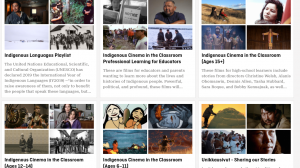
“Our educational playlists are selections of films on themes that tie in with Canadian curricula and address the important issues of the day. Many of the playlists are also linked to our study guides.”

Within the “Indigenous Voices and Reconciliation” tab, some playlists that I have flagged for review are:

  • Indigenous Cinema in the Classroom Professional Learning for Educators
  • Indigenous Cinema in the Classroom (Ages 15+)
  • Indigenous Cinema in the Classroom (Ages 12-14)
  • Indigenous Cinema in the Classroom (Ages 6-11)

https://www.nfb.ca/education/educational-playlists/#indigenous-voices-and-reconciliation

M1P3: Indigenous Culture-Based School Mathematics in Action

Indigenous Culture-Based School Mathematics in Action: Part I: Professional Development for Creating Teaching Materials

  • This first of a pair of articles describes a professional development project that prepared
    four non-Indigenous mathematics teachers (Grades 5-12) to implement Canada’s Truth and
    Reconciliation Commission’s (TRC, 2016) notion of reconciliation: cross-cultural respect through
    mutual understanding

https://scholarworks.umt.edu/tme/vol18/iss1/9/

Meyer, Sharon and Aikenhead, Glen (2021) “Indigenous Culture-Based School Mathematics in Action: Part I: Professional Development for Creating Teaching Materials,” The Mathematics Enthusiast: Vol. 18 : No. 1 , Article 9.

__________

Indigenous Culture-Based School Mathematics in Action Part II: The Study’s Results: What Support Do Teachers Need?

  • The research question: What precise supports must be in place for Grades 5 to 12 teachers to enhance their mathematics classes in a sustainable way with Indigenous mathematizing and Indigenous worldview
    perspectives?

https://scholarworks.umt.edu/tme/vol18/iss1/10

Meyer, Sharon and Aikenhead, Glen (2021) “Indigenous Culture-Based School Mathematics in Action Part II: The Study’s Results: What Support Do Teachers Need?,” The Mathematics Enthusiast: Vol. 18 : No. 1 , Article 10.

_______

*June 20 – Edit*

I came across this resource that pulls together the above two pieces of research. It is from the McDowell Foundation, which provides grants for teacher-led research projects in Saskatchewan.

Culture-Based School Mathematics for Reconciliation and Professional Development

M1P2: British Columbia’s FPPL

First People’s Principles of Learning

  • Looking forward to referencing this document and incorporating these principles into my classroom, and seeing how they can align with Alberta curriculum.
  • I also found this link as an “informational URL” on the BC Government’s website, offering suggestions for how teachers can include the FPPL in their classrooms.

M1P1: The Alberta TQS

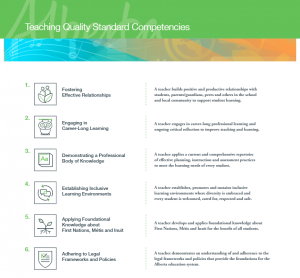
“The professional practice of all Alberta teachers is guided by the Teaching Quality Standard (TQS). This standard is the basis for certification of all Alberta teachers and holds them accountable to the profession and to the Minister of Education.”

In 2008, a sixth competency was added: Applying Foundational Knowledge about First Nations, Métis and Inuit. As it is important for all teachers to keep up to date with their professional practice, the TQS is an important document that I will be referencing throughout this course.

Alberta Teaching Quality Standard infographic

Module 1 Post 5: First People’s Principles of Learning

First Nations Education Steering Committee (FNESC) is a Vancouver-based organization dedicated to creating resources and supporting First Nations learners in British Columbia. Their resource, First People’s Principles of Learning, has been a hallmark of B.C.’s curriculum for the past couple years. FNESC suggests the FPPL acts as a “respectful and holistic approach to teaching and learning”. Learning, in this case, can refer to learning inside or outside the classroom. The principles listed prompt us as human beings to engage with oneself in a constant and consistent cycle of exploration and reflection. Learning (and therefore living) is intimately tied to ones well-being and connectedness. The FPPL is worth exploring no matter where one might be in life.

Classroom Technologies and First Peoples Principles of Learning – SET-BC