Category Archives: MODULE 1

Module 1 Post 4: Life Long Learning Models

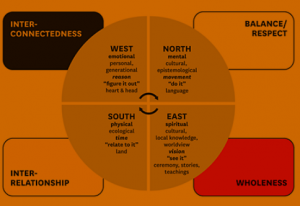
First Nations Pedagogy offers a bounty of Indigenous resources consolidated by a Canadian scholar, June Kaminski. Specifically note-worthy, the life long learning models seen through this link (half-way down the page) offers infographic representations of the ways First Nations, Inuit, and Métis communities engage with learning. Interconnectedness is a theme that runs deep across Indigenous communities, and has fortunately been more prominent in the redesign of B.C.’s curriculum. The infographics show how different domains of knowledge exist in our lives, how knowledge is gained and given, and how we fit into the puzzle at large. These models support our journeys as humans navigating our complex and intersecting lives.
All My Relations

Module 1 Post 3: Legends of Vancouver

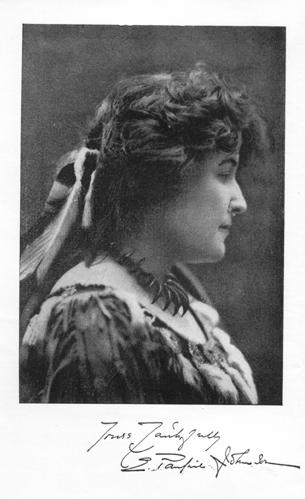
Legends of Vancouver is a digitized version of E. Pauline Johnson’s book originally published in 1911. She is a famous Canadian poet, author, feminist, and Indigenous activist who documented her adventures around some of Vancouver’s most notable areas. Many of these areas unbeknownst to the layperson have a deep history tied to Indigenous knowledge. This resource is fantastic for unpacking and decolonizing the places tourists consider “landmarks”. My particular interest lies within the story of The Two Sisters.  There is a picture book that delivers the story in a beautifully illustrated way, digestible by all ages. The stories and conversations Pauline Johnson had are remarkable and help connect us to the city we exist in.

profile view of woman with hair ribbon and necklace; signature of E. Pauline Johnson below

Module 1 Post 2: Music Counts

Music Counts is a Canadian charitable organization associated with the JUNO Awards who create educational resources, sponsor scholarships, and help create music education across the country. Their Kanata: Contemporary Indigenous Artists and their Music program is the creation of several Indigenous educators, advisors, and artists. This free program consists of a wealth of tools and resources for grades 7-12 which amplify Indigenous voices in music. I find this resource to be refreshing compared to the often tokenized Indigenous “lesson plans” in the past. The artists and stories within Kanata are authentic and contrast the all-too-common narrative that Indigenous peoples live in our history books. Modern pop-culture driven content such as Kanata helps to challenge the status quo and bring Indigenous peoples into mainstream media as other BIPOC communities have been trying to do so for so long.

Module 1 Post 1: Traditional Ecological Knowledge

First Nations Education Steering Committee (FNESC) is a Vancouver-based organization dedicated to creating resources and supporting First Nations learners in British Columbia. The specific resource I am referencing is “Science First Peoples” — a teacher resource for understanding and implementing First Peoples’ scientific knowledge for grades 5-9. FNESC works diligently to ensure their resources align well with the B.C. curriculum while also delivering curricular competencies in a way that recognizes and embodies Indigenous ways of learning. Specific local examples, stories, and materials are used throughout the guide to make for a more interconnected learning journey.

Module 1 Post 5

The Medicine Wheel was something I had seen before in terms of the four directions, but this article focuses on it as an anchor for teaching and learning. From there, it goes into more detail of what exactly the four directions represent, as seen below. The article also talks about the interconnectedness of the four directions and that that creates wholeness. In teaching holistically, students could start with circles to address their spirit, then, for the physical aspect, they would need to work with the land, the emotional aspect through healing circles, and finally the mental aspect in learning their people’s ways. The question lies on how to incorporate that authentically into non-indigenous classrooms.


https://www.lincdireproject.org/wp-content/uploads/ResearcherShareFolder/Readings/Teaching%20by%20the%20Medicine%20Wheel.pdf

Module 1 Post 5

My heart is heavy this week as news breaks of the children found at a former residential school in Kamloops. And once again I look to my role as an educator within a system that has failed so many. Further, Lee Brown’s interview has served as a reminder that the “traditional” forms of education only serve those that see themselves represented within the system. And so I continue to reflect and change my practice. I come back to the First Nations Education Steering Committee (FNESC) and their guiding principles on learning. This website also provides rich resources for helping to move First Nations education in BC. While it is generalized in that it attempts to reflect a collective First Nation practice as much as possible, it serves as a reminder of the approaches I take in my classroom.

https://www.fnesc.ca/first-peoples-principles-of-learning/

Module 1 Post 4

Hidden History is an interactive e-book that offers resources to educators on the history of residential schools in Canada, which is part of the grade 4/5 curriculum I teach. It includes information on the formation of residential schools, the practices within, and consequences. It also looks towards reconciliation and the role of teacher in this process. I found the six steps outlined by project of the heart particularly impactful as action that can be taken within the classroom. It expands beyond “teaching about” and gives teachers a stepping stone for helping students listen to the stories of survivors and to take social justice action. It is a collaboration between the BC Teacher’s Federation (BCTF) and Indigenous peoples of BC, and offers some authentic voices along with a western written history.

Hidden History E-Book

Project of Heart information

Further resources related to Project of the Heart


Module 1 Post 3

The Path of the Elders provides an opportunity for deepening knowledge of First Nation studies in the classroom through guided activities. It includes teacher programs for grades 4 to 10 as well as an introduction to language considerations. I appreciate that this is geared towards the students themselves and gives them an opportunity to engage with the content either on their own or as steered by the teacher. I appreciate both the breadth of knowledge and the way in which it is presented. From a technology perspective, it is fun and engaging, with good graphics and few glitches. From an education perspective, it offered an authentic voice, games with clear rules, and lots of information for students of all ages.

https://www.pathoftheelders.com/

Module 1 Post 2

This virtual museum provides information on Métis history and culture. It presents collections, exhibits, learning resources and some information on Michif, the orally based language of the Métis. Returning to the idea of presenting and preserving culture in its many forms, this is an interesting resource for deepening student understanding of Métis people. I found it particularly relevant for a French immersion classroom, given the history of the French on the Métis. I think the use of primary documents is of particular importance as we gain growing awareness on who’s voice is being heard when history and reality are being taught.  From a technology standpoint, it is an interesting blend of visual, audio and video files including oral history interviews.

The Virtual Museum of Métis History and Culture.

Module 1 Post 4

This post is a graphic and a link to the site it originated at. This is from Centennial College (Toronto) and represents their approach to indigenous education. There are 5 pillars;

  1. Indigenous Nations and Communities
  2. Equitable Access Opportunities
  3. Indigenous Learning and Development for All
  4. Indigenous Spaces
  5. Student Services and Experiences

They also identify strategies within these. This struck me as I have been focusing on indigenous education in my classroom, but also need to consider that as a whole school structure. I can’t just incorporate some teachings into my curriculum, it is much bigger than that.

https://www.centennialcollege.ca/indigenous-education/indigenous-strategic-framework-pillars/