Category Archives: MODULE 1

Module 1- Blog Posts

  1. Learning First Peoples classroom resources- https://www.fnesc.ca/learningfirstpeoples/

This website aims to describe the increased inclusion of First Peoples perspective in the bc curriculum. The First Nations Education Steering Committee, First Nations Schools Association, and teachers developed some teacher resources that  follow Learning First Peoples. One of the calls to cation of the Truth and Reconciliation Commissions was that indigenous knowledge and teaching methods into classrooms.

Resources available: 

BC First Nations Land, Title, and Governance Teacher Resource Guide

FNESC/FNSA Secondary Science First Peoples Teacher Resource Guide

Science First Peoples,

Authentic First Peoples Resources Guide, for K to Gr. 9 (2016) 

First People’s Principles of Learning,

  1. “Importance of Indigenous Education” https://www.un.org/press/en/2003/hr4674.doc.htm

This website, found on the United Nations website, outlines the importance of including indigenous education into westernized or modern education systems.  They discuss the importance of educating youth in their own cultures and languages.  This document stresses that education is the key to self-determination. There are many comments from various leaders around the world, including indigenous leaders, that reiterate the importance of indigenous ways of knowing being incorporated into our education system.

  1. “What matters in Indigenous Education: Implementing a Vision Committed to Holism, Diversity, and Engagement”- https://peopleforeducation.ca/report/what-matters-in-indigenous-education/
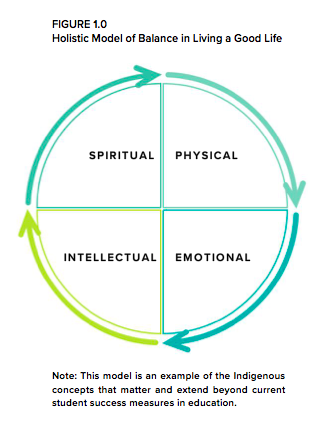
This paper, written by Dr.Pamela Toulouse discusses how an Indigenous approach to learning and what the important concepts and themes are that will align with Indigenous educational success. Concepts discussed include what a quality learning environment looks like, how indigenous worldviews reflect learning environments, and what components make us this teaching/learning setting.

  1. Sylix Okanagan Nation https://www.syilx.org/about-us/syilx-nation/

Okanagan Nation Alliance

This website gives a brief overview of the indigenous nation that I, and my school, reside on.  It describes the geographical space that makes up the nation. The website describes the history of colonization of its territory. It explains that a treaty was never negotiated and therefore the land still belongs to the Sylix people. This land is known as the traditional unceded territory of the Sylix.

Resources: Okanagan Nation Declaration: https://www.syilx.org/wp/wp-content/uploads/2017/01/ON_Declaration.pdf

  1. Westbank First Nation- https://www.wfn.ca/docs/our_people__our_communityreduced.pdf

Guiding Documents and Principles - Westbank First Nation

This powerpoint contains a ton of information about the Sylix People. It contains a brief history of the Westbank First Nation, which is apart of the Syilx Territory.  It also describe many aspects of the Sylix culture including the Four Food Chiefs which is a story that connects to the beliefs and traditions of the Sylix. This website also includes common Sylix phrases. The website then goes into a brief history of Residential schools and the formations of the Westbank First Nation Government.
Mod#1-Post 5: Coders North: Online coding for Indigenous youth

For my final project I am interested in researching means to attract and involve Indigenous students in computing education. Coders North is an online platform developed by Elephant Thought to empower mainly Indigenous youth with the knowledge and skills that help them to create the web and digital world with content that reflects their identities and cultures; It is part of the Government of Canada’s CanCode program. The website also serves as a resource for educators and their students to share, learn, collaborate, and celebrate coding and the digital world’s Indigenization. It includes three main links:

1- Learning Modules

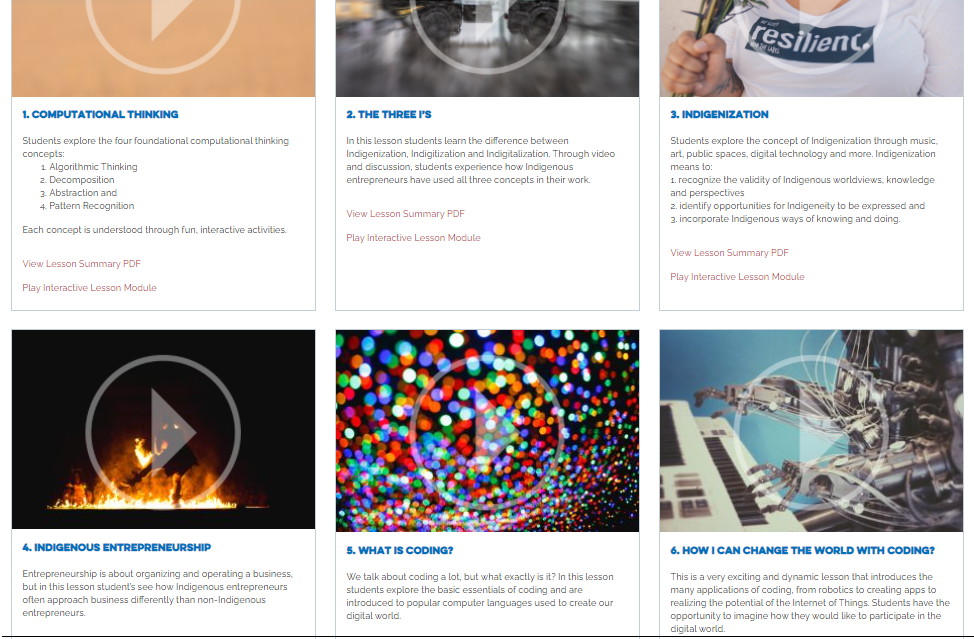
A set of interactive lessons that speak to Indigenous entrepreneurship, successful role models, computational thinking, coding and much more. These lessons are designed for grades 8-12 and are free to use for any educator interested in incorporating them into their class.

Screen capture of learning modules (Coders North, n.d.).

2-Student Showcase

A multimedia showcase of Indigenous and non-Indigenous student-led projects exhibiting intriguing and innovative concepts ranging from music to storytelling to sports and beyond. You will notice that projects created by Indigenous adolescents, as well as youth from marginalized and at-risk communities and situations receives a lot of attention.

3- Video Library

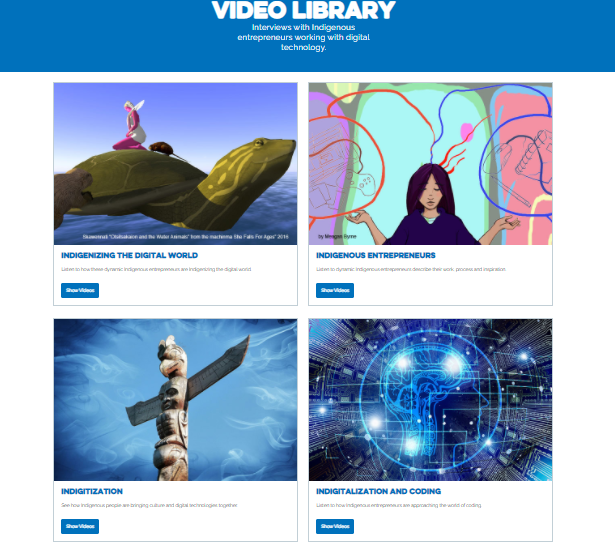
It includes artists, web designers, coders, app designers, gamers and contributors on the Coders North site talking about how they participate on the cyberspace in purposeful way to support the Indigenization of computing field such as: a Métis game designer Meagan Byrne and Metis coder Jon Corbet (he is the presenter of Indigenizing computer programming for cultural maintenance , also the developer of a morphemic computer programming language “Cree#” based on the Cree language and syllabary). I would like to note that the video content is not technical.

Screen capture of Video Library (Coders North, n.d.).

Reference

Mod#1-Post#4: Two-eyed Seeing Approach

One key insight that I gained throughout this first module is that culture matters. As such, I am curious to learn more about the integration of indigenous culture in instruction design and the classroom practices. While exploring this topic, I came across “Two-eyed seeing” concept, developed by Mi’kmaw Elder Albert Marshall. It is a culturally responsive approach to learning in which students learn to see from one eye with the strengths of Indigenous knowledge and methods of knowing, and from the other eye with the strengths of Western knowledge and methods of knowing (The Green Interview, 2019, January). In his interview with Silver Donald Cameron, Marshall says the concept was initially used with the youth in his community, “to look at everything from another perspective” and constantly learn from one other. He adds: “The fundamental principles of two-eyed seeing are not meant to question the integrity of something, of an action, of a word but rather to encourage you to put your curiosity in a higher gear, invoke that curiosity so that you can fine-tune this action or this word to be much more reflective so you will be that much more effective as a community member or a nation.” (The Green Interview, 2019, January, para.6). I believe the incorporation of approaches like this may help all students, educators, and professionals better understand and appreciate Indigenous values, learning styles, and traditional ways of knowing. Below is the YouTube video of the interview.

References

Module 1, Post 5

APTN YouTube Channel

“Our stories, told our way.”

After reading Ginsburg’s article “Screen Memories: Resignifying the Traditional in Indigenous Media,” I was intrigued to see if some of the networks she mentioned were still operating. I found the Aboriginal Peoples Television Network (APTN) has a current YouTube channel that you can subscribe to. This publicly supported and indigenously controlled national aboriginal television network, the first of its kind in the world, shares stories from an Indigenous perspective and has current news stories uploaded. They seem to have several main segments, ‘National News, Face-to-Face, APTNKids, and InFocus.’ I think that having a YouTube channel is an important step in keeping stories accessible to younger generations and available at any time.


Reference:

Ginsburg, Faye D., “Screen Memories: Resignifying the Traditional in Indigenous Media” in Media Worlds: Anthropology on a New Terrain, eds. Faye D. Ginsburg, Lila Abu-Lughod, and Brian Larkin, Berkeley: University of California Press, 2002, 39-57.

Module 1, Post 4

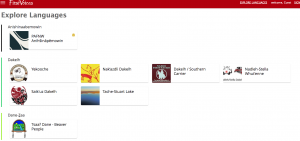
Explore Languages

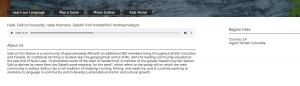
I think this website represents the potential for how technology, specifically computers, can benefit Indigenous culture! It is interactive, hands on, and relevant. It includes recordings of several Indigenous languages and specific high frequency words from each. When you click a certain language, you have the option of learning more words from that Nation, playing games, or seeing pictures of their territory. 


When technology is used correctly, I feel like this is the positive power it has. Language is an aspect of Indigenous culture that is dying and it is important to preserve it. It can take a long time to truly learn another language, this way there is always an opportunity to learn.

M.1 P.4 ImagineNATIVE Film & Media

“Screen Memories” by Faye D. Ginsburg (2002) has led me to explore the Indigenous film, media, and television world a little deeper.

imagineNATIVE is the world’s largest presenter of Indigenous screen content.

“The organisation is recognised locally, nationally, and internationally for excellence and innovation in programming and as the global centre for Indigenous media arts. imagineNATIVE (legal entity: The Centre for Aboriginal Media) is a registered charity committed to creating a greater understanding of Indigenous peoples and cultures through the presentation of contemporary Indigenous-made media art including film, video, audio and digital media.” (imagineNATIVE, n.d.).

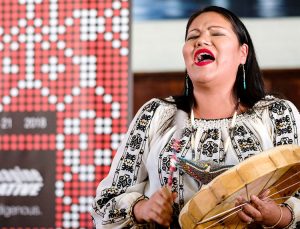
imagineNATIVE Film & Media Arts Festival launched in 2000 and presents in Toronto every October. They also present the annual imagineNATIVE Film & VR Tour across Canada with a focus on remote communities. This website has past archives of previous festival films and media, as well as an INdigital space for digital and interactive creations. You can find dramatic features, documentaries, feature-length and short format films, podcasts, audio works, VR, and interactive games all created by Indigenous artists.

One example of a film you can find on imagineNATIVE is this stop motion picture BIIDAABAN (The Dawn Comes). A beautifully compelling story about maple syrup and shapeshifters.

BIIDAABAN (THE DAWN COMES)

References

Ginsburg, Faye D., “Screen Memories: Resignifying the Traditional in Indigenous Media in Media Worlds: Anthropology on a New Terrain, eds. Faye D. Ginsburg, Lila Abu-Lughod, and Brian Larkin, Berkeley: University of California Press, 2002, 39-57.

imagineNATIVE. (n.d.). Original. Indigenous. https://imaginenative.org/about

Strong, A. (Director). (2018). Biidaaban (The Dawn Comes). [Film]. CBC Gem. https://imaginenative.org/imaginenative-playlist/2020/4/6/atanarjuat-the-fast-runner-2j7rb-aw7xs

M1. P5

The following question was posed under the Theme of Decolonization, Intellectual Property Rights, Virtual and Actual Reality:

Indigenous peoples are diverse, but they share the common experience of being colonized by western and imperialist powers. Can technology be useful in supporting Indigenous communities’ efforts to de-colonize values and thoughts?

This is a topic that I am most interested in, especially how oral tradition and story can be integrated with technology so that it doesn’t lose the authenticity and voice of a face-to-face sharing of lived experiences.

The paper below is one that I have found invaluable in this endeavor and spoke to an interactive mapping tool. This made me connect back with an introduction to Thinglink from Jorden Habib in her Introduction Post on Canvas.

You can read the paper HERE and learn more about Thinglink HERE – or you can watch the video below.

– Sasha Passaglia

M.1 P.3 The Canadian Mountain Network

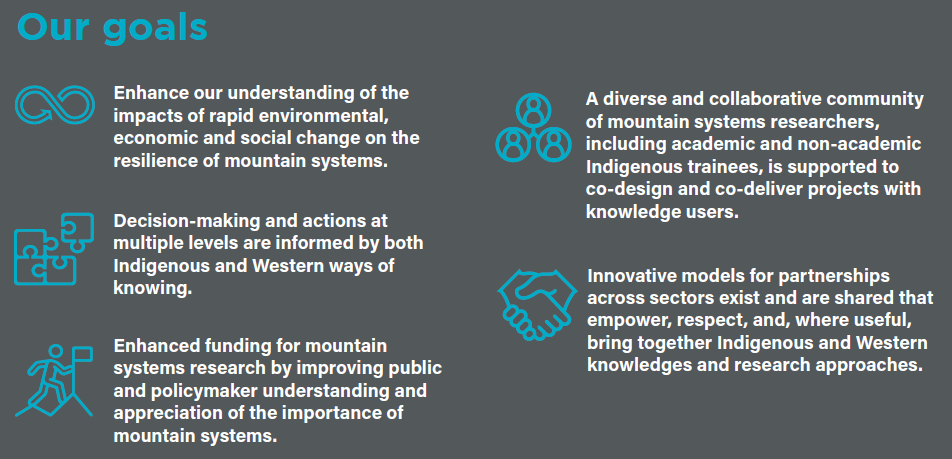
“The Canadian Mountain Network (CMN) was established in 2019 to support the resilience and health of Canada’s mountain peoples and places through research partnerships based on Indigenous and Western ways of knowing that inform decision-making and action” (CMN, n.d.)

I found this website to be incredibly insightful with links to opportunities, research, events, news, knowledge, training, and a blog that uploads news articles, reports, special events, and podcasts. Below you can see the goals of The CNM, linked to the main website.

Canadian Mountain Podcast: Mountain research through Indigenous and Western knowledge systems

I enjoyed this podcast as it discusses the benefits of using both Indigenous and Western approaches to understanding mountains. This podcast hits especially close to home as it relates to the research my partner is currently doing, working closely with elders to embrace and engage with traditional forms of knowledge and learning where we live in Northern B.C.

References

Canadian Mountain Network. (n.d.). CMN Mountain Portal. https://canadianmountainnetwork.ca/

M1. P4.

InStem: Indigenous Youth in Stem. I came across this program a while back when I was researching Women in Stem opportunities and organizations. I quickly realized that if women are being challenged with finding opportunities in STEM careers, that Indigenous Women are probably having an even harder time.

This particular program focusses on Indigenous Youth and provide a for-CREDIT land camp where instructors integrate STEM content with land-based learning. Through this program, Indigenous Youth have been able to work towards graduation while also learning about their identity and connection to place. Furthermore, after graduation, students can come back and become instructors as their first jobs.

You can visit the program HERE – which can also be done at schools. The video below is an introduction to the InStem model.

– Sasha Passaglia

M.1 P.2 “Look to the Mountain”

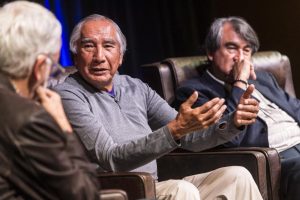
Banff Centre for Arts and Creativity hosted a panel of Indigenous academics to discuss the similarities and differences between Indigenous knowledge and western science. The link to the picture below will take you to the website.

Look to the Mountain is a metaphor. “We need to observe history (the path you come from), understand the present (the top of the mountain), and look at possibilities of the future (the things you can see) with the idea of spirit and resonance, a participation of the world that indigenous people have always had” (Cajete, 2014).

(Indigenous Knowledge and Western Science: Contrasts and Similarities Panel Discussion)

(Leroy Little Bear, former Director of the American Indian Program at Harvard University and professor emeritus of Native Studies at the University of Lethbridge)

(Dr. Gregory Cajete, Director of Native American Studies at the University of New Mexico)

(Rob Cardinal, a research associate at the University of Calgary and Executive Director of The First Light Institute)

References

Banff Centre for Arts and Creativity. (2015, April 14). Challenging the chance of the Cheshire cat’s smile. https://www.banffcentre.ca/articles/challenging-chance-cheshire-cats-smile