Category Archives: MODULE 1

M1. P3.

The First Peoples Principles of Learning are deeply engrained in the curriculum for me. This particular site is a blog created by Jo Chrona di waayu. Kitsumkalum di wil’waatgu. Ganhada di pdeegu. She has over 20 years of experience in K-12 and post-secondary systems in BC and among many other degrees, she holds a Masters of Education Technology too. Her blog has invaluable knowledge of the FPPL, authentic resources, professional development, and experiences. Of note, which is a crucial part of our discussions lately, is the last paragraph on her Home page:

A final note – while the words are mine (except for the Principles themselves, and where referenced otherwise) the ideas shared on this site are built upon the knowledge gained from a vast number of Indigenous peoples including Elders, knowledge-keepers, formal and informal teachers, scholars, and story-tellers (oral and written) from whom I have learned during the journey of my life. This work is for them and for the learners yet to come.

You can visit and explore the blog HERE

– Sasha Passaglia
Mod#1-Post#3: Using the Medicine Wheel for Curriculum Design

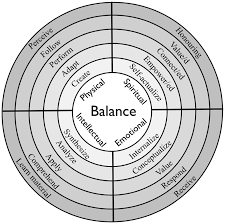
After listening to Dr. Lee Brown’s thoughts about the Native medicine wheel and emotions, I searched for publications about the incorporation of the medicine wheel in education. I found an interesting article entitled “Switching from Bloom to the Medicine Wheel: creating learning outcomes that support Indigenous ways of knowing in post-secondary education,” through which the author, Marcella LaFever (2016), suggests a new framework that expands Bloom’s three domains of learning to a four-domain structure based on the Medicine Wheel’s four quadrants. The proposed model has the fourth quadrant, spiritual, deemed as essential for balance in curricular design that supports students’ learning goals (see figure 1).

Four-domain framework from (LaFever, 2016, p.417)

According to LaFever (2016), the four-domain model is a good place to start when responding to Canada’s Truth and Reconciliation Commission’s call to action (i.e., call to action number 62 [ii] asks educational institutions to educate teachers on how to integrate Indigenous knowledge and teaching methods into classrooms and to utilize Indigenous knowledge and teaching methods in classrooms (Truth and Reconciliation Commission of Canada, 2015, p.7)). Also using the Medicine Wheel for curriculum design in education is a step that every educator, across all disciplines, can take to indigenize their teaching practice (LaFever, 2016).

References:

Mod 1 P.3

https://www.facinghistory.org/stolen-lives-indigenous-peoples-canada-and-indian-residential-schools

I recently came across the website Facing History, with the mission to use “lesson of history to challenge teachers and their students to stand up to bigotry and hate”. There are many issues from the past that are avoided in classroom as educators do not feel comfortable talking about things, or simply don’t know how to start and guide the conversation. Facing History has a number of resources to empower both teachers and students to critically think about pivotal moments in history, such as global immigration, bullying & ostracism, genocide & mass violence and more.

While the website is primarily American based, there is a section on residential schools and their long-lasting effects on the Indigenous Peoples of Canada. The resource includes a link to a book that can be purchased, or downloaded in PDF form to use in classrooms. There are also videos, pictures and more that can support the conversation about residential schools and reconciliation.

Mod 1 P.2

https://enowkincentre.ca/index.html

The En’owkin Centre, pronounced Eh-now-kehn, is located on the Penticton Indian Band reserve. It is an “indigenous cultural, education, ecological and creative arts organization that develops and implements Indigenous knowledge and systems at the community and international levels.” The En’owkin centre hosts art workshops and exhibitions, as well as international conferences and forums related to Indigenous education, arts and culture, as well as environmental concerns.

The En’owkin mandate is:

In consideration of sacred responsibilities given to us by the Creator, upheld through our culture and continues nsyilxcen Language class through our Elders,
we are committed to:
PROVIDE the educational needs and programs of the Indigenous people with full participation by the Elders, the parents and the community.
ENHANCE the mental, physical, emotional, spiritual and social needs of our people by preserving and reinforcing Indigenous culture, practice and teachings.
DEVELOP and implement community based education programs, which focus on the needs of the Indigenous community and are controlled and monitored at the community level.
RESTORE the Okanagan language to its rightful place as the communicator of the culture, under the guidance of the Elders.

I had the opportunity to visit the En’owkin centre with my students a couple years ago. We spent time listening to stories shared by Elders, having a guided tour of the native plants, and putting out hands in the soil to help replant and populate native species of plants. If you live in the Okanagan, the En’owkin centre is a wonderful resource!

MOD #1 POST #1: First Peoples’ Map of BC

Site: https://maps.fpcc.ca/

Information: https://fpcc.ca/stories/first-peoples-map/

The discussion on “Is technology culturally neutral?” brought up interesting dialogue on languages, especially those dominant in cyberspace. From that interaction, I found this resource which is a living map of the First Peoples’ languages in BC. Not only does it map the areas visually, but it also provides audio samples of the pronunciation of greetings, names, and more. Statistics about the communities and languages are included, such as the population and the number of fluent speakers. Along with languages, arts and cultural heritage points of interests are overlayed on the interactive map, providing a resource to learn more place-based information about First Peoples’ history in your community in BC.


Module 1, Post 3

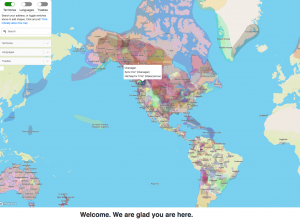
Native Land

This website is run by a non profit organization and strives to map Indigenous lands. They work to “map Indigenous territories, treaties, and languages across the world in a way that goes beyond colonial ways of thinking in order to better represent how Indigenous people want to see themselves.”

This map amplifies the voice of Indigenous communities and is a visual representation of their fight for land which was taken from them. You can focus on locally, national, or global communities and narrow your search by territories, language, or treaties. 

I think that this resource is a great provocation for discussion about land, ownership, borders, and the right anyone has to any of those.

Module 1, Post 2

Learning First Peoples Classroom Resources

http://www.fnesc.ca/learningfirstpeoples/

This website is rich in resources that can be used in the classroom immediately. The First Nations Education Steering Committee and the First Nations Schools Association, in collaboration with teachers and partners, have developed the following Learning First Peoples series of teacher resources to support English Language Arts, Science Social Studies and Mathematics courses. All of the resources reflect the First Peoples Principles of Learning and strive to integrate indigenous knowledge and way of learning into the classroom. Each book has a PDF version which is downloadable and includes lessons taught from an indigenous perspective and with cultural content. As a teacher, I find this website to be a strong jumping off point and gives me confidence to try.

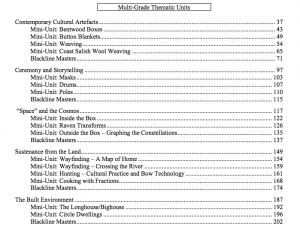
This is a screen shot of the table of contents for the math teacher guide.

M1, P3: Decolonizing Collections: A Map-based Interface

After reading the Marker’s (2006) paper this week, I was thinking about how a map interface might respect Indigenous ties to place more than a plain, old Western index. After a few searches, I came across this paper by a prof at the University of Alberta:

Shiri, A., Borys, C., & Huang, C. (2019). Mapping Canada’s Indigenous Digital Collections. Proceedings of the Annual Conference of CAIS / Actes Du congrès Annuel De l’ACSI. https://doi.org/10.29173/cais1060

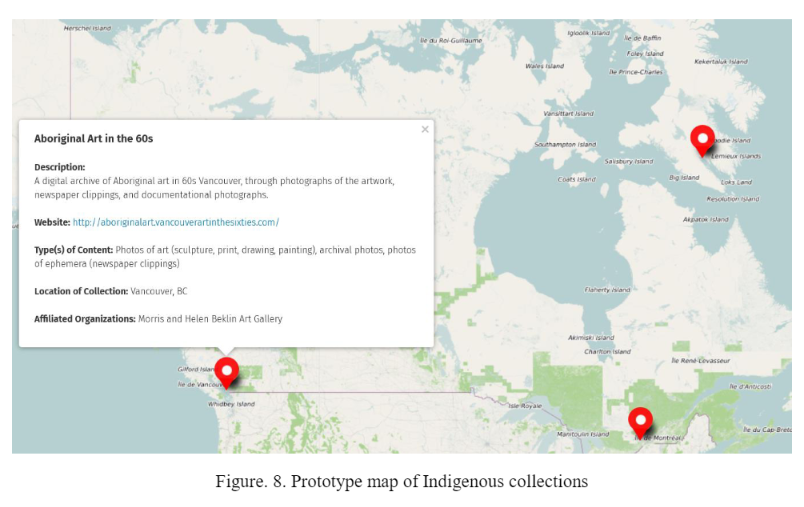
The objective of this paper is to report on a comprehensive study to examine, identify, and map Canada’s Indigenous digital collections available on the web in order to provide a metadata-rich, map-based interface that supports unified, organized, and systematic access to the Indigenous digital collections.

Below is a prototype of the mapping interface Shiri et al. (2019, p.7) propose to develop:


Marker, M. (2006). After the Makah whale hunt: Indigenous knowledge and limits to multicultural discourse. Urban Education41(5), 482-505.

Shiri, A., Borys, C., & Huang, C. (2019). Mapping Canada’s Indigenous Digital Collections. Proceedings of the Annual Conference of CAIS / Actes Du congrès Annuel De l’ACSI. https://doi.org/10.29173/cais1060

M1, P2: Recorded Stories: CBC Legends Project

This week I’ve started looking at how Indigenous stories have been recorded, digitized, and indexed. I came across the CBC Legends Project and was excited to listen to some recordings.

The CBC Radio’s Legends Project (2013) “compiles traditional oral stories, legends and histories of Canada’s Inuit and First Nations, gathered in communities across the country.”

However, I was initially so disappointed with the site. The first site I was directed to, CBC Aboriginal, was somewhat defunct. The site wasn’t displaying properly, it had not been maintained, and the recordings requiring installing Flash.

I reran my search and found the records on CBC Radio with a modern, pleasant display and the audio played well. It was clear and high quality.

The CBC changed their sub-site label from Aboriginal to Indigenous in 2016 and it looks like the first link was the previous, cached, iteration. It reflects poorly on repositories and archives when the site is poorly maintained, and the items are inaccessible. It does a disservice to the collections and the users. With the decision to record and make stories available, an organization needs to commit resources to maintain access and minimize digital obsolescence.  CBC did follow through but how many people will go back and try the search again? How many would assume the CBC did not invest in a long-term commitment?

Canadian Broadcasting Corporation Radio. (2013, July 26). Legends of the Ahtahkakoop. https://www.cbc.ca/radio/ideas/legends-of-the-ahtahkakoop-1.2913531

M1, P1: On Including Indigenous Stories

In this video, Dr. Jo-Ann Archibald (Q’um Q’um Xiiem; Sto:lo Nation) introduces protocols, processes, and procedures for including Indigenous stories in a classroom and identifies questions educators should ask when including Indigenous stories. Some of the questions include:

What are some of the cultural protocols or guidelines for various stories?

What are some of the purposes of stories?

Who can tell the stories?

What types of stories exist in their communities?

How to use the stories?

These protocols could have implications in how repositories of oral traditions identify and annotate records, and could affect how they make them available.