Category Archives: MODULE 1

Looking Back and Living Forward (M1P4)

I stumbled across this interesting book in UBC’s library database, Looking Back and Living Forward: Indigenous Research Rising Up (Markides & Forsythe, 2018). Grounded in pedagogy, this collection brings together a vast array of research done by and with Indigenous peoples from Canada and beyond. The book is available online, and you can download the PDF version.

Here is a short sampling of some of the chapters, and what curricular connections I can see them having:

  • History (Ch. 1: The Cold War, the Nuclear Arctic, and Inuit Resistance)
  • Culinary Arts (Ch. 7: Indigenous Food Sovereignty Is a Public Health Priority)
  • Computer Studies (Ch. 13: Channelling Indigenous Knowledge through Digital Transmission / The Opportunities and Limitations of Indigenous Computer Games)
  • Digital Citizenship & New Media (Ch 17: Canadian Cyber Stories on Indigenous Topics and White Fragility)
  • Art and Change-Making (Ch 26: Scaling Deep / Arts-Based Research Practices)

Bookcover


Reference:

Markides, J., & Forsythe, L. (2018). Looking back and living forward indigenous research rising up. Brill/Sense.

Mod 1 P.1

https://www.collectionscanada.gc.ca/stories/index-e.html

While museums can share artifacts and primary sources with us, they are not always something educators have access to or can bring students to. Collections Canada has put together and archive called “Our Voices, Our Stories” celebrating the Inuit, Métis and First Nations peoples, from the past to the present. The website has educational resources, stories, images with captions, and primary sources that can be used in the classroom, or just to gain a deeper understanding. It is one thing to talk about something with students, but to be able to show students images and to read primary sources together has so much power.


Module 1 – Post 3

While reviewing resources, I thought I’d share a resource from my own school division’s First Nations, Metis and Inuit Success Coordinator, Sandra Lamouche. Sandra has been part of our school division (Livingstone Range School Division) for the past four years. She is a Cree Hoop Dancer, educator as well as a wife and mother. In our school division, Sandra works with staff and students on First Nations history, culture and ways of knowing. Sandra also works with schools to not only teach hoop dancing but also to share oral stories, plan lessons, connect with elders and support teachers in a deeper understanding of First Nations, Metis and Inuit cultures. Sandra, “Uses hoop dance teachings to inspire others to live in balance and harmony with themselves, their friends and family, and with the environment. She uses hoop dance teachings to inspire others to live in balance and harmony with themselves, their friends and family, and with the environment.” Last spring, Sandra gave a TedTalk with the University of Lethbridge called: The Beautiful Struggle of Life and Other Hoop Dance Teachings. She speaks to her connections with her culture, her work with the school division and her own personal story of how her son was able to connect to his daycare through music and dance. 

Lamouche, S. (2020, June 1). The beautiful struggle of life and other hoop dance teachings. [Video]. Ted Conferences. https://www.youtube.com/watch?v=39KhpZ-JhOc&list=PL39hx3FDRKyagIgmFg_ASBkEes1CkxrqN

Module 1, Post #5 – Storytelling Through Digital Music

What is the colonialism of sound?

Right in our backyard of Vancouver, “Edzi’u is a mixed race Tahltan and inland Tlingit artist, songwriter and composer. Her songs are an incarnation of her family’s ancient tradition of storytelling, realized by designing sound through vintage and current audio recordings, electronic instruments and the voice.”

It’s neat to see how Edzi’u incorporates oral stories from interviews and match the energy with instrumental music. I’d be interested to find out how oral storytelling that passes from generations before us can continue to be told in this digital age.

Module 1, Post #4 – Revitalizing Indigenous Language Through Technology

Our planet is home to over 7000 languages currently spoken, yet this unique linguistic diversity—the defining characteristic of our species—is under extreme stress, as are the indigenous communities that speak these increasingly endangered languages.

Indigenous and other historically marginalized speech communities are leveraging new digital tools and technologies in inspiring ways to reclaim their languages and move historically oral traditions into online spaces.

The National Research Council of Canada (NRC) is working on various collaborative projects that aim to utilize speech- and text-based technologies to assist the stabilization, revitalization and reclamation of Indigenous languages. I have included a screenshot of the different projects from the website: https://nrc.canada.ca/en/research-development/research-collaboration/programs/canadian-indigenous-languages-technology-project


Module 1, Post #3- Indigenous & inSTEM

Indigenous sciences often use a qualitative, integrated approach that results in a holistic understanding of how to live in harmony with nature. Research shows that Indigenous students perform better when educators provide a culturally responsive curriculum that combines Indigenous ways of knowing nature with Western scientific knowledge. Indigenous educators refer to this as “Two-Eyed Seeing” — a way of learning that leverages the strengths, perspectives, and knowledge of both cultures.

However, in most school districts, Indigenous students study science, math, and technology from a largely Western perspective; Indigenous cultures and ways of understanding STEM subjects are not represented in curriculums. As a result, many Indigenous students feel alienated, and opt out of science and math classes once they reach high school. How do we engage these indigenous learners and increase their participation?

Introducing InSTEM: Indigenous Youth in Stem. It is a national program that incorporate traditional practices of living into educational pedagogy. It aligns land-based learning to western STEM experiences and renew indigenous identity and perspectives. In the end, it fosters skills and confidence for aboriginal youth to apply to future careers in STEM.

M1. P2.

Indigeneity is tied to land and place. I’m very interested in learning more about the importance of place and identity and how technology can be integrated in a meaningful way to support this. I came across an incredible program from Pirurvik, which is an Inuit-owned center of learning based in Nunavut’s capital, Iqualuit. Through this program, there is an online free opportunity called Tusaalanga which allows anyone to learn Inuktut in seven different dialects and with thousands of sound files. This can be accessed anywhere you have wifi or internet. Furthermore, Pirurvik has launched a packet of 3 keyboards for use on Apple’s iPhone for free so that it can be converted into syllabics on screen. This was really exciting to see because the people who identify with this land, have not only created a holistic space where Inuit language, cultural expression, and wellbeing would be fully integrated but have also done so with various technologies.

You can visit Pirurvik by clicking HERE

You can visit Tusaalanga by clicking HERE

– Sasha Passaglia

Art as Heritage Time-Capsules (M1P3)

In her short but poignant TED talk, Kayla Briët explains how she uses music and film to explore her identity and create artifacts of her multicultural heritage.

“I never felt I was enough — never Chinese, Dutch-Indonesia, or Native enough. Because I never felt I was a part of any community, I sought to learn the stories of my heritage and connect them together to rediscover my own.” [2:00]

It all started with a question: what happens when a story is forgotten?

An important aspect of Briët’s story is Hoop Dancing. Something I find fascinating about this tradition is how far it has travelled outside of the American Southwest, reaching youth across Turtle Island. In my hometown of Williams Lake (located on Secwepemc traditional territory, and close neighbours to both the T’exelcemc First Nations and the Xat’súll First Nation), Elder Francis Johnson teaches kids, both Indigenous and Non-Indigenous, the art of making and dancing with hoops. Meanwhile, a Potawatami and Cree teen is also keeping the dance alive with colourful LED hoops.

I bring this up because it makes me wonder about cultural remixing and appropriation, especially in regards to the Arts.

Here is the documentary that Briët made, Smoke that Travels:

For more on Briët’s work, here is a link to her official portfolio.


Reference:

Briët, K. (2016, October 28). Smoke That Travels (2016) [Video]. YouTube. https://youtu.be/jRJaCgMCohA

Briët, K. (2017, April). Why do I make art? To build time capsules for my heritage [Video]. TED. https://www.ted.com/talks/kayla_briet_why_do_i_make_art_to_build_time_capsules_for_my_heritage?utm_campaign=tedspread&utm_medium=referral&utm_source=tedcomshare.

CBC Kids News (2019, February 6). Rising Star: Hoop dancer glows in the dark I CBC Kids News [Video]. YouTube. https://youtu.be/mA5CPjOOqFo

CBC Kids News (2019, February 6). Rising Star: Hoop dancer glows in the dark I CBC Kids News [Video]. YouTube.

Williams Lake First Nations Hoop Dancer. (2016). YouTube. https://youtu.be/0wbRojVXF6Y.

Module 1 – Post 2

In our school division we have only lightly explored the Walk With Us Project. It was brought up as a resource during a meeting but I had not explored it further until my last ETEC class where I worked on a group project on different types of virtual tours. This project was developed by a former teacher in Ontario “to help students in remote First Nation communities showcase their hometown and tell their childhood stories through the use of Google Maps Street View.” Essentially the Walk With Us project breaks itself down in two ways. The first is by connecting First Nations communities in a visible Google Map. The interactive map allows you to upload 360’ images of your school and community and once you have uploaded the images you are now part of the map. This allows anyone to visit the communities and learn more about them. The other part of the project is to work with students to help create these visual tours of their communities for storytelling. The, “Students are the historians by interviewing Elders and teaching others about where they live in an immersive and engaging way.” This is a great way to connect communities together and to allow stories to be shared from those communities as well as understanding more about those communities.

Walk With Us Project


Walk With Us Project: https://sites.google.com/view/walkwithusproject/home?authuser=0

(n.a). (2019, July 6). Walk with us project helps First Nation students ‘tell stories of where they live’. CBC News. https://www.cbc.ca/news/canada/thunder-bay/thunder-bay-walk-with-us-project-1.5121822


Skateboards and Stories (M1P2)

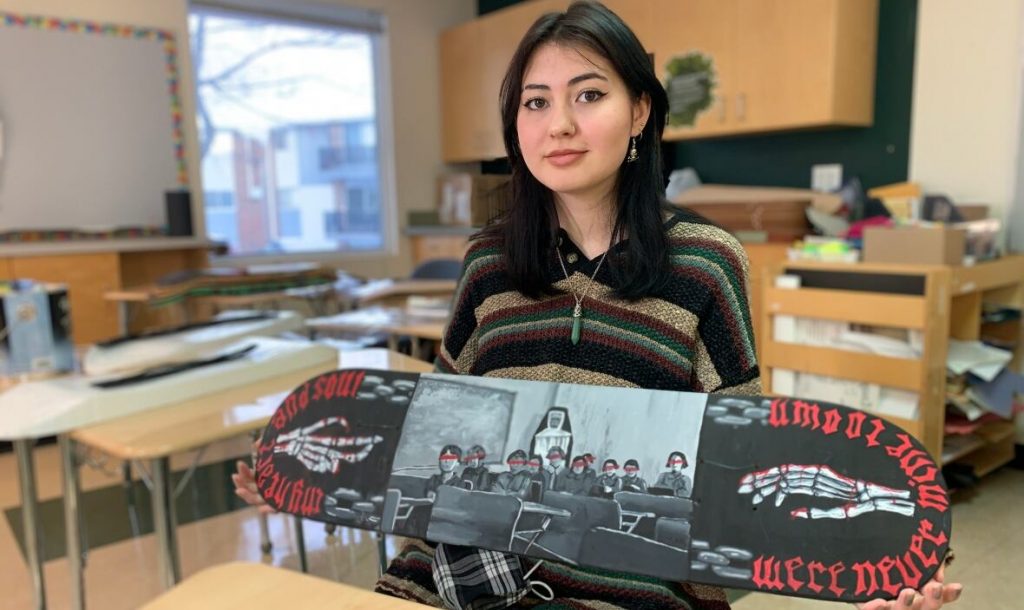
An Albertan teacher made waves with his “sk8trepreneur” course in 2020. One of the class projects was on “Exploring Colonialism, Creativity and Reconciliation with Skateboards, [which] combines skateboard design with Indigenous history” (CBC).

Kristian Basarada had his students create their own brands from the ground up, from defining their brand’s purpose to designing a logo. He teamed up with Cree artist Jon Cardinal and Cree professional skateboarder Joe Buffalo. Buffalo is also a residential school survivor and shared his experiences with the students. The project culminated in the students’ work being showcase at a local skateshop for over a month.

Grade 12 student Georgia Lantz displays her skateboard design. (CBC/Dave Bajer)

Grade 12 student Georgia Lantz displays her skateboard design. (CBC/Dave Bajer)

As a Digital Arts / Graphic Production teacher, I find Basarada’s project incredibly inspiring. He authentically ties together teen culture, history, maker-skills, and the community. Skateboards have a history of pushing the underrepresented out from under the rug of Mainstream Culture. Candian Dimension has an excellent interview with Micheal Langan, owner of Colonialism Skateboards. “Riding is resistance. Every kickflip, nose grind, or ollie in an occupied territory like Canada is an act of thrashing colonialism” (Sean Carleton, 2018).


References:

CBC/Radio Canada. (2020, November 29). Sherwood Park teacher wins GG award for course linking skateboard design, Indigenous history | CBC News. CBCnews. https://www.cbc.ca/news/canada/edmonton/sherwood-park-teacher-wins-gg-award-for-course-linking-skateboard-design-indigenous-history-1.5816784.

Sean Carleton. (2018, June 13). Thrashing colonialism: Skateboarding, history, and the power of education. Canadian Dimension. https://canadiandimension.com/articles/view/thrashing-colonialism-skateboarding-history-and-the-power-of-education.

– Laura Ulrich