In 2016, the annual Elders Gathering was held on the T’exelcemc traditional territory in Williams Lake. A live stream was recorded of the event. This gathering is especially important to me, as the speakers are Elders and leaders from my local community.
At [3:15:20] Chief Joe Alphonse speaks. He talks about his ancestral connections to the Chilcotin War in 1864, and about the monumental win of the Tŝilhqot’in Nation in gaining the first declaration of Aboriginal title in Canada. “It was not just a Chilcotin win, it was a win for all First Nation” [3:17:00].
I invited Chief Joe to my Career & Life class a couple of years ago. One of the most impactful pieces of wisdom he shared was the importance of being a warrior. Today’s weapons are different (education, words, and legislation), but the goal remains the same: to stand up for a better future.
I wish I had downloaded the second day’s video when it aired, as it was quickly taken down. I think the reason(s) why is an important point to discuss. YouTube said it was for “copyright infringement”. It was unclear if the algorithm flagged it, or if it was reported by an individual.
Was it because local Indigenous musicians shared their love of Elvis by singing his songs in their language?
Was it because some of the sacred dances’ origins are points of contention?
Was it because of protocols, or because someone disagreed with sacred wisdom being shared on a public platform?
To make matters worse, the file I had saved my favourite quotations on seems to have been lost in the ether. This just goes to show that while digital technology can be a boon (ex: allowing anyone to witness the Elders Gathering during/after it took place), our reliance on it can be dangerous, and lead to even greater losses of Indigenous Knowledge.
Note to self: backup MET notes as PDFs and print them, rather than leave them on the obscure mind-mapping program I have been using.
Given the current situation within the education system amid the pandemic, many districts have opt to carry on online learning for the next school year. Is this a benefit or problem for students who live in remote areas? How about the effectiveness of e-learning for aboriginal students? As I continue to search into my inquiry question of how e-Learning could support Indigenous students in rural communities, here is an article to share:
This article explores perspectives of e-Learning for Indigenous students in remote communities in Labrador. It discusses the opportunities and challenges that students in rural communities face with distant learning, and the learning needs of Indigenous students and their achievement issues that characterize aboriginal populations.
Reference:
Philpott, D., Sharpe, D., & Neville, R. (2010). The effectiveness of web-delivered learning with aboriginal students: Findings from a study in coastal Labrador. Canadian Journal Of Learning And Technology / La Revue Canadienne De L’Apprentissage Et De La Technologie, 35(3). Retrieved from https://www.cjlt.ca/index.php/cjlt/article/view/26386/19568
After listening to Lee Brown’s interview on emotional health, I have been diving deeper into his six teachings on how to recover emotional health, both in and out of the classroom. I found this study, Aboriginal Perspectives on Social-Emotional Competence in Early Childhood, conducted through the University of Alberta. It looked at identifying the most important elements of healthy development for Aboriginal children, with a focus on social-emotional development. It mirrors some of Lee Brown’s points about how interconnected cultural wellness, emotional wellness, mental wellness, and social wellness are and how they make up the foundation of one’s identity. The study supports Brown’s claim that emotional skills are vital to success. Granted there are some critiques I would have regarding the study. For example, there were only 37 participants and I’d like to know more about the people conducting the study, are they Indigenous? Does the fact that they are women influence anything? Nevertheless, this study is jumping off point for diving deeper into exploring emotional competency.
In ETEC 510, I came across the One Laptop Per Child (OLPC) Initiative. The idea of providing access to a laptop to every child in developing countries sounds like a wonderful idea. Given some communities have the similar issue in accessibility in devices, I wonder if this is something that is embraced and welcomed by Indigenous people? The reason is that Ginsburg (2008) mentioned the notion of Aboriginal people viewing media and technology, which are dominated by western ideals, as a mean to “wash out” indigenous lives and cultural practices. They don’t want their traditional knowledge to be under the Western systems of intellectual property. Hence, I am intrigued to explore the effect of this initiative in aboriginal communities further more.
Reference:
Mmnationtalk (2013, May). Students of First Nation School receive laptops from One Laptop per Child Canada. Nation Talk. Retrieved from https://nationtalk.ca/story/students-of-first-nation-school-receive-laptops-from-one-laptop-per-child-canada
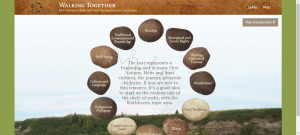
In Alberta we have a resource called Walking Together that focuses on First Nations, Metis, and Inuit Perspectives in Curriculum. Some of the topics you can explore are Connection to the Land, Treaty Rights, Elders and Culture and Language to name a few. I explored the topic of Oral Traditions to see just what was available and how the voice of Oral Traditions is represented. The link allows the user to, “Develop an understanding of stories that preserve and reinforce the oral traditions of Inuit, Métis and First Nations people.” From this link there is a small collection of videos that showcase stories and there are further weblinks to storytelling. This seems to be a rich resource on many topics that help to understand curriculum perspectives on First Nations, Metis and Inuit.
In this first module, a guiding question we had was, “How might Indigenous education and use of technology have different goals than “mainstream” educational goals and purposes?” Keeping this in mind, I began my dive into the web looking for current opportunities for Indigenous Youth when it comes to technology and what the impact of mainstream education on those opportunities looks like.
I first came across a site created by June Kaminski and Sylvia Currie who at the time were from Kwantlen Polytechnic and the Nicola Valley Institute of Technology. The site is called First Nations Pedagogy Online which you can access HERE. The purpose of the site is to provide “best practices and support for online learning initiatives that are intended for Indigenous students, Elders, educators, curriculum developers, and educational leaders.” This particular resource is extremely beneficial for developing an understanding of First Nations Pedagogy and all that it encompasses, including culture.
Ultimately, to the indigenous peoples of this planet, culture is living, growing, and ever evolving.
I created a screencast of the website focussing on how mainstream culture has impacted Indigenous Education and Peoples as well as a brief explanation of all the opportunities for learning within the site.
Under the education section in the 94 Calls to Action, #10 states:
We call on the federal government to draft new Aboriginal education legislation with the full participation and informed consent of Aboriginal peoples. The new legislation would include a commitment to sufficient funding and would incorporate the following principles: i. Providing sufficient funding to close identified educational achievement gaps within one generation. ii. Improving education attainment levels and success rates. iii. Developing culturally appropriate curricula. iv. Protecting the right to Aboriginal languages, including the teaching of Aboriginal languages as credit courses. v. Enabling parental and community responsibility, control, and accountability, similar to what parents enjoy in public school systems. vi. Enabling parents to fully participate in the education of their children. vii. Respecting and honouring Treaty relationships.
What the government website says is happening…
Based on the policy proposal for transforming the Government of Canada’s support for First Nations elementary and secondary education that was co-developed with First Nations, Indigenous Services Canada has established a new policy framework for First Nations elementary and secondary education.
I’m not sure what the policy framework is, because it was not linked to the government site. But suffice to say that I will be inquiring and investigating more about it and to see if it supports this call to action.
94 Calls to Action as a result of the Truth and Reconciliation Commission Call to Action #9.
We call upon the federal government to prepare and publish annual reports comparing funding for the education of First Nations children on and off reserves, as well as educational and income attainments of Aboriginal peoples in Canada compared with nonAboriginal people.
As you can see from the repetition of parts of this call, Call #8 was to eliminate the discrepancy, and then call #9 is about reporting out. This report only speaks to 2016-2017. It’s 2021… I find it interesting that there is not clearer data even though every school year there should be a report. I did find the chart particularly interesting below. In theory, anyone attending a provincial school even on-reserve should have full funding from the government. I wonder if they are?
What is happening?
Indigenous Services Canada is continuing to produce reports on education funding. The most recent public report is from the 2016 to 2017 school year:
Use the link above to see the whole report on funding.
Of particular interest for those that are not understanding, FTE means “Full-Time Equivalent” so if a student is part-time they are not a 1.0FTE. Those schools under self-governance agreements are something I am very interested in learning more about.
Table 1: First Nations K-12 education: Number of FTE students by type of school (2016-2017)
BC
AB
SK
MB
ON
QC
Atlantic
All provinces
% of total
First Nation-operated schools
4,639
9,752
15,834
15,143
12,884
6,230
1,661
66,141.9
65%
Provincial schools
7,143
6,838
3,556
5,693
5,915
1,597
1,536
32,277.6
32%
Private/Independent schools
725
243
28
189
525
344
44
2,096.6
2%
Federal schools
70
1,398
1,468.0
1%
Total FTE students
12,472
16,902
19,418
21,024
20,722
8,171
3,240
101,984.1
100%
Note: Figures may not add up due to rounding. FTE counts do not include students under self-government agreements.
Call to Action #8 We call upon the federal government to eliminate the discrepancy in federal education funding for First Nations children being educated on reserves and those First Nations children being educated off reserves.
The Call to Action is one that is near and dear to my heart. I worked with Fort Nelson First Nations as one of their high school science and math teachers in 2006 and at the time, the band had voted to agree to pay BC teachers the same amount as we would have had worked at one of the BC School District Schools. This meant there was less money from their accounts going to elder care, and children programs, but they wanted to recruit and retain teachers at an independent school. That’s something to note, that many of the on-reserve schools are considered independent schools and are not eligible for the same funding model from the province per student in the schools. There are also stricter reporting guidelines. My goal is to see what the government says is happening in Module 1 and research what is happening in Module 2 and how to get people interested, invested and caring about Truth and Reconciliation.
The Government of Canada says that the following about what is happening with this particular Call to Action.
To help address the education attainment gap, the Government of Canada has made significant investments, totaling $2.6 billion over 5 years for primary and secondary education on reserve. This includes funding to address immediate needs and to keep pace with cost growth over the medium term, as well as investments in language and cultural programming and literacy and numeracy.
The Government of Canada has worked closely with various First Nations partners to implement an inclusive and comprehensive engagement process on First Nations kindergarten to grade 12 education on reserve, including investing $3.6 million to support community-level discussions. The engagements were led by First Nations organizations and provided community members with the opportunity to share their views on how to improve First Nations student success.
On January 21, 2019, a new co-developed policy and improved funding approach to better support the needs of First Nations students on-reserve was announced. As of April 1, 2019, the new funding approach:
replaces outdated proposal-based programs with improved access to predictable core funding
ensures base funding is comparable to provincial systems across the country while working towards additional funding agreements based on need to better account for factors such as remoteness, school size, language, and socio-economic conditions
provides First Nations schools with $1,500 per student, per year, to support language and culture programming
provides new resources which will support full-time kindergarten in every First Nations school for children aged 4 and 5
ensures special education funding is more predictable, with fewer application-based requirements
#7. We call upon the federal government to develop with Aboriginal groups a joint strategy to eliminate educational and employment gaps between Aboriginal and non-Aboriginal Canadians.
Below is the exact wording of the budget and what happened. I found it interesting that students were supported by predictable and sustained base funding. I wonder if that translates into the same amount of dollars to dollars that a student going to school off-reserve would get? It is also interesting to note that many on-reserve schools are considered independent schools and therefore do not receive the same base funding usually. I will have to look into this more.
Below is a detailed account from the link above on what has been done to eliminate educational and employment gaps between Aboriginal and Non-Aboriginal Canadians to date.
Budget 2016 provided new investments in primary and secondary education on reserve, totalling $2.6 billion over 5 years. This includes funding to address immediate pressures and to keep pace with rising costs in the medium term, as well as provide for additional investments in literacy and numeracy programs and special needs education.
Building on this investment, on April 1, 2019, Indigenous Services Canada began implementing a new approach to First Nations elementary and secondary education, which was co-developed with First Nations education leaders and experts from across the country. This approach includes new formula-based regional models for First Nations education that will ensure that students attending First Nations schools are supported by predictable and sustained base funding that is more directly comparable to what students enrolled in provincial systems receive. On top of this base funding, this new approach will provide additional funding to on-reserve schools for language and culture programming and full-time kindergarten for children aged 4 and 5.
Budget 2016 invested $969.4 million over 5 years for the construction, repair and maintenance of First Nations education facilities. With respect to post-secondary education, Budget 2016 provided $1.53 billion over 5 years to increase amounts of the Canada Student Grants and $329 million per year after that. Budget 2016 also announced that funding provided by the Post-Secondary Student Support Program will no longer impact eligibility for the Canada Student Loans Program’s non-repayable grants and loans support. As a result, Indigenous students can access both student funding programs as long as they meet eligibility criteria. This measure will increase the amount of non-repayable Canada Student Grants and Canada Student Loans that Indigenous students may receive.
Budget 2017 provided:
$90 million over 2 years, beginning in fiscal year 2017 to 2018, for the Post-Secondary Student Support Program
$100 million for the First Nations and Inuit Youth Employment Strategy Skills Link and Summer Work Experience program
$5 million per year for 5 years, starting in fiscal year 2017 to 2018, for Indspire, a national Indigenous-led registered charity that invests in the education of Indigenous peoples, conditional on Indspire raising $3 million per year in matching funds from the private sector
The Government of Canada undertook a comprehensive and collaborative review with Indigenous partners of all current federal programs that support Indigenous students who wish to pursue post-secondary education. The purpose of the review is to ensure that these programs provide Indigenous students with the resources and support they need to attend and complete post-secondary studies.
Building on this engagement, Budget 2019 announced $815 million over 10 years, starting in fiscal year 2019 to 2020, and $61.8 million ongoing in support of Indigenous post-secondary education. This includes:
$327.5 million over 5 years to support First Nations post-secondary students and the development of regional education strategies
$125.5 million over 10 years and $21.8 million ongoing to support an Inuit-led post-secondary strategy
$362.0 million over 10 years and $40 million ongoing to support a Métis-Nation strategy
Budgets 2016 and 2017 committed to renew and expand the Aboriginal Skills and Employment Training Strategy beyond March 31, 2018. Budget 2018 announced $2 billion over 5 years and $408.2 million per year ongoing, to support the creation of a new Indigenous Skills and Employment Training Program, which will replace the Aboriginal Skills and Employment Training Strategy. Extensive engagement took place with Indigenous partners in 2016 and 2017 to develop a proposal for future labour market programming. The Government of Canada has consulted with, and heard from, Indigenous partners on the importance of a distinctions-based approach that recognizes the unique needs of the First Nations, Inuit and the Métis Nation. To that end, the new program will provide:
$1.1 billion over 5 years and $235.7 million per year ongoing, for a First Nations stream
$325 million over 5 years and $67 million per year ongoing, for a Métis Nation stream
$161.2 million over 5 years and $32.6 million per year ongoing, for an Inuit stream
$213.4 million over 5 years and $45.2 million per year ongoing, for an urban or non-affiliated stream
Work with First Nations, Inuit and Métis organizations and service providers to ensure all Indigenous people have access to the skills development and employment training they need to fully participate in the Canadian economy will continue.”