Category Archives: MODULE 2

Module 2, Post 2 | University of Manitoba Press

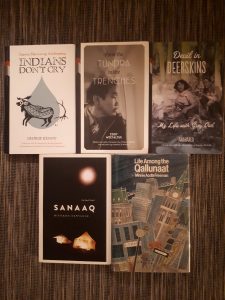
From what I can see, the University of Manitoba Press is doing great work. By focusing on local, and place-based content, their front-list titles consistently seem to reflect a broad lens on Indigeneity. I’m particularly fond of their First Voices, First Texts imprint – which “aims to re-connect contemporary readers with some of the most important Indigenous literature of the past.”

M2P4 – Changing Teaching Math

M2P4 

This article digs deeper into the how behind incorporating indigenous content, but more importantly how to change teaching mathematics to indigenous students. As I have started to realize, the article says the process requires investment from the teachers, indigenous communities and takes time, planning and small steps. While the initiative took place at many schools, the article follows one school in particular, and notes that a benefit was that the school was more welcoming and had more warmth due to the strengthened relationship to the community. Teacher transformation was also needed for change. The teachers received teaching strategies and tools, but also teachings being responsive to students. This responsive teaching was scaffolded with consultation and mentoring with two way sharing of culture and intellectual knowledge with Indigenous peoples. I think about how I am worried about proceeding due to worry of offending, or ‘doing it wrong’. The level of collaboration and support these teachers received with ingidenous experts was astounding and something to aspire to.

Owens, K. (2015). Changing the teaching of mathematics for improved indigenous education in a rural Australian city. Journal of Mathematics Teacher Education, 18(1).

Module 2, Post 1 | Indigenous Editors Association

This organization’s goal is to provide editorial, consultation, and training services to authors and publishers that work with content intended to reflect Indigeneity. Staffed by folks with an Indigenous heritage, they make editorial, consultation, and training opportunities available to their members so that publishers and authors can be put in touch with an appropriate IEA consultant/editor. My final project looks at how publishers can make their content more reflective of diverse perspectives; employing a services like this, that provides consultation and sensitivity readings, is a step forward on the path to more inclusive content.

https://www.indigenouseditorsassociation.com/

M2P3 – Numeracy In Haida Gwaii

While this resource is long, it includes deconstructing the layers of numeracy to create a shared understanding of what numeracy is. From there, it dives into epistemologies in learning math, and an overview of research methodology. While it is a valuable and interesting read, my interest peaked when I looked at Chapter 5 – Numeracy Practices in the Community of Haida Gwaii. This includes over a hundred pages of traditional ways of the Haida and their use of math in their cultural context. One example would be the Rythm of the Tides. It explains how it is important to Haida culture, including information from Haida, Parks Canada, as well as pictures and data. It connects the pattern to the sinusoidal function, and to sine function. That concept in math I would have never dreamed or guessed how to show a real world example, but it was all there, with cultural context to boot!  It also included actual activities to do within the appendix like blanket designs and meaning.

Neel, K. I. S. (2007). Numeracy in haida gwaii, BC: Connecting community, pedagogy, and epistemology Retrieved from https://peterliljedahl.com/wp-content/uploads/Thesis-Kanwal-Neel.pdf

MOD #2 POST #1: Why Indigenous Languages Matter and What We Can Do to Save Them

Why Indigenous Languages Matter and What We Can Do to Save Them | Lindsay Morcom | TEDxQueensU – YouTube

Lindsay Morcom at the TEDxQueensU spoke of how Indigenous languages in Canada are either endangered or vulnerable. Losing languages wasn’t by accident, she discussed how laws and policies were implemented, especially the residential school system, and the impact of cultural genocide. Her presentation included cultural and place-based examples to emphasize the importance of Indigenous languages. Dr. Morcom also described ways we can support the revitalization of languages. Examples include the Mi’kmaq culture and language-based education implemented by self-government as well as the Kingston Indigenous Languages Nest program. What can we do? Need for policies with funding to ensure Indigenous languages are incorporated meaningfully in both on-reserve and off-reserve educational settings. In addition, the need for support, not just financial but physical spaces to learn and dialogue into why Indigenous languages are important. Preserving languages is a vital step for reconciliation.

M2P2 – Math Catcher

The site below was created out of a grant from 2011 with sponsorships from BC and it’s goal was to overcome challenges in teaching math to Aboriginal youth by teaching math in a cultural context and teaching basic skills and problem-solving early on. The particular part of the site that drew me in was the Stories/Movies section which includes a series of stories with mathematical themes including many different translations of each story, such as English, Cree and Blackfoot.  I also loved that it stayed true to the idea of oral storytelling, and the stories are oral, not written. There are moving pictures that assist in telling the story, and also background noises found in nature, such as birds chirping, and water running. One story, Small Number and the Basketball Tournament, described a boy and his day in school, and the basketball tournament. It explains the amount of hopes, the amount of players, and shifts using algebra but also the family connections and female empowerment. At the end, it repeats Small Numbers conclusions, and asks the audience how he figured it out. I could see this story being used as a good brain warm up in class, getting kids to talk it out, replay the story, and come up with the reasoning. I will be looking forward to trying that out in my own classroom.

Stories/Movies. Math Catcher. (n.d.). http://mathcatcher.irmacs.sfu.ca/stories

M2P1: Haida Legends and Math

This article followed a group of teachers from School District of Haida Gwaii Queen Charlotte Islands who collaboratively worked with local community members, educators and researchers from UBC. The goal was to create math experiences within the context and connection of Haida Gwaii culture. I really liked that the intent was not just to find connections between math and Haida culture, but they referred to it as math experiences – a naturally occurring connection making it relevant to lives and culture. The particular lesson they shared came from a Haida legend called “Raven Brings the Light’ and involves building bentwood boxes with students from grade 4-9, which is within my age range. They connected the legend and activity to curricular concepts in math, such as ratio, 3D geometry and measurement . I also enjoyed that the students would be presented on their graduation with their boxes, as well as other culturally created items. The article provides a lesson plan, including where to find the legend in an audio from CBC radio, which makes this resource very accessible for teachers.

Novakowski, Janice (2008). Haida Legends: Culturally Responsive Mathematics. Vector, 49(2) 20-24.  https://www.bcamt.ca/wp-content/uploads/vector/492-Summer-2008.pdf

Building Resiliency through the We Light the Fire Project (M2P5)

Fanian et al. (2015) evaluate the role art plays in building resiliency through the Kots’iìhtła (“We Light the Fire”) Project. The participants were Tłı˛cho˛ youth (of the Northwest Territories), facilitated by Indigenous youth artists/mentors. While the project’s original goal was suicide prevention among youth, participants steered its course by choosing issues that were important to them. During the workshops, “participants began to share about challenges such as alcohol use, cyber bullying and suicide and employment, as well as positive aspects of their community and visions for their own and collective future through the artwork and in conversations” (p. 7). Projects ranged from visual arts to music, film to photography. At the end of the project, the particpants’ creations were shared with the community. The project was deemed a success, as both participant self-reflections and mentor observations saw an increase in participant confidence and resiliency. Additionally, participation in art-making was found to have the potential for facilitating bonding and sparking conversations for change.

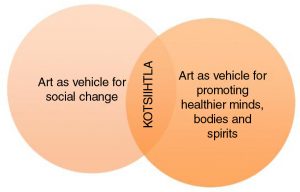
Art as a vehicle for social change + art as a vehicle for promoting healthier minds, bodies, and spirits = Kotshiihtla

Reference:

Fanian, S., Young, S. K., Mantla, M., Daniels, A., & Chatwood, S. (2015). Evaluation of the Kots’iìhtła (“We Light the Fire”) Project: building resiliency and connections through strengths-based creative arts programming for Indigenous youth. International Journal of Circumpolar Health, 74(1), 27672. https://doi.org/10.3402/ijch.v74.27672

Bridging Communities Through Murals (M2P4)

In their paper, Taonsayontenhroseri:ye’ne: the Power of art in Indigenous Research with Youth, Whitlow et al. (2019) report on their arts-based research project, Transformation, Action, Grafitti (#TAG). Participants were from Six Nations, the unceded territory of Brantford, Chili, and the Mapuche territory of Kompu Lof. The project’s goals were first, to nourish cultural pride for Indigenous youth, and second, to educate non-Indigenous youth “through a for-Indigenous-people-by-Indigenous-people framework” (p. 182). During the workshops, participants created doodles based on what they were seeing and hearing. Later, these doodles were collected by the Alapinta (Chilean) muralists, who tied them together into two sister murals. The murals were painted in prominent locations in Six Nations and the Brantford downtown-core. They sparked conversations about reconciliation that, thanks to the Internet and social media, reached globally.

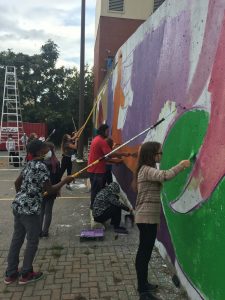
Participants working on the Brantford mural

Participants working on the Brantford mural

The authors say this about the power of art:

“For this reason, art was even better medium for communication across the barriers of colonial languages. Haudenosaunee people often struggle to translate their stories from their original languages as English does not communicate the depth and complexity of their own morphology. The images that appear in the mural can be interpreted and valued regardless of spoken language. Indeed, art was the bridge between groups of people who spoke four different languages, often through a translator. Despite our struggles with language, symbolism and cultural imagery became a shared and complex form of communication” (p. 186).

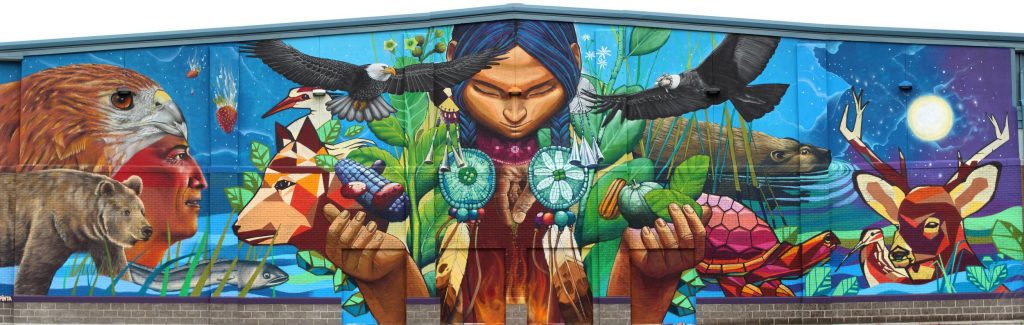
the Six Nations mural

The #TAG’s completed Six Nations mural


Reference:

Whitlow, K. B., Oliver, V., Anderson, K., Brozowski, K., Tschirhart, S., Charles, D., & Ransom, K. (2019). Taonsayontenhroseri:ye’ne: the power of art in Indigenous research with youth. AlterNative: An International Journal of Indigenous Peoples, 15(2), 180–189. https://doi.org/10.1177/1177180119845915

Indigenous Youth Leadership: HIV-prevention and the Arts (M2P3)

In their paper, “Because we have really unique art”: Decolonizing
Research with Indigenous Youth Using the Arts, Flicker et al. (2014) outline the process and results of the project for Taking Action!, an Indigenous-youth-led project on using art for HIV prevention. The paper opens with the following quote by France Trépanier:

Art can be medicine, a survival tool, an antidote. Art is our identity, our place, a sign of our presence on this planet. It is medicine as it helps healing because we’ve been through so many things. Art is for the people. It can help build our communities.
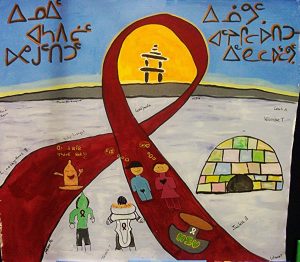
Mural Created by Inuit Youth Participants of Puvirnituq, Nunavik

Mural Created by Inuit Youth Participants of Puvirnituq, Nunavik

The goal of the project was to “explore the links between community, culture, colonization, and HIV” (p. 16). Twenty Indigenous artists and over one hundred youth (age 13-29) participated from six different communities across Canada. The project was guided by a committee of Indigenous youth. The paper is full of commentary from the participants, who found the workshops to be fun and helped them talk about HIV. The opportunity to learn ” traditional art forms, such as carving, throat singing, drumming, and painting, was an effective way to focus on the issues while learning about, and in some cases, reclaiming, parts of their heritage” (p. 22). The authors emphasize the importance of giving participants choice in what they did. As an educator, one comment particularly stood out to me: “You talk so much you don’t really remember, but if you do art you are going to remember it all” (p. 23).

At the end of the workshops, the participants had created pieces that they were proud of. These were shared with the community, such as paintings showcased locally and songs played on the radio. The project helped the participants challenge stereotypes about Indigenous youth. “Using the pieces as a springboard for discussion was suggested as a way to help people open up when talking about ‘hard things'” (p. 26).


Reference:

Flicker, S., Yee Danforth, J., Wilson, C., Oliver, V., Larkin, J., Restoule, J.-P., Mitchell, C., Konsmo, E., Jackson, R., & Prentice, T. (2014). “Because we have really unique art”: Decolonizing Research with Indigenous Youth Using the Arts. International Journal of Indigenous Health, 10(1), 16–34. https://doi.org/10.18357/ijih.101201513271