Category Archives: MODULE 2

M2P5: Tua’ll (and then) I used math to tell a story

Tua’ll (and then) I used math to tell a story: Using think alouds to enhance agency and problem solving in an indigenous high school mathematics class

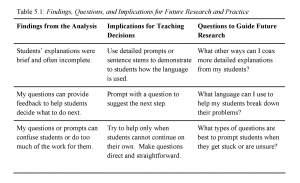
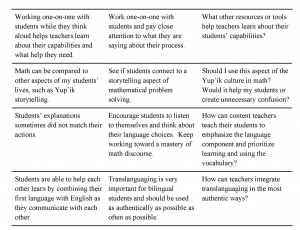
This thesis is an action-research project in a high school math classroom that focuses on student discourse and agency. I am excited that I found such a detailed and extensive account of someone’s journey of incorporating Indigenous culture into an Indigenous high school mathematics class.

Below are some findings, implications, and questions from the report.

M2P4: Indigenous Learning Preferences and Interactive Technologies

A research study conducted in BC that studied the impact of interactive technologies on math achievement of Indigenous students in Grades 4-7.

Kitchenham, A. (2017). Indigenous Learning Preferences and Interactive Technologies. The Australian Journal of Indigenous Education, 46(1), 71-79. doi:10.1017/jie.2016.12

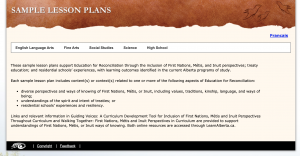
M2P3: Alberta Ed Sample Lesson Plans

These sample lesson plans support Education for Reconciliation through the inclusion of First Nations, Métis, and Inuit perspectives; treaty education; and residential schools’ experiences, with learning outcomes identified in the current Alberta programs of study.

Each sample lesson plan includes content(s) or context(s) related to one or more of the following aspects of Education for Reconciliation:

  • diverse perspectives and ways of knowing of First Nations, Métis, or Inuit, including values, traditions, kinship, language, and ways of being;
  • understandings of the spirit and intent of treaties; or
  • residential schools’ experiences and resiliency.”

I was excited to find this resource, but then noticed that Mathematics was not a subject included, which makes me eager to try to gather resources for teaching math in the K-12 classroom, but also makes me question why?

M2P2: Indspire Online Resource Centre

“Indspire is a national Indigenous registered charity that invests in the education of First Nations, Inuit and Métis people for the long term benefit of these individuals, their families and communities, and Canada.”

Within the Online Resource Centre contains documentation and evaluation of various projects that Indspire has completed. Some that interested me are:

M2P1: Stepping Stones

Stepping Stones is a publication of the Alberta Teachers’ Association Walking Together: Education for Reconciliation and is intended to support certificated teachers on their learning journey to meet the First Nations, Métis and Inuit Foundational Knowledge competency in the Teaching Quality Standard.”

This resource is helpful in providing a detailed overview of various topics including, but not limited to, terminology, Treaties, Canada’s history, First Nations Traditions and culture, and residential schools.

Module 2 Post 3

This paper was recommended to me by Dr. Hardman. It discusses the significance that place has for Indigenous peoples, specifically looking at the landscape that the Coast Salish nations live on. One concept that really stood out to me is that energy and life is found in all that surrounds us. This goes some way to explain why it is that Indigenous peoples are able to find a much better balance with their local environment. Rather than seeing it all as exploitable resources, it is respected as much as another human would be respected, as a living being. Marker mentions the “ensouled landscape functions in harmony with human needs – provided the correct preparations and protocols of humility are enacted” (p. 458). This term humility is so important and really not used enough in the mainstream discussion of the environment. Acknowledging our dependence on the environment to take care of us will be one key element that I want to carry forward in my teaching practice. If students can leave my classes understanding just how much we rely on the environment to be healthy and functioning, the element of humility will hopefully come through.

Analysis of Marker paper: https://www.tandfonline.com/doi/pdf/10.1080/09518398.2018.1430391?needAccess=true

Module 2 Post 2

For this blog post I reviewed an article I read regarding place-based learning. The article discusses how nature studies can be a great way to engage students’ inherent curiosities to allow for them to connect to their local environment. This part of it seems quite intuitive, however what I found very interesting was the mention that from having a local appreciation of nature, the transition to investigating nature nationally and internationally becomes easier. This again shows that local is the best place to begin when doing any sort of scientific inquiry. The examples of live labs in the local river areas that is mentioned is similar to my current idea of taking my Environmental Science classes into Stanley Park. Just like the class mentioned in the article investigating the characteristics of their local environment, I would have my class do the same! It was nice to get some encouragement that place based learning is a great way to engage students and facilitate their interests and relationship with the local environment.

Resource from: https://www.jstor.org/stable/pdf/20440205.pdf?refreqid=excelsior%3A0995ac45deb59cdf3077e43f8e0111a8

Aabijijiwan Media Lab (M2P2)

The new Aabijijiwan Media Lab is the first of its kind in Canada. Part of Winnipeg University, this space is a hub for new and established artists, housing four specialized labs as well as a collaborative studio space. These labs support community members through a range of digital maker equipment, from 3D printers and laser cutters to audio recording equipment and VR programming. The collaborative studio also serves as a space for intergenerational gatherings and working with physical-plane artforms, such as sewing, caribou hide tufting, and beading. They also run many online workshops, such as the one shown below, in both digital and traditional artforms. While these workshops are recorded, at the time of this post they do not appear to be accessible after the event has ended.
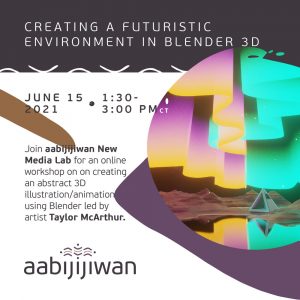
workshop with Aabijijiwan Media Lab

From CBC Indigenous:

Aabijijiwan’s first artist in residence is Scott Benesiinaabandan from Lac Seul First Nation in northern Ontario, who specializes in photography and is now focusing on augmented reality and virtual reality work.

“There’s going to be a lot of young artists with their first introduction to these sort of advanced technologies… It gives you that access, portability to technologies that we wouldn’t have otherwise and I think it’s going to be a very generative and fertile sort of place to burst new artists and new artistic ideas,” said Benesiinaabandan.


References:

Monkman, L. (2021, March 28). New Indigenous media lab at University of Winnipeg to help creators combine art and technology. CBC Indigenous. https://www.cbc.ca/news/indigenous/aabijijiwan-media-lab-winnipeg-1.5966433
Module 2 – Post 5 Student Action

The Legacy of Hope website relates back to my final question of how technology can be a tool to inspire social action in my students. The 94 calls to action are a great resource for teachers but the language is overwhelming for students. What I appreciate most about the Legacy of Hope’s Get Involved page is that it provides small steps in simple language that grade 4/5 students can understand and act on. When inspiring social action at this age, there can be a push pull with the parents. These steps range from small to large and tie nicely into other areas of curriculum to further buttress against any parent complaint (which unfortunately does exist at times).

Module 2 – Post 4 Decolonize Technology

While not focused specifically on Indigeneity, this blog by Beatrice Martini offers some hard truths and a well-developed reading list on how to decolonize technology use. I particularly appreciate the introduction to the term “borderless colonial phenomenon” as a result of digital technology. Understanding how technology continues to impart colonial values throughout the world can only help enhance my understanding of its use within Canada and my classroom.