Category Archives: MODULE 2

Module 2 – Post 3 Personal Reading Recommendation

Pulling Together: A Guide for Teachers and Instructors

This professional learning series has four sections beginning with locating yourself within history and indigenous practice through to building an indigenized practice. It offers the reader opportunities to pause, reflect, and reread before placing the information within an educational context. I found Chapter 6, Knowing yourself in relation to Indigenous People particularly interesting as a teacher. Chapter 7, Holding Space for Humility and Other Ways of Knowing and Being, had some great starting questions for considering, especially as I move to decolonize my technology use.


Module 2 – Post 2 Social Media as a resource?

I had never considered the possibility of posting an Instagram or TikTok account in a university discussion, but here we are 🙂

Peter NotSo White was introduced to some of my students with social media by a classmate. Since being introduced, his posts have sparked discussion and learning both in class and at home. He presents small but timely information bits on many different aspects of indigeneity, including where does knowledge on indigenous people come from and some of the stereotypes people are exposed to. He also uses story time to deliver messages about life that students in my class really connect with. His content is mostly age appropriate for grade 4/5 (scan first – I have not watched all of them) and his tone and manner are engaging.

His account, and others like it, is an important part of decolonizing my classroom. Relying on outdated texts that tell us a colonial view of history does not help move reconciliation forward. Neither does using texts or media created by non-indigenous voices. The Government of Canada, for example, has a plethora of information available but who benefits from its use?

Module 2 – Post 1 Colonial practice and Minecraft

While the days of Oregon Trail are well behind us, Minecraft has stepped in and filled the “exploration game” void. One of the most popular Microsoft games available for children, my school district has encouraged widespread use of Minecraft Education for socials and STEAM studies. And I happily jumped on the train: what a great way for students to be passionate about learning!

Like all technology, however, it requires a critical eye.

As we have discussed, technology goes not exist in a culturally neutral void and Minecraft is no exception. This infographic was shared by a colleague and, while simple, it effectively helped connect the game to our colonial history. There is a growing discussion about the use of Minecraft as a conquering game and who’s agenda is being pushed. Certainly, this infographic and the supporting documents I have attached have given me pause for classroom use of Minecraft. I do not believe the game itself needs to be thrown out. Rather, what conversations am I having with my students about the messages the game portrays? What activities am I asking them to do? What standard of behaviour is being set?

Further reading:

Minecraft: The Robinsonade of Creativity or Colonialism?

https://journals.sagepub.com/doi/pdf/10.1177/1555412016655678

M2. P5.

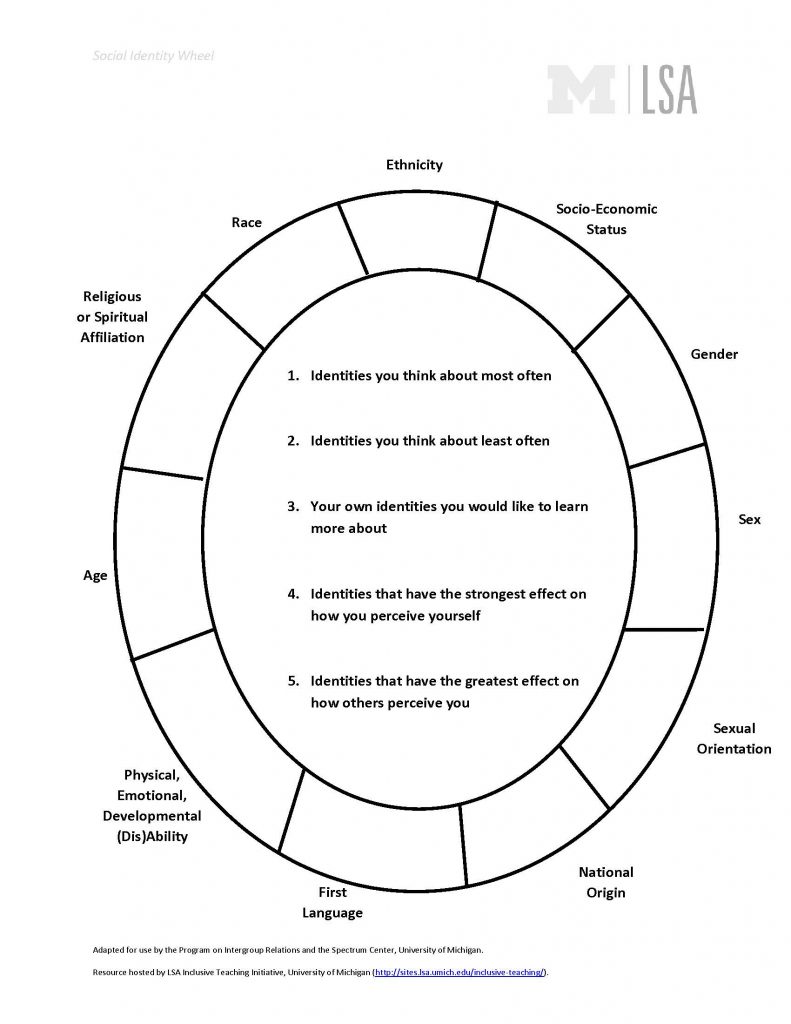
The following are Identity-based activities from the University of Michigan’s Inclusive Teaching site. Although not developed based on the FPPL, I believe that they would be valuable activities to do with students to begin the conversation surrounding who they are and how they see themselves. Even though the site doesn’t state any relation to FPPL, these activities are labelled as “Personal Identity Wheel,” and “Social Identity Wheel.” It immediately creates this connection to Indigenous ways of knowing and learning from the term “wheel” which I can connect to circles, which we know are incredibly important to Indigenous culture as they relate to the cycles of the natural world.

A note on the last image here – there is language and terms that I would absolutely refrain from using as they are negative in nature. I would even remove the “body size” category and ensure that Gender/Sex had appropriate examples that were inclusive of all.

M2. P4

The FNESC which stands for First Nations Education Steering Committee has an incredible website with tons of valuable knowledge and resources for Educators. If you click on the image below, you will be taken to a PDF of authenticated First Peoples resources along with documents to help you or your school evaluate the authenticity of resources you find or bring into your building. As I’m focussing on Identity, I loved how each resource is annotated in-depth with information about all the authors, the retelling, Indigenous Language used, and features of the resource such as if it includes a teacher guide.

M2. P3

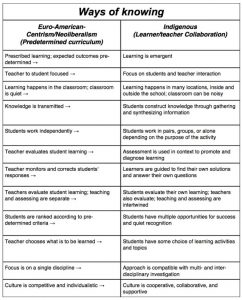
Whenever I develop Units, I’m always thinking about the end goal first. What is it that I want my students to know and what should they be able to do. However, after viewing the Ways of Knowing chart in my previous post, I can see that part of the assessment is also student-focused (and I do currently include my students in their assessment) where they evaluate their own learning.

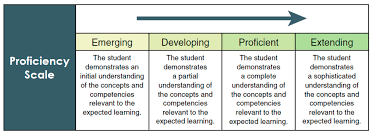
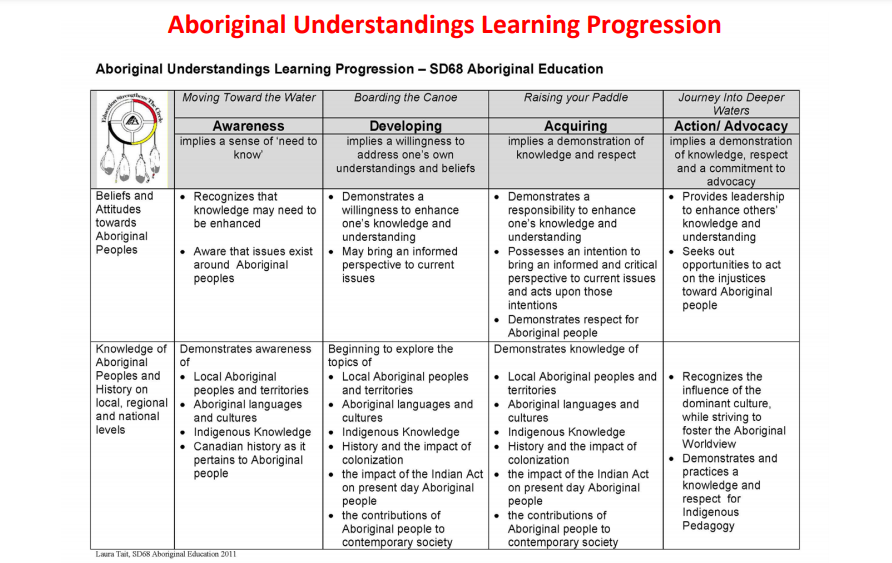
As I was researching Indigenous ways of knowing, I came across a rubric developed in SD68 along with input from FNESC and their Aboriginal Department. It speaks to beliefs, attitudes, and knowledge towards and of Aboriginal Peoples. What I love the most is how this isn’t labelled a scale but instead, a progression as one of the FPPL is that learning involves patience and time and is not about expected learning, but instead focused on experiential learning. In my district, we have a Proficiency Scale for assessment for reporting which, after reading the differences in Euro-centric views vs Indigenous in my last post I can see clearly how they do not align for Indigenous Understandings of learning.


M2. P2

In a video that I watched recently titled, “If not here, where?” the speaker said, “Success for me is when we don’t need Aboriginal Education, we just have Education.” This reminded me of how we decide assessment or the “how will we know they get it” part of our lessons and units. It speaks to the future date of how will we know the Government gets it in terms of reconciliation and I think it’s a powerful phrase that needs to be shared.

The image below is something I came across while reading the Aboriginal Resources Guide from the Surrey School District. I think this visual is really important for us and our students to see the differences and begin to practice them within our everyday lives.

Surrey Schools

Link to video here

M2. P1

I’ve been spending a lot of time reframing my final project platform and topic to focus solely on developing a Unit that speaks to the First People’s Principle of Learning; How learning requires exploration of one’s identity

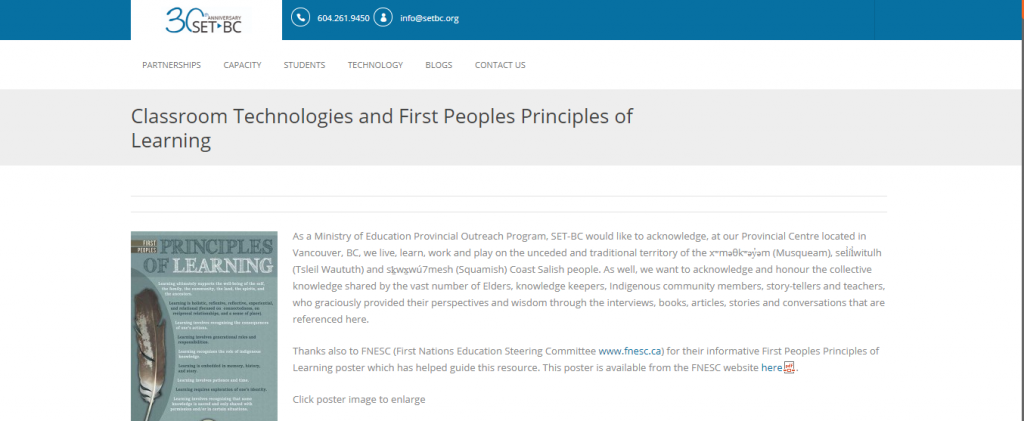
On my search for resources into how best to develop education around this principle, I came across a number of fantastic readings/videos, and sites. The first is from SET-BC which is a Ministry of Education Provincial Outreach Program which was created to “assist school districts in educating students who require or would benefit from using technology to access the curriculum.”

What I was most interested in was their Blog page which is where I found a post titled, “Classroom Technologies and First People’s Principles of Learning.” On this page, it provided a series of Modules that focussed on one particular principle. Each module includes audio, video, resources, and a breakdown of the content which can be used to fit your classroom. You can view the page by either clicking HERE or you can scroll through it below – EDIT (apparently iframes are not supported on this blog although I have used them many times before…so you can just see what the front page looks like instead or click above!)


Module 2, Post 5

What Matters in Indigenous Education

This resource addresses both the Indigenous holistic approach to learning and how to make a classroom environment welcoming for students, where all voices are recognized as integral to the construction of activity knowledge.  Dr. Pamela Toulouse explores how classrooms can be turned into quality learning environments for Indigenous students where authentic learning can take place. She also addresses issues that are preventing Indigenous students and families from learning and gives suggestions of how to create a culture of respect and acceptance. I feel that this resource culminates some major themes of my research; the holistic and emotional competency as well as helping teachers create inviting learning environments.

Module 2, Post 4

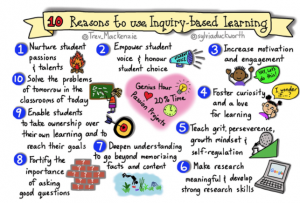
Using Inquiry in the classroom to help boost teacher confidence

Trevor Mackenzie’s Books on Inquiry in the Classroom


Trevor Mackenzie is a leader when it comes to using Inquiry-based learning in the classroom. His books have strategies and lessons that can be applied to any classroom setting. An area of research for my project is to create confidence in teachers to implement Indigenous ways of knowing and learning. Several peers commented at the beginning of this course that they don’t feel confident teaching Indigenous material. I believe that Mackenzie’s approach to teaching through inquiry will help teachers feel like they are on the learning journey with their students and not feel the pressure to know everything beforehand.