Category Archives: MODULE 2

Module 2, Post 3

First Nations Perspective on Health and Wellness

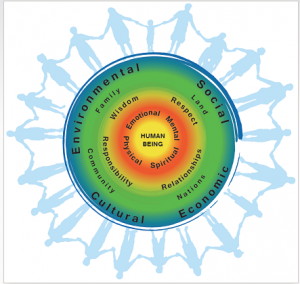
This website was developed by the First Nations Health Authority (FNHA) to work with Indigenous families and individuals on their health and wellness journey. The website works to honour traditions and cultures of Indigenous peoples while championing health and wellness from an Indigenous perspective. It aims to teach health and wellness from a holistic point of view. One of the images on the website is a circle depicting the vision of wellness.

The intention of the circles bleeding into one another is to represent wellness as a fluid concept. Wellness can change and is not confined to remain the same. The FNHA describes different types of health and wellness. They explore personal wellness, environmental wellness, mental wellness, traditional wellness, and cultural wellness. I think this will be a very beneficial resource for my final project of looking to add an emotional competency to BCs core competencies.

Module 2, Post 2

Lessons from the Medicine Wheel

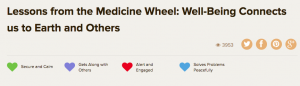
This resource builds off my first post for Module 2. This website offers lessons which connect the medicine wheel to British Columbia’s curriculum, specifically the core competencies. It provides examples of how to have students use their discussion and critical thinking skills to explore how the medicine wheel can be used as a model for teaching Personal and Social core competencies. 

Module 2, Post 1

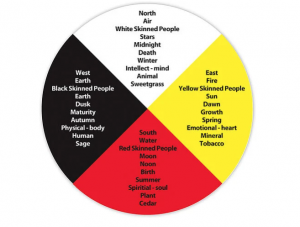
Learning about the Medicine Wheel


As I explore different resources for my project, I feel it is important to begin with learning about the medicine wheel which is a part of the foundation of Indigenous culture. It demonstrates a holistic approach to learning. This blog outlines the teachings of the medicine wheel. I also find it very useful that within the article there are links to other Indigenous teachings; like interconnectivity and the natural world. It seems that there is a plethora of information beyond the home page which makes this blog valuable for me as I begin my research.

Module 2 Post 1

My first blog post for this module is a rather sensitive one. While the FPPL is a fantastic tool for BC educators, for the sake of my assignment and searching for only the ways of knowing of the Coast Salish nations, FPPL in isolation is not a useful resource. FNESC, the organization that has put together the FPPL is a BC wide organization that includes members from 129 nations. This is a lot more than just the 3 Coast Salish nations I’m hoping to hone in on! Therefore, I must say that for my purposes, the FPPL on its own is not a tool I can solely rely on for my final assignment.

Membership and Board

M.2 P.5 Knowing Home: Braiding Indigenous Science and Western Science

When we braid Indigenous Science with Western Science we acknowledge that both ways of knowing are legitimate forms of knowledge.

I believe both of these books will prove to be useful not only for my research journey but for educators everywhere. Both of these books are free for download too! The relationship between Indigenous science and Western science is an important one. I think it touches on many points we have previously discussed in this course including Indigenous perspectives, world views, and ties them into science teachings and curriculum. It highlights another critical theme in Indigenous culture, the importance of place, and how this is interweaved with identity.

Together, the co-editors and authors, almost all of them Aboriginal, present multiple useful paths towards identifying and recognizing two huge shortfalls in the Canadian educational system to date. One is the abysmal failure of many schools to provide quality education for Aboriginal children and youth, particularly in the areas of science, technology, and health. This situation is reflected today in the marked underrepresentation of Aboriginal students participating in university-level programs in these areas, and, further, in the dearth of professional scientists from Aboriginal communities across the country. The second gap, equally lamentable, is that students of mainstream western science and technology have been deprived of learning about the immense body of Indigenous scientific knowledge, perspectives, and applications acquired and built over generations of dwelling in particular places.  Knowing Home…  will be a wonderful resource that will bring all Canadians to a higher level of understanding in these two areas.
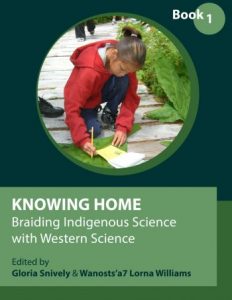
Book 1 provides an overview of why traditional knowledge and wisdom should be included in the science curriculum, a window into the science and technologies of the Indigenous peoples who live in Northwestern North America, Indigenous worldview, culturally responsive teaching strategies and curriculum models, and evaluative techniques. It is intended that the rich examples and cases, combined with the resources listed in the appendices, will enable teachers and students to explore Indigenous Science examples in the classroom; and in addition, support the development of culturally appropriate curriculum projects.
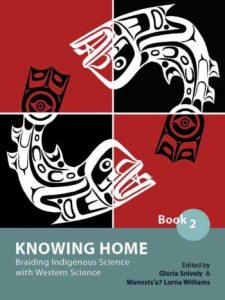
Book 2 provides supportive research, case studies, and commentary that extends and enriches the chapters presented in Book 1. The chapters provide rich descriptions related to Indigenous cultural beliefs and values; an Aboriginal concept of time; transforming teacher thinking about Indigenous Science; the use of digital video as a learning tool for secondary Aboriginal students; the perceptions and experiences of post-secondary Aboriginal students during science instruction; a WSÁNEĆ concept of “knowledge of most worth”, and a study of successful Aboriginal students in secondary science.

Snively, G. & Williams, W. (2016). Knowing Home: Braiding Indigenous Science with Western Science Book 1. University of Victoria. https://pressbooks.bccampus.ca/knowinghome/

Snively, G. & Williams, W. (2018). Knowing Home: Braiding Indigenous Science with Western Science Book 2. University of Victoria. https://pressbooks.bccampus.ca/knowinghome/
Concordia’s Aboriginal Territories in Cyberspace (M2P1)

Concordia University’s Aboriginal Territories in Cyberspace (AbTeC) was established in 2005. It is a network of artists, academics, and technologists whose goal is to ensure Indigenous-populated spaces in Cyberspace. In 2017, Concordia shared a curated collection from AbTeC through an art show, Owerà:ke Non Aié:nahne / Combler les espaces vides / Filling in the Blank Spaces. This show “illustrate[ed] a multitude of ways in which Indigenous artists, researchers, educators, designers and community activists are creating and employing new media to strengthen and complement their cultures and communities” (Jason Edward Lewis, co-founder of AbTec, as cited by Dunk, 2017).
The AbTeC website includes a gallery of projects, both past and present. One of the projects, She Falls for Ages, was created by AbTeC’s other co-founder, Skawennati. The project’s website describes it as a “sci-fi retelling of the Haudenosaunee (Iroquois) creation story reimagines Sky World as a futuristic, utopic space and Sky Woman as a brave astronaut and world-builder.”
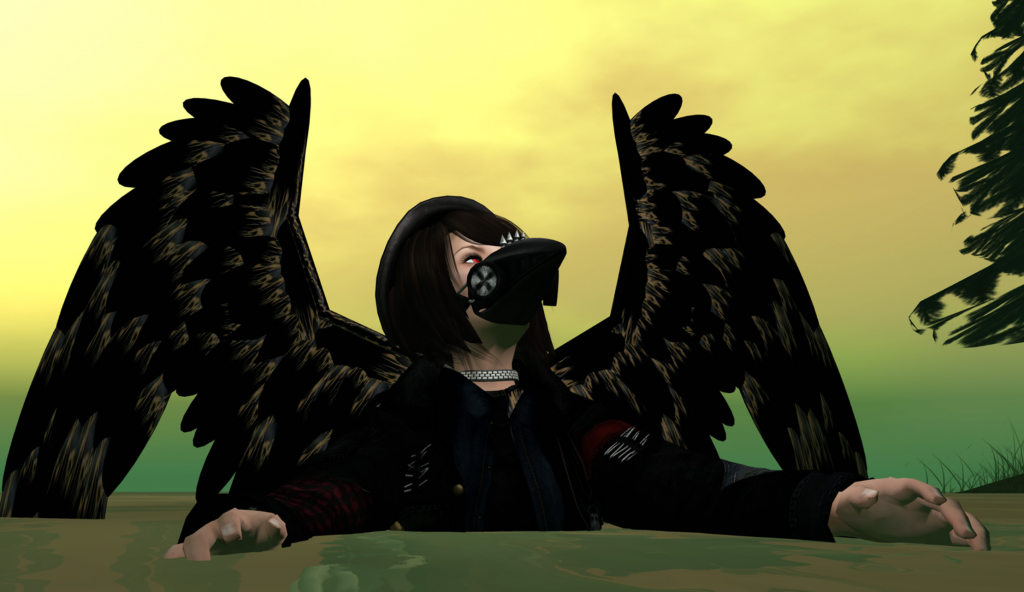
How the Loon Got Its Walk, created in a Skins machinima workshop

How the Loon Got Its Walk, created in a Skins machinima workshop at the MacKenzie Art Gallery

One of their ongoing projects is the Skins Workshop, which is part of their Indigenous Futures initiative:

The Skins Workshops teach Indigenous youth how to adapt stories from their community into experimental digital media, such as video games. One of our goals is to encourage our youth to envision themselves in the future while drawing from their heritage. We believe this helps to promote and preserve our stories, languages and cultures while also exposing our youth to the digital tools of today and tomorrow.

References:
Dunk, R. (2017, October 30). Indigenous digital art — past, present and future. Concordia University News. https://www.concordia.ca/cunews/main/stories/2017/10/30/indigenous-digital-art-leonard-bina-ellen-art-gallery.html


M2, P5: X̱wi7x̱wa Library

UBC’s X̱wi7x̱wa Library is the first (and, at present, the only) Indigenous branch of an academic library in Canada. The library, once headed by the brilliant Gene Joseph, is a leader in Indigenous academic library work. For classification, they use a variation of the Brian Deer Classification system, a method of Indigenous Knowledge Organization, that prioritize place in the classification.

In this video, Gene Joseph talks about knowledge and libraries. X̱wi7x̱wa translates to the English ‘echo’ and it’s perfect for a library, a place where knowledge is ready for the next person to access it.


M.2 P.4 STEM FOR ALL

The National Science Foundation (NSF) STEM for All Video Showcase is an annual online event. It is created by a TERC, which is an independent, non-profit, research-based organization dedicated to engaging and inspiring all students through stimulating curricula and programs designed to develop the knowledge and skills they need to ask questions, solve problems, and expand their opportunities.

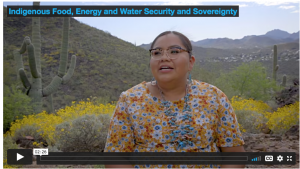
Video: Indigenous Food, Energy, and Water Security and Sovereignty.

This video talks about building sustainable technologies in the face of the destruction of balance between people and the environment. An interesting aspect is that they involve the communities themselves in the process. It summarizes the work that can be found at https://energy.arizona.edu/indigefewss.

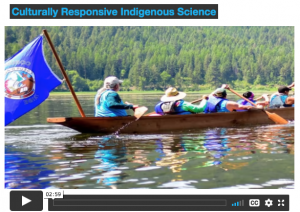
Video: Culturally Responsive Indigenous Science

This video highlights the work that discusses engagement in Indigenous knowledge systems and how public schools are missing this way of knowing and learning. The Culturally Responsive Indigenous Science (CRIS) project stems from decades of relationship building, in part facilitating culturally responsive youth development projects with our partners.

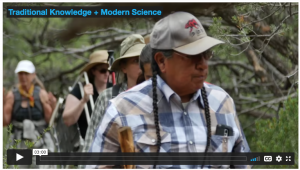
Video: Traditional Knowledge – Modern Science

The Ute STEM Project explores the integration of Western science, technology, engineering and math (STEM), and Native American Knowledge bases. This video is one in a series of videos on the project, the others can be found at https://vimeo.com/showcase/5723628. The video discusses how knowledge of the environment (TEK) and innovations have been passed down for centuries, and Western science can help to understand that past. It also highlights that it is important to understand dichotomies and not rely on just one or the other (TEK or Western) science, as well as the importance to reconnect with the land as it is what informs us.

References

202o STEM For All Video Showcase. (2020) Learning from Research and Practice May 5 – 12. https://stemforall2020.videohall.com/

TERC. (2021). Because Math and Science Build Futures. https://www.terc.edu/

M2, P3: Indigenous Heritage Action Plan (LAC)

Library and Archives Canada collects, preserves, and provides access to historical materials documenting the Canadian experience. In 2019, they worked with members of the Indigenous Advisory Circle to create the Library and Archives Canada (LAC) Indigenous Heritage Action Plan. The plan outlines 28 concrete actions LAC will take to engage, collaborate, manage, identify, support, and promote Indigenous heritage materials within the LAC collection.  The action plan introduces their approach to institutional change and how they intend to fulfill their commitment to the TRC calls to action.

Per the Action Plan (LAC, 2019):

Library and Archives Canada (LAC) is committed to playing a significant role in reconciliation between the Government of Canada and First Nations, Inuit and the Métis Nation based on a renewed nation-to-nation or government-to-government relationship, particularly with regard to human rights. These rights include international Indigenous rights, as defined by the United Nations Declaration on the Rights of Indigenous Peoples (UNDRIP), a Declaration to which the Government of Canada is fully committed. LAC has an important role to play in ensuring Indigenous rights to culture and language preservation, and in managing information relating to Indigenous peoples. International rights extend to include victims and survivors of human rights violations, as set out by the United Nations Joinet-Orentlicher Principles (UNJOP). Through the preservation of information documenting human rights abuses, such as those that took place within the Indian residential school system, LAC supports Indigenous peoples’ inalienable right to know the truth about what happened and why.

Library and Archives Canada. (2019). Indigenous heritage action plan. Indigenous documentary heritage initiatives. https://www.bac-lac.gc.ca/eng/discover/aboriginal-heritage/initiatives/Pages/actionplan.aspx