Category Archives: MODULE 2

Module 2 – Post 4

The Weaving Ways Video Series is found within the Empowering the Spirit website that I shared in my third post. I wanted to build upon the previous post as this resource site has so much to offer. This resource is found under the Classroom Supports tab on the Empowering the Spirit website. The resource is built around four interconnected quadrants of: Cultures of Belonging, Sharing Through Story, Pedagogy and Instructional Design. I found this particular part to be useful as it provides videos on Alberta teachers providing examples of how they create lessons to weave in Indigenous ways of knowing with their current practice. There are currently three videos available each with a different focus on different grade levels (elementary, middle school and high school). The video series also accompanies the Weaving Ways Introductory Guide as well as the Weaving Ways of Knowing in Classrooms and Schools Conversation Guide which can help support teachers and schools in going deeper with the video series.

I have provided the link to the first video and in particular I like how the teacher has provided a hands-on learning experience for her grade four students. She explains how she has blended in the learning from the Alberta curriculum with First Nations people by making it more authentic and real for the students by bringing them into a hands-on learning experience.

ARPDC. (2019, Sept. 16.) Weaving Indigenous Ways of Knowing in Elementary Schools and Classrooms. [Video]. YouTube. https://www.youtube.com/watch?v=H25YqrY89TY&t=21s

Empowering the Spirit website:https://empoweringthespirit.ca/classroom-supports/
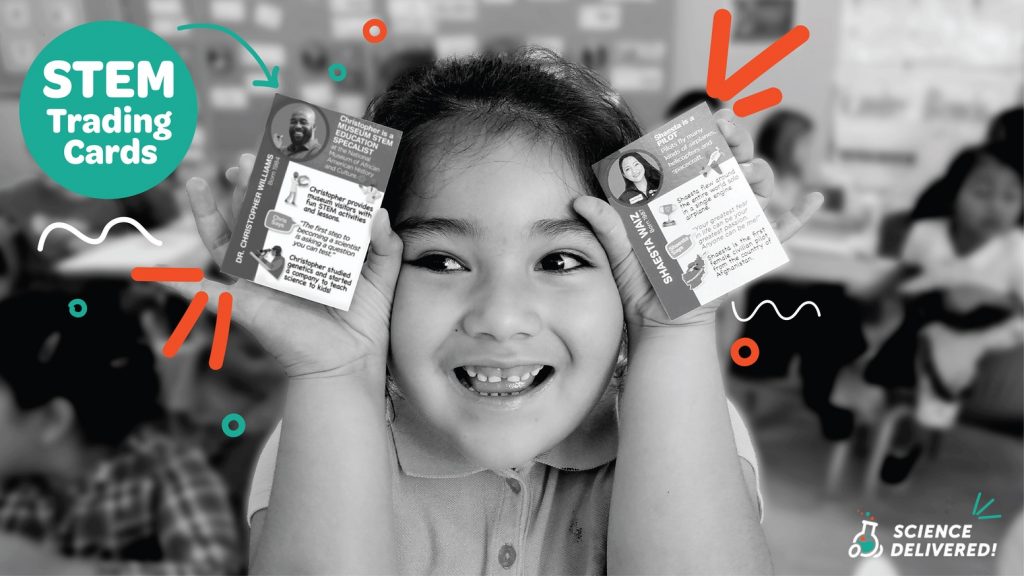
M.2 P.1 STEM & TEK

STEMTradingCards.org is a database of resources created by professionals in STEM (science, technology, engineering, and math) careers. This resource has a series of lessons on Traditional Ecological Knowledge geared towards upper elementary and middle school. Files can be downloaded and include readings, discussions, and hands-on activities.

The term TEK is often used to refer to knowledge, beliefs, value systems, and practices in Indigenous communities that relate to the environment. For many Indigenous peoples, TEK is “active” (the way in which one relates to the environment) and is sometimes referred to as a “way of life.” TEK is a branch of Indigenous science.

New to TEK: Teacher’s Guide: This resource is a great place to start if educators are unfamiliar with TEK. It includes definitions and comparisons of TEK and western science, a brief history of western science, and the integration of TEK and western science.

Dos and Don’ts for Teaching TEK: This is a quick list of guidelines to be used when teaching TEK or other aspects of Indigenous culture and history.

Lessons 1 – 5: These lessons help students and educators learn about a variety of aspects of Indigenous knowledge and science.

References

STEM Trading Cards. (2020). Science Delivered. https://www.stemtradingcards.org/teklessons


First Nations Governance – M2 P5

Grade 6 Social Studies focuses so much on looking at government.  It seemed extremely fitting to look into First Nations governance, before colonization, after colonization, and what it’s like now.  Hearing my Indigenous Advocate talking about traditional leaders being chosen based on respect instead of elections made me very curious about the traditions. This resource from the First Nations Education Steering Committee is a great resource to help kids of all grades understand the past, present and future of First Nations land, title and government in BC.  This would be a fantastic resource for early elementary all the way up to grade 12.


Potlach from the perspective of Kwakwaka’wakw peoples M2 P4

This is a fantastic resource to learning authentically about the potlach traditions, history and current use.  The site was created by the The U’mista Cultural Society who is focused on ensuring the survival of the cultural heritage of the Kwakwaka’wakw First Nations peoples whose traditional lands are on the West Coast of BC.  They have a collection of videos, writings, photos etc that cover the history of the tradition for their people, the impact of the ban, and how potlach is used currently. Potlach is a commonly known Indigenous celebration, but one that so many non-Indigenous assume is used by all the First Nations which is inaccurate.  Knowing that I am working and teaching on the lands of the Syilx people, it would be a great opportunity to compare and show the diversity of the Indigenous peoples.  While the lessons are geared towards Social Studies 4/5, I think it could very easily be adapted to middle school students to learn about biases, perspectives and the impact of government and colonialism. Also to focus on the power and resilience of Indigenous peoples who refused to give up their traditions even when they were technically made illegal.


https://umistapotlatch.ca/intro-eng.php
Living Tradition

Module 2 – Post 3

The Empowering the Spirit website focuses on sharing resources to provide a better understanding “to increase awareness, understanding and application of First Nations, Métis and Inuit histories, perspectives and ways of knowing for the purpose of implementing treaty and residential schools education and Truth and Reconciliation Commission Calls to Action for education.” Within the website, there are resources such as lesson plans, land based learning, videos, tool kits, teacher professional development and lots of links to other websites to support schools in applying Indigenous knowledge into the classroom. 

I was particularly drawn to the section on Instructional Design section as it gave me a better idea on weaving in Indigenous ways of knowing and western practices into the classroom. In particular guiding information about strengthening cultural viewpoints that can be brought into lessons and the learning environment. 

The Empowering the Spirit website resources were “developed by Alberta Regional Professional Development Consortia (ARPDC) as a result of grants from Alberta Education to support implementation.” 

https://empoweringthespirit.ca/

Mod#2-Post#5:The Future Imaginary

After completing the first module I realized that the current technology productions are in conflict with Indigenous culture. The questions that I had in mind: How is it possible to change that? How can an Indigenous led-space exist? How can engines and system be coded from an Indigenous worldview? Here I came with the core idea of my project: There is an urgent need for Indigenous people to be part of the future of this industry. It’s a mission that’s crucial not only for Indigenous people, but for anyone who wants a better, more inclusive technology.

Inline with the aim of my project inquiry, in the following TEDX (2013, September 30) production, Jason Lewis talks about the future imaginary for Indigenous communities (see the Initiative for Indigenous Futures [IFF] if you wish to know what this talk relates to). He warns that the lack of representation in technology sector (i.e., design and development) would lead to future made for Indigenous people rather than with them (7:13) and he adds that Indigenous absence from the technology world “implies at best lack of importance and at worse lack of existence” (7:26). These threats made him to work in collaboration with his colleague Skawennati Tricia Fragnito to create Aboriginal Territories in Cyberspace (ABTEC), which hosts the Skins workshops, where indigenous youth engage with the technical and creative aspects of digital media so “they become creators of technology rather than just consumers” (8:35). He emphasized that the importance of such effort is to “seed” into the Indigenous youth minds that they are also capable “to bend complex technology to their own ends” (9:08). He draws the attention that technology structures and systems reflect their builders’ perspectives and “affect us all” (12:57), and that “native people need to get involved in the building of these structures” (13:05). By that, Indigenous participants can increase the assumptions (epistemological/ cultural) upon which the technology systems are based and also the involvement will enable the indigenous people to “colonize some that future imaginary for [themselves]” (13:16). He ends his talk by stating that he asks his students to keep in their minds three questions while designing the future: “Whose past? Whose Present? Whose future?”(14:46), which I believe a message for youth to enact the future with and through their own identities/histories/cultures.

Here is a link to publications of Jason Lewis: Jason Edward Lewis — publications (jasonlewis.org)

Reference:

Indigenous perspectives on UN Sustainability goals – M2P3

UN Sustainability Goal from an Indigenous Perspective

This connects to my previous post but it’s more of a contrast because it’s showing video interviews of Indigenous leaders from all over the world speaking to the UN sustainable development goals and how they impact their people. Looking at this from a lens of Gr 6 Social Studies, there is a deep connection again to government and the choices, laws and priorities they have. What can/should the federal government, provincial government, and local governments be doing to support these? Where does the responsibility lie? How can we, as citizens, let our government know what we’d like them to prioritize. Who is it affecting and how?

Food sovereignty Syilx perspective – M2P2

Food sovereignty from the perspective of the Syilx people

This is a fantastic resource that connects to the UN sustainability goals (connections to #1 – no poverty, #2 – zero hunger, #11 sustainability, #12 responsible consumption, #14 Life below water and #15 Life on land). Talking about preserving traditional ways of getting food from the land is such a vital part of not just their traditions, but sustaining their people and our land. Looking at the Gr 6 Social Studies curriculum, this would certainly fit when talking about government and thinking about who controls what parts of the food chain and why. It’s also a neat fit into science when you look at the partnerships like the Slow Food partnership that talks about how they are trying to restore things like the Sockeye Salmon runs etc. There would also be a tie into Literacy when talking about storytelling and all the captikwl that are told around food.

Mod#2-Post# 4: Ethnocomputing with e-textiles for broadening Indigenous youth participation in Computing

Research title & link: Ethnocomputing with electronic textiles: Culturally responsive open design to broaden participation in computing in American Indian youth and communities

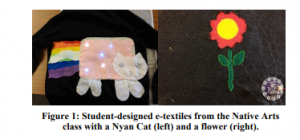
Kafai, Searle, Martinez, and Brayboy (2014) used Eglash’s ethnocomputing concept in an intervention using e-textiles, with the Lilypad Arduino sew-able electronic circuits, leveraging traditional sewing and decorative beading to learn about computing. They reported that while the activities were intended to be linked to Indigenous culture, not all the students were interested in these links, and sometimes students lacked the cultural knowledge that the activities were supposed to connect to. They note complex issues here: “Craft, like many other types of Indigenous knowledge, is rooted in particular places and connected to activities that extend beyond the space of a classroom and a computer screen. For instance, when we think about integrating community basket weaving practices with e-textiles materials, we know that there are certain times of the year during which reeds for making baskets can be collected. We also know that particular designs have cosmological significance, ties to origin stories, and are expressed within local aesthetic frameworks. Knowledges of these designs is not something that can be learned by anyone, but something that the learner must be prepared to know, coming to understand the responsibility that comes with such knowledge and the protocols for appropriate use.” (p. 245)

Kafai et al. (p.243-244)

In conclusion, the researchers advocated that Indigenous students be given agency in order to construct computational designs that are relevant to their interests and identities (Kafai et al., 2014). They added that it is crucial to place the computer science learning in the context of Indigenous knowledge, so students can connect what they are learning to their history and emergence of their communities in ways that can meaningfully broaden participation in computing (Kafai et al., 2014).

Reference

  • Kafai, Y., Searle, K., Martinez, C. & Brayboy, B. (2014). Ethnocomputing with electronic textiles: Culturally responsive open design to broaden participation in computing in American Indian youth and communities. SIGCSE 2014 – Proceedings of the 45th ACM Technical Symposium on Computer Science Education. 241-246. DOI:10.1145/2538862.2538903.


Mod#2-Post#3: IDMT-Indigenizing Computer Programming

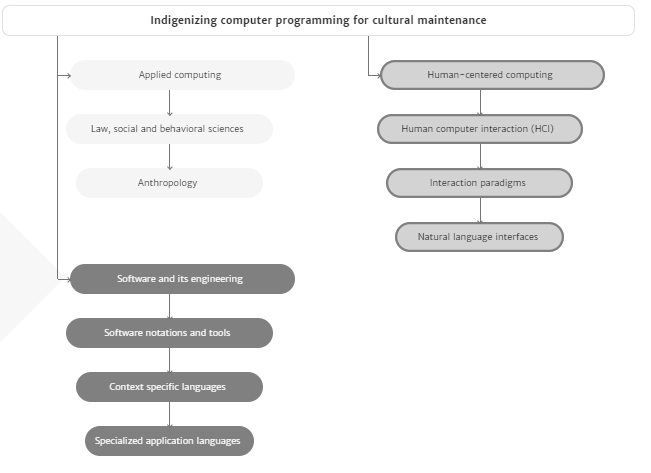
While looking for programming environment developed with indigenous views or languages, I found the research paper ” Indigenizing computer programming for cultural maintenance” that I believe will innovate computer programming and Indigenous digital design. For his doctoral research, Corbett (2018) is working on the development of a toolkit that will unite Indigenous cultural components with natural programing language, an Indigenous Digital Media Toolkit (“IDMT”) he calls it. Corbett (2018) explains that IDMT is “a programming language with a specialized user interface that uses the Cree language and syllabic writing system to programmatically create digital artworks and provides a digital foundation for the maintenance and/or revitalization of Indigenous culture” (Corbett, 2018, p.243). He adds that IDMT also contributes to the reconciliation process (Corbett, 2018).

An important point that he mentioned about his development is that he considers the design of technology at a deeper level. I want to explain why this point is essential in computer science education for Indigenous students. Most of the modification done in culturally responsive programming tools (part of my investigation for my final project), whether visual platforms (e.g., CDSTs, Alice, Scratch) or the translated environments that are used in educational/ work contexts encounter surface changes such as modifying the language, the context the tool is presented in, or the design of the computing activities themselves. However, none of these developments have entirely escaped from the legacy of the industry and the Western-coded engines/system. In turn, Indigenous students’ self-determination in design and development and possibilities of self-expression are still very limited by the pre-existing system. IDMT is the first programming language that goes to the next level as it addresses the “underlying culture as an inherent component of the coding language itself” (p. 244).

IDMT Model (Corbett, 2018)

Reference: