Category Archives: MODULE 4

M4P5: AlbertaEd – Walking Together & Talking Together

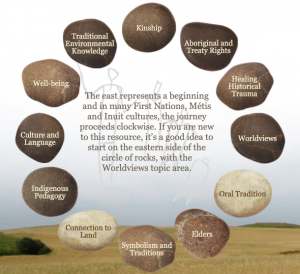
Alberta Education created a very comprehensive and interactive guide called Walking Together that provides educators with the necessary resources needed to incorporate FNMI perspectives into the curriculum.

One of my goals in my final project is to create a teacher self-reflection tool to determine which Indigenous perspectives are addressed in a particular lesson. The self-reflection tool would be a circle, similar to the front page of Walking Together, with the perspectives around the outside divided into pie pieces and then specific keywords underneath each perspective, to help guide the teacher in really analyzing their lessons.

I think this resource could also be used as a student activity, perhaps with the student reflecting on how the participation in the activity aligned with Indigenous perspectives. The student version would have student friendly language and offer sentence starter prompts for each perspective/keyword.

However, before introducing this self-reflection tool, students and teachers would both need to have an awareness of Indigenous knowledge and these various perspectives before the tool would be used meaningfully. I plan on creating an interactive multimodal game where these perspectives will be explored as a part of my final project.

M4P4: MathCatcher – Meet Small Number

“Mathematics Through Aboriginal Story Telling”

MathCatchers is an outreach program for educators and learners, encouraging numeracy through storytelling, pictures, and hands-on learning. They created a character named “Small Number” who ‘engage(s) Aboriginal learners in math and science through the use of First Nations imagery and storytelling.’ Through various videos, the opportunity for various discussions about anything from basic counting and pattern recognition to exponential growth and probability permutations and combinations. These videos will serve as a foundational part of my final project, with many Alberta curriculum pieces being tied to various sections of the video. I envision these videos being part of the regular classroom routine, with students constantly being brought back to the story and encouraged to dig deeper into the math and culture embedded within.

The main character in our animations thus far is a boy called Small Number. He is a bright, playful kid, with the ability to recognize patterns and calculate quickly.”

M4P3: Danielle Black – Indigenous Film Maker

After reading Ginsburg’s Rethinking the Digital Age, I wanted to find more about Indigenous media local to my area.

Danielle Black grew up in Calgary, and is a member of the Siksika First Nations, a part of the Blackfoot Confederacy, Plains people, Treaty 7. She is an Indigenous artist who is using film to change perspectives and tell stories about Indigenous past but also about modern Indigenous people. She created a short film titled A Love Letter To My Unborn Child, “which speaks to her future child about the joys and trials that will await him/her as an Indigenous person navigating the world.”

I chose to include this in my research for my final because it displays resilience, strength, and hope in the face of adversity. This is a good piece of media to analyze with students, as it features Indigenous youth and offers a modern perspective on the struggles that Indigenous peoples face, and I think it shows many values of Indigenous knowledge and cultures. There is a lot to unpack in this 7 minute video, and I think it is worth unpacking and diving deep into the meanings.

M4P2: Nurturing the Learning Spirit of First Nation Students

“The Report of the National Panel on First Nation Elementary and Secondary Education for Students on Reserve”

The Assembly of First Nations put out this report, which contains principles for reform as well as recommendations for foundations of a strong Indigenous education system. Within the recommendations and principles is an emphasis and importance of a child first and child-centred education. This child-centred approach will be incorporated into my final project as the foundation and backbone of any material and resources created for use in a classroom.

 “The First Nation child must be placed at the center of the national priority of building an education system.  Improving education attainment, and ensuring that children receive the supports needed to enable them to excel and thrive as learners, while their identity, culture and language as First Nation peoples is strengthened, is essential” (p. 29).

Module 4 Post 5

I would like to conclude my posts with calling to attention another issue with decolonization and truth and reconciliation. Our Prime Minister has acknowledged one of the important Indigenous groups that is not being given its fair treatment in our society is the women. Many Indigenous women have been murdered or declared missing, and at times there has not been equal levels of police inquiry into these cases. One factor that could help change policing attitude towards Missing and Murder Indigenous Women and Girls (MMIWG) is the commitment and action from Canada’s Prime Minister. Instead, we see how the PM has said he cares about this issue but not taken action.

Ultimately, action is going to be the key, even our words in Land Acknowledgement are not enough unless we truly take action. This is my last thought for the blog posts in this course and one of my key takeaways from the course. Words only go so far, ultimately actions need to occur to make any difference in reconciliation for the Indigenous peoples.

https://ipolitics.ca/2020/06/03/on-anniversary-of-mmiwg-report-trudeau-opts-not-to-share-release-date-of-action-plan/

M4P1: Education – Calls to Action

With the focus on creating an Indigenous knowledge-based curriculum/lessons/assessment plan, it is important to acknowledge the work currently in progress in regards to the 94 Calls to Action. There are two Calls to Action in particular that I will be referencing in my final project. CBC News has created an interactive resource (#Beyond94) which measures the progress of the Calls to Action. This resource is something that should be referenced when speaking to teachers about the importance of incorporating Indigenous based knowledge in the classroom.

10: Draft new Aboriginal education legislation – In Progress

  • Most recent update… “In June 2021, the Yukon government announced the creation of a separate school board for First Nations, paving the way for schools geared specifically toward Indigenous students in the territory.”

12 Develop culturally appropriate early childhood education programs – In Progress

  • In 2018, a framework for Indigenous Early Learning and Child Care was released, and in February 2021, the government proposed to invest $2.5 billion to support this mandate.

This image is an up to date account of the progress being made in the 94 calls to action. It is concerning to see 20 projects not yet started, the majority of them falling under the “Reconciliation” category. 

Module 4 Post 4

Indigenous people have been given lots of lip service by many of our Canadian leaders. Justin Trudeau has often made himself seem to be an ally of Indigenous people, though he simultaneously spent $4.5 billion on the Trans-Mountain pipeline. Ultimately, this shows that saying you will be an ally for truth and reconciliation and truly being an ally seems to be elusive to the country’s Prime Minister. This shows that there are gaps that still need to be closed for a true implementation of the calls to action from the Truth and Reconciliation commission. What is necessary is for allies to call out and keep our politicians accountable. Until then, politicians can continue to abuse the system, say what they need, and not be held accountable.

https://www.thenation.com/article/activism/wetsuweten-canada-pipeline-protests/

Module 4 Post 3

The recent development in a class action lawsuit by Indigenous peoples against the Canadian government regarding access to clean drinking water is a perfect example of how decolonization and reconciliation have not reached the required standard. The fact that 142,000 individuals from 258 nations are being considered for compensation means that a large portion of individuals in Canada don’t have access to a minimal standard for life. How can we expect Indigenous people to have reconciliation for the injustice they have faced when they do not have access to something as simple as clean drinking water? We need to provide Indigenous people with access to minimal human necessary resources, so nothing more is going to be something we should expect. By trying to provide these minimal requirements we can ideally move towards reconciliation and providing Indigenous people the chance to move forward.

https://www.cbc.ca/news/politics/drinking-water-class-action-proposed-settlement-1.6123251

Module 4 Post 2

Given the need for decolonization and its steps in moving forward Canada’s relationship with the Indigenous peoples, I felt it was important to address the truth and reconciliation commission and its 94 calls to action. The TRC is broken down into the following categories, under Legacy, child welfare, education, language and culture, health, and justice, and under Reconciliation, Canadian governments and UN declaration on the rights of Indigenous peoples, royal proclamation and covenant of reconciliation, settlement agreement parties and the United Nations, equity for Aboriginal peoples in the legal system, national council for reconciliation, professional development and training for public servants, church apologies and reconciliation, education for reconciliation, youth programs, museums and archives, missing children and burial information, national centre for truth and reconciliation, commemoration, media and reconciliation, sports and reconciliation, business and reconciliation, and newcomers to Canada.

So far, the only one I have seen make public news is missing children and burial information. Even church apologies and reconciliation has not reached its needed fruition. This is an indication that Canada has failed to truly make amends to Indigenous peoples and fulfill the needs of the Indigenous peoples.

https://www.cbc.ca/news/politics/truth-and-reconciliation-94-calls-to-action-1.3362258

MOD #4 POST #5: College/ university Language programs in BC

Although the focus for the final project is K-12 education, I have come across this recent article: https://www.cbc.ca/news/canada/british-columbia/ubco-bacheclor-indigenous-language-fluency-program-1.5970694

Armstrong says the Bachelor of Nsyilxcn Language Fluency program she leads is Canada’s first ever degree program taught in an Indigenous language and is critical in keeping the endangered Nsyilxcn language alive.

Students can receive an Indigenous language fluency degree from UBCO in Nsyilxcn, an endangered language spoken among the peoples of the Okanagan Nation. Included in the program are language immersion courses and courses on revitalizing endangered languages. This program is part of a BC government initiative to create academic Indigenous language fluency programs in BC.

After reading the article, I was curious to see what university/ college-level courses are offered in British Columbia. I have come across a few programs and courses offered throughout BC:

The First Nations and Endangered Languages Program at UBC.

Language courses are offered along with language documentation and revitalization courses. By working with the Indigenous community, research into languages and creating educational materials to support Indigenous languages in BC.

https://fnel.arts.ubc.ca/

Indigenous languages program at Nicola Valley Institute of Technology.

Diploma and certificate programs both on-site and in the communities support the retention and maintenance of Indigenous languages. Advanced Diploma in Indigenous Language Teaching can be taken by diploma graduates to prepare students to teach in school settings.

https://www.nvit.ca/programs/indigenouslanguages.htm

Indigenous Language Fluency Certificate at North Island College

Kwak’wala and Nuu-chah-nulth immersion programs are available. Their goal is to support students expand their skills and support language revitalization in their communities.

https://calendar.nic.bc.ca/preview_program.php?catoid=3&poid=358

Indigenous language revitalization at UVIC.

Diploma, certificate, bachelors’ degree, and graduate-level programs available for Indigenous language revitalization. On-campus courses are offered as well as within language communities.

Students in UVic’s Indigenous language revitalization programs:

  • develop practical strategies for Indigenous languages to thrive and flourish

  • build language skills

  • conduct research

  • prepare to be teachers and interpreters

  • connect generations of Indigenous language speakers and educate future generations

  • curate oral histories

  • create new dictionaries, videos and apps

https://www.uvic.ca/education/areas-study/indigenous-language/index.php https://www.uvic.ca/about-uvic/about-the-university/indigenous-focus/indigenous-language-revitalization/index.php