Category Archives: MODULE 4

MOD #4 POST #4: First Peoples’ Cultural Council Language Programs

https://fpcc.ca/programs/about-our-language-programs/

First Peoples’ Cultural Council (FPCC) has various initiatives and grants that work towards supporting Indigenous languages in BC.

FPCC is a strong advocate for Indigenous peoples’ right to live and speak our languages and practice our cultures. We provide funding, training, resources and support for language revitalization.

Programs offered include their youth empowered speakers program, language revitalization planning program, language technology program, mentor-apprentice programs, and language nest programs for young speakers. Also included is FirstVoices, a program designed to support the use of online tools for language documentation.

Grants offered by FPCC support community-led efforts in digitization, language gatherings and sharing, and language revitalization activities. Grants are combined as part of their Pathways to Language Vitality Program, which allows flexibility for communities to address needs specific to their community.

MOD #4 POST #3: No new funding for Indigenous languages in B.C.

https://www.cbc.ca/news/canada/british-columbia/no-new-funding-bc-indigenous-language-1.6045504

“Indigenous language teachers across B.C. were alarmed to learn earlier this year there would be no renewal of funding from the provincial government.”

This is recent news (June 2021) has come up as we were working on our project. As we found, funding is vital in the Indigenous language revitalization and preservation efforts by Indigenous communities and advocates. Curriculum development, paying teachers to teach the language, and creating online platforms is supported by funding from the government.

“In 2018, the province invested $50 million over three years for Indigenous language revitalization for the nearly 200 First Nation communities in the province. The funding was not renewed and no new funding was provided in this year’s budget.”

One conclusion from a report Indigenous Languages Recognition, Preservation and Revitalization from the National Dialogue Session on Indigenous Languages in 2016 was that: language funding must be sustainable to be effective.

In addition to funding, another barrier mentioned in the article is the lack of support in government computers for non-English or non-French text characters found in Indigenous languages. For example, a glottal stop (ʔ) is replaced by a 7. Indigenous names need to be anglicized when inputted into government systems and computers. These are some barriers faced by Indigenous communities and advocates when attempting to support Indigenous languages in British Columbia.

MOD #4 POST #2: Language Education Planning

http://www.fnsa.ca/wordpress/wp-content/uploads/2016/04/61415-FNESC-Language-Education-Planning-WB-MARCH16-F-WEB-1.pdf

This document by the First Nations Education Steering Committee (FNESC) and First Nations School Association (FNSA) is a user-friendly guide created for Indigenous communities and advocates hoping to create and plan Indigenous language programs. This guide is meant for planning language programs at any level and meant to work alongside other resources available online. Whether the user is planning a language nests, school language programs, immersion programs for kids, or adult language programs, all of these can be supported by this workbook.

The workbook includes fillable activities with guiding questions to help the user develop their plan/idea. Activities include:

1) Forming your core group

2) Encouraging community involvement

3) Surveying language education in your and neighbouring communities

4) Environmental scan of language resources in your and neighbouring communities

5) Developing a vision and a plan for language education in your community

6) Evaluating what you did

The workbook then guides the user into thinking about engaging parents and families, teacher training and education required, curriculum building, and funding. This step-by-step guide is helpful for those hoping to revive language through education.

MOD #4 POST #1: First Nations Education Foundation (FNEF)

https://www.fnef.ca/

First Nations Education Foundation (FNEF) is an organization collaborating with First Nation Governments in supporting their language revitalization efforts. By working with the community, they hope to use interactive technology and educational practices to support at-risk languages. Currently, they are working on a pilot program with the Yuułu?ił?ath Government (Ucluelet First Nation) in Ucluelet, BC. Their process of preserving existing knowledge includes professionally recording elders, creating living dictionaries, listening to community feedback, developing curriculum, using digital tools (such as quizzes and social forums).

“Not an endowment fund, FNEF is a foundation in the sense that it provides nations with an infrastructure and methodology through which they can create and sustain their own language revitalization efforts independently and autonomously. The result is an organic process where language resources are streamlined into a comprehensive archive and made accessible to the whole community through an open-ended digital platform. A 21st century approach makes contemporary learning strategies feasible for small communities and offers real hope for Indigenous language revitalization.”

M4. P5

In the last of my blog posts, I wanted to share the process of self-inquiry. Throughout this course, I have begun to explore who I am as well as recognizing and acknowledging the damaging and lasting effects of colonialism in our Education System. I know that we must begin to embed Indigenous ways of knowing, being, and doing in every aspect of our Education and that there are no longer “one-offs” or “single activities” to check off a box. I know that I am responsible for sharing the knowledge I have gained so Indigenous Education can become Education one day. That we are all working towards acknowledging the colonialism that still resides in our classrooms and schools, and doing everything we can to change it.

Kelly Hansen, a Doctorate student from UBC wrote the paper;  The First Peoples Principles of Learning: An Opportunity for Settler Teacher Self-Inquiry which speaks about her experiences with embodying the First Peoples approaches to learning. In her writing, she notes the following questions for daily practice:

  1. How is what I am teaching related to nurturing well-being for myself, my students, our
    community, and the greater world?
  2. Where am I learning, and what is my relationship to this land? How do these
    relationships represent the consequences of our actions?
  3. How am I considering multiple generations in my learning?
  4. To what extent am I considering and appreciating Indigenous knowledge in my
    teaching and learning?
  5. What stories am I learning from, sharing, and creating?
  6. What is my relationship to time? Am I acting with patience?
  7. Who am I at this moment and who do I want to be?

It is this type of self-inquiry that allows us to be the Educators that our students and this world needs. To come from a place of understanding, compassion, and respect of language, land, and culture. To build relationships, listen to stories, and reflect on who you want to be so that you can help guide others in the same inquiry. These questions will become a part of my daily practice not only with my students but with my children as well.

M4. P4

As part of my MET program, specifically in ETEC 510, we focused a lot on the purpose of technology in learning environments – basically – why we choose what we choose. One of the tools that have really made a positive impact on my learning, along with that of my colleagues in my school is Ruben Puentedura’s, SAMR model, which is seen below from The Scholarly Teacher.

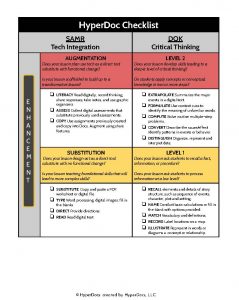
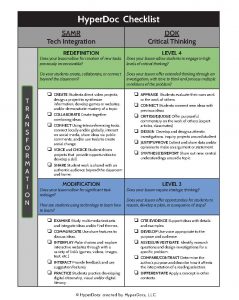
As I’m developing a digitally based Unit, it is crucial for me to engage in reflection of the type of technologies I’m going to use or have my students use and ensure that we are not just substituting for something else. Below is a checklist I plan on using to do just this – reflect on the choices I make to allow my students to create, connect, and collaborate beyond the classroom. You can CLICK the images to be taken to a Google Doc of this checklist.

M4. P3

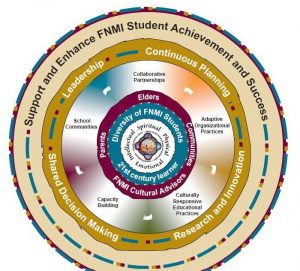
When creating a Unit that focuses on FPPL I wanted to ensure that I had a framework from which I could follow – a guide you might say – that I could refer back to throughout my planning. The Alberta Government developed a collaborative framework building relationships companion resource which speaks to teaching the whole child which is located at the center of the framework and is represented by the physical, emotional, intellectual and spiritual dimensions. Within an Aboriginal understanding of knowledge, education and learning, there is no separation of mind, emotions, body and spirit. Learning is understood to engage all four realms and is integrated into one’s daily activities at every stage of life. Therefore, the needs of the whole child must be addressed in order for the child to experience success, both academically and in life overall.

Although this particular framework focuses on First Nations, Metis, and Inuit Education, I believe it can be used to teach all students as we should always be focussing on our students and who they are first.

I’ve attached the guide – collaborative-frameworks-building-relationships – for your reference.

M4. P2

When the topic of Identity comes up in conversation, usually the first question people get is, “What are you?” or, “Where are you from?” Usually, I respond with something witty such as, “I’m a human, from Earth.” But, as you can imagine, I get a lot of eye rolls and will eventually tell people my incredibly elaborate racial and ethnic background.

As I continue to create my Unit, I keep coming back to Identity and how the importance of Place is in regard to Indigenous ways of knowing, being, and doing. In order to authentically develop a sense of our identity, I believe that the place(s) in which we have lived and/or have had lived experiences is crucial to our story.

Below is one option for Mapping our Identity.

  1. Using Google Maps or MapMe you can create your Identity Story by dropping pins in places that have helped you develop or create your Identity. Click HERE for a PDF on how to do this.

Module 4 Post 1

I read the steps outlined by Mark Aquash in regards to decolonization and the process. Aquash outlines 4 steps, rediscovery and recovery, closure, visioning, commitment, and action.

Rediscovery and recovery involve language, identity, and culture. The rediscovery and recovery phase can lead to increased interest and inspire further research into these areas.

Closure involves not allowing the anger towards colonization to be a constant stopping block. Instead of sitting in the grief, Aquash says it must be confronted and used as a source of empowerment to continue the decolonization process.

Visioning is the phase where new ideas can be considered as to how to change the current societal structures. The systems that must be revisited are the “political, social, economic, judicial, administrative, and educational”. This is when the colonial structures are ideally going to be changed to decolonized systems.

Commitment involves the Indigenous communities uniting and sharing a single voice as they commit to the decolonization process. Finally, action is working on making changes and bringing forward the decolonized structures that were thought of during visioning.

Reference

https://ineducation.ca/ineducation/article/view/142/617

M4. P1

Jo-Anne Chrona said it best when speaking about the FFPL and what needs to happen first:

“a deep understanding of the FPPL is first necessary, and this understanding can then be used to guide educators’ choices about what is important to learn, and what kinds of learning experiences to create for, and with, learners in the contexts the learners and educators are in. This will vary from place to place, and community of learners to community of learners” (2014).

As I was researching the worldviews, I came across this incredible video resource from Focused Education Resources. You can find the link HERE. Of note for me, was the video below which goes through connectedness and relationships. Through this course I have developed a deep understanding for the importance of these particular principles and how we must “look for ways to relate learning to students’ selves, to their families and communities.”

References

Chrona, J.First peoples principles of learning. Retrieved from https://firstpeoplesprinciplesoflearning.wordpress.com/

Focused Education Resources. (2021). Retrieved from https://focusedresources.ca/en/supports-tutorialsvideosguides