In my exploration of story and math concepts, I found connects of the legend Raven Brings the Light and making Bentwood Boxes (bent from one piece of wood to store items) using ratio, 3D geometry and measurement to discover measurements based on the volume of the objects. In the activities I found, there were written version of the story, but I wondered how authentic that was. I also found a story book written in collaboration with indigenous people that was read out loud by a teacher. This satisfied me a little more, in that it was read out loud and had some images for students. However, in reading in this course, it talked about cadence, volume and speed being important factors of story telling. I then found a storyteller Nakoma Volkman who was videoed retelling the Lakota story of ‘Raven Brings Light’ and that was more appropriate. However, as I watched, it may not be engaging to all students. I then found the video below which belongs to a series (link to site below as well) of animated shorts that aim to educate and entertain students while teaching them First Nations legends. There are voices, music and sounds and the production is high quality.
Category Archives: MODULE 4
M4P4 – First People’s Principles of Learning
Our district (SD #23) aspires to follow the First Peoples Principles of Learning, and I have the poster cited hanging on my wall. These principles have taken on a deeper meaning to me throughout this course. In particular, ‘learning recognizes the role of indigenous knowledge’ and ‘learning is embedded in memory, history, and story’ are two principles that I feel I am able to address better in my own teaching practice. By exploring indigenous knowledge I have gained a deeper understanding and confidence in using that knowledge in the classroom. Instead of just ‘shoving’ content in to satisfy our curriculum, I am better able to embed learning naturally into my every day lessons. Particularly in math, I am grounding indigenous stories with math, as well as other stories, to make math more relevant and interesting to students. While I have not mastered these two principles, and still have the rest to consider and endeavor to accomplish, it was a great jumping off point for me in my learning journey.
First Nations Education Steering Committee. (2015). First Peoples Principles of Learning Poster [PDF file]. Retrieved from http://www.fnesc.ca/wp/wp-content/uploads/2015/09/PUB-LFP-POSTER-Principles-of-Learning-First-Peoples-poster-11×17.pdf
M4P3 – Aboriginal Student Population
While exploring how to incorporate indigenous content into my math and science curriculum I came across the question of why. Why aboriginal and not other cultures? The Aboriginal Report found in the link below had many answers for me. It gave me achievement reports as well as population statistics that are as recent as last year. If it is of interest to you, you can also find this data broken down by school district as well. One caveat is that the numbers of Aboriginal people are only recorded if a person self identifies as Aboriginal. So there could be students who did not self identify that are uncounted in the data. I was not initially surprised at the ratio of Aboriginal to all other students, and the district data lines up with my school data which showed 10.5% across the district and 8.4% at my school this year. I did take a quick peek at the English Language Learners (ELL) student numbers to find them similar to Aboriginal students. In my class this year I had 16% of my student identify as aboriginal which is above the average. This data confirms my need to incorporate aboriginal content into my curriculum.
Aboriginal Report 2015/16 – 2019/20. How Are We Doing? (2020). Retrieved 9 June 2021 from
M4P2
I really enjoyed reading about the dimensions of learning framework (Parrish and Linder-VanBerschot, 2010) and much of it resonated with my teaching and experience. For example, when looking at individualism and collectivism, I see times for both. We as teachers are forced to report on individual learning, so assessment and tasks are sure to have that embedded and have specific content in it, but many tasks can be designed as a collective challenge to a group, working on communication skills, rather than content skills. While I encourage students to share their thinking, it is not forced upon them. However, the two areas that really struck me were the time dimensions. In my educational setting, we are forced to have instructional activities start and stop, however, my colleagues and I have now merely looked at these ‘subject blocks’ as blocks of time. The instructional activity can continue as far as we want, and the only thing stopping it would be scheduled break times of the school. As for linear/cyclical time, our curriculum is designed to be cyclical in that the same concepts come up in later years and are built upon, but we do work in a linear model with reports and deadlines. However, opportunities to show learning in my classes are plentiful. I do feel like having some repetition in learning is comforting and helpful to students, but it should never be so specific with everything that it becomes a rut. I found the contrast between these two time dimensions to be vast. I have included an image of a few dimensions of the framework to consider.
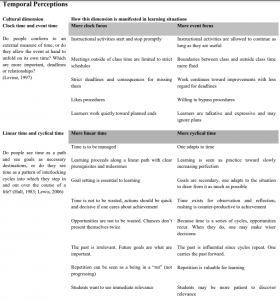
Parrish, P. & Linder-VanBerschot, J. A. (2010). Cultural dimensions of learning: Addressing the challenges of multicultural instruction. International Review of Research in Open and Distance Learning, 11(2), 1-19.
M4P1
Another curriculum tie was to teach probability through stick games by Danielle Vankoughnett. The author provides an in-depth explanation of different stick games (Drop stick and Blackfoot Confederacy Stick Game) with images to aid in understanding, a lesson plan and worksheets. She also provides teacher resource links to videos and readings for background information about the Blackfoot Confederacy and linking Pow Wow dances to drop stick designs). I find this invaluable as one barrier I face is feeling uneducated about the topics, and such links build that knowledge and confidence. By learning different indigenous stick games, students also unpack the concept of theoretical and experimental probability. I included an image to give a visual on how she included examples to scaffold teacher understanding.
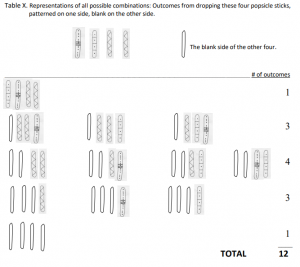
Vankoughnett, Danielle, (2019). Stick Games and Theoretical/Experimental Probability. Stirling McDowell Foundation. Retrieved from http://mcdowellfoundation.ca/research/culture-based-school-mathematics-for-reconciliation-and-professional-development/
Module 4, Post 5 | Publishers & Reconciliation in Canada
The Calls to Action do not specifically mention publishers, though these businesses can be important players in the dissemination of knowledge. BookNet recently published some interesting articles on how publishers can find their role in reconciliation by seeing themselves in the Calls to Action. Notably,
- We call upon the federal, provincial, and territorial governments, in consultation and collaboration with Survivors, Aboriginal peoples, and educators, to (i) make age-appropriate curriculum on residential schools, Treaties, and Aboriginal peoples’ historical and contemporary contributions to Canada a mandatory education requirement for Kindergarten to Grade Twelve students.
- We call upon the corporate sector[…] to (i) Commit to meaningful consultation, building respectful relationships, and obtaining the free, prior, and informed consent of Indigenous peoples before proceeding with economic development projects. (iii) Provide education for management and staff on the history of Aboriginal peoples, including the history and legacy of residential schools, the United Nations Declaration on the Rights of Indigenous Peoples, Treaties and Aboriginal rights, Indigenous law, and Aboriginal–Crown relations. This will require skills based training in intercultural competency, conflict resolution, human rights, and anti-racism.
- We call upon Library and Archives Canada to (i) fully adopt and implement the United Nations Declaration on the Rights of Indigenous Peoples and the United Nations Joinet-Orentlicher Principles, as related to Aboriginal peoples’ inalienable right to know the truth about what happened and why, with regard to human rights violations committed against them in the residential schools.
https://www.booknetcanada.ca/blog/2021/6/21/what-it-means-to-talk-about-reconciliation
Module 4, Post 4 | Indigenous Corporate Training
A company that offers services to help businesses navigate cultural issues and contribute to reconciliation. My final project focus on how publishers in Canada can move closer to reconciliation and these types of companies and consulting practices offer an interesting solution, as it can be difficult to know where to start and how to move forward — hiring consultation is one way to move closer to goals related to inclusivity.
Module 4, Post 3 | Weaving Indigenous and western knowledge
An article focusing on the growing interest in educational and research institutions across the country embracing a holistic approach to its scientific methods, which integrates Indigenous knowledge with classroom teaching methods to decolonize education.
A response to the TRC’s Calls to Action, this collaboration reinforces the cultural values of Indigenous knowledge and highlights applicability across a broad range of subjects.
https://www.universityaffairs.ca/features/feature-article/weaving-indigenous-and-western-knowledge/
Module 4, Post 2 | Education is the Key to Reconciliation
Justice Murray Sinclair said,
Education is what got us into this mess — the use of education at least in terms of residential schools — but education is the key to reconciliation. We need to look at the way we are educating children. That’s why we say that this is not an aboriginal problem. It’s a Canadian problem.
How do we go about solving this problem? For starters, we ensure that curriculum reflects Canadian history accurately.
https://www.univcan.ca/media-room/media-releases/education-is-the-key-to-meaningful-reconciliation/
Module 4, Post 1 | Land Education Design Project
Indigenous-led non-profit and community organizations in collaboration with Eve Tuck are working to support several Indigenous community organizations and a youth research collective to encourage land-based education programs that designed by and for Indigenous Peoples and their communities. The Connaught Community Partnerships Research Program recently awarded the project $50,000 in funding.
https://www.utoronto.ca/news/indigenous-communities-drive-connaught-funded-research-projects