Category Archives: MODULE 4

Module 4- Post 1: The Urban-Aboriginal


The Urban Aboriginal Primitive Technology Studies & Practice page is a site targeting urban indigenous people that provides information on how to make things like dreamcatchers, crossbows, cattail visors, shelters and pretty much everything other traditional aboriginal practice you could think of. The site demonstrates a practical approach to technology and how it can be used to support cultural transmission.

Although there is no vision statement included, it appears that the goal of the website is to support the development of traditional skills by offering resources and instructional materials (often in video format) among people who do not have opportunities to learn these practices through elders or community members.


Mod 4 P. 5

 https://native-land.ca/resources/territory-acknowledgement/

In working to implement Indigenous ways into my classroom and learning experiences, I wanted to take a deeper look into the territory acknowledgements and find out more about why they happen and how to do so appropriately. There is a standard acknowledgement used in my school district, but it can feel impersonal to me. This resource gave me some great background information about why the acknowledgements are done as well as how to do so, including if you are unable to pronounce a nation’s name. There is also information about how to create an acknowledgement that is more intentional or detailed. Another part of this resource that I thought was valuable was the ability to search for a location in order to find the territory acknowledgement information. While it is important to know the information from the lands on which you live, learn, work and play, you may not have the information for other areas you visit and this resources helps you obtain the information. 


Mod 4 P.4

https://www.openschool.bc.ca/indigenoused/

Continuing our Learning Journey: Indigenous Education in BC is a fantastic resource. It is designed as a “professional learning experience for educators on how to include authentic Indigenous knowledge, perspectives, and content in BC’s curriculum.” It is a series of videos and discussion prompts that ideally would be done with a group of educators, however I found that the discussion prompts also allowed for self-reflection. There are 3 modules: Module 1 BC Context and Assumptions, Module 2: Using the First Peoples Principles of Learning, and Module 3: Authentic Resources and Frequently Asked Questions, as well as Final Messages and Next Steps. As I work through my learning journey, the reflection allowed me to reframe my thinking and see things in a new light. I also appreciated the frequently asked questions as some of the questions, such as the fear of making a mistake, were questions that run through my mind. To hear that others have similar questions, and to hear and reflect on the responses, helps to move my practice forward as an educator.

Mod 4 P. 3

https://learn.sd61.bc.ca/wp-content/uploads/sites/96/2017/09/First-Peoples-Principles-of-Learning-for-Teachers.pdf

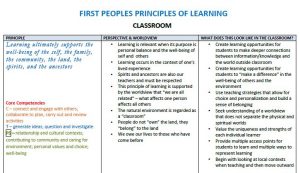
If you are looking for a direct connection between the First People’s Principles of Learning, the BC curriculum, and the classroom, this is a document for you! This document was produced by the Aboriginal Nations Education Division (ANED), Greater Victoria School District #61. The document breaks down each of the First Peoples Principles of Learning and makes direct connections to the BC Curriculum core competencies. The document also breaks down and explains the perspective and worldview related to each of the principles. Lastly, the document also shares what each of the principles looks like in the classroom. The practicality of this document really drew me in. In learning about the First Peoples Principles of Learning, it is so helpful to see what they look like in a classroom and how they relate to the curriculum. It allows educators that are unsure of their next steps to see what it looks like. I think often educators feel they need to change everything they do and by being about to read about what the First Peoples Principles of Learning looks like in the classroom, educators can see that there may be many things they already do in the classroom that connect to the First Peoples Principles of Learning and the First Peoples Principles of Learning doesn’t mean starting from scratch, rather it is change the structure through which the classroom and learning happens.

Mod 4 P.2

https://learningconference-fppl.trubox.ca/origins-and-importance/

I have started narrowing my research and while I had previously looked at resources about the First Peoples Principles of Learning, I have now started to now look at different ways educators have implemented the First Peoples Principles of Learning into their classrooms and into learning experiences for students. I came across the website First Peoples Principles of Learning – Bridging the Gap with Technology and discovered it is a website that was created by a MET student(s) in ETEC 512. This resource not only discusses what the First Peoples Principles of Learning are and why they are important, but include examples of how they can be implemented with place-based learning, digital storytelling, art, and science. Another valuable part of this resource are the Padlets embedded into the website where others can also discuss how they implement the FPPL and share with other educators. These practical examples and discussion boards demonstrate how the FPPL can be implemented and give educators the opportunity to connected with other educators and ask questions.

Mod 4 P.1

https://www.learninglandscapes.ca/index.php/learnland/article/view/983/995

In looking into the First Peoples Principles of Learning, I came across this article written by Kelly Hanson, a former colleague of mine. The paper, The First People Principles of Learning: An Opportunity for Settler Teacher Self-Inquiry is written in first-person perspective as she “describes her emerging self-awareness as opening to a deeper understanding of her Euro-American worldview, cultural narratives that maintain gaps between settler teachers and First Peoples perspectives, and how ongoing self-inquiry is a way to improve as an educator.” I really connected with the article and with Hanson’s journey. I feel that I am on a similar journey myself and to be able to read about Hanson’s questions and learning experiences gave me lots to reflect on as I work towards understanding why the First Peoples Principles are important, how I can implement them into my classroom and learning experiences, and how my mindset and outlook has changed.

Module 4, Post 5

Syilx Anchor Books

The Syilx Okanagan Nation Alliance website has a list of anchor books teachers can use in their lessons.  The books are specifically about the Syilx people, which is the community’s land on which I teach. For my final project, my partner and I researched how to use anchor books authentically in teaching. We will look to use some of these books as we develop our lesson plans.

Module 4, Post 4

How to measure learning using a holistic approach

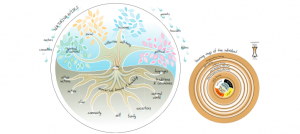
This resource is useful as it breaks down the holistic learning model into sections that teachers can apply in their practice. One of the most valuable sections gives examples of how to measure learning using a holistic learning model. There are also beautiful images of holistic learning and how interconnected the teachings are. You can see how the cyclical designs relate to life and all relations. I hope to use this resource to support why it is important to add an emotional competency in education as it helps teach to the whole child.

Module 4, Post 3

Settler Education

This article describes “Settler ethics” which includes discussing, accounting for, disrupting, analyzing, unsettling, and challenging settler identities and knowledge. The work addresses the settlers’ perspective and how settlers have not been accountable for the actions of their ancestors and things like land acknowledgements are often done to say, “See, I did something, I’m fixing it”, but they are like empty promises that only really help appease the conscience of the settler, not actually enact change for the colonized.

I think that settler ethics are an important thing to address and recognize as my partner and I look to build a unit based on creating teacher confidence using Indigenous ways of knowing and doing. We need to make it very clear that we are not the owners of these practices and give credit and recognition to Indigenous Peoples.

Module 4, Post 2


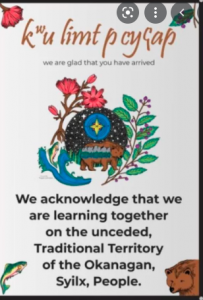
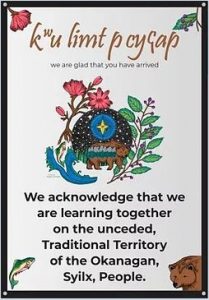
Land Acknowledgements

This UBC website explains the importance of land acknowledgments. 

“Land acknowledgements are considered a respectful, yet political, statement that acknowledges the colonial context of the Indigenous territory/territories where a gathering is taking place. It recognizes relationships between land and people, and in particular Indigenous peoples’ continued presence on the lands being acknowledged” (2021). 

The website also gives suggestions on how to create a land acknowledgment and how to make it more personal.  I was under the impression there was a standard template for land acknowledgments, so it was wonderful to learn that it is more authentic and meaningful to make them more personalized. For my final project, my partner and I will make a personal land acknowledgment and demonstrate how it is one way teachers and students can start to build a relationship with Indigenous ways of knowing and learning.