Tag Archives: authentic resources

M4P5: AlbertaEd – Walking Together & Talking Together

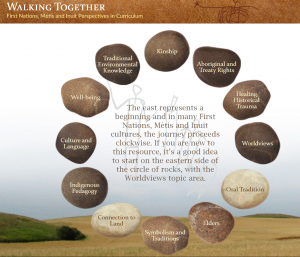
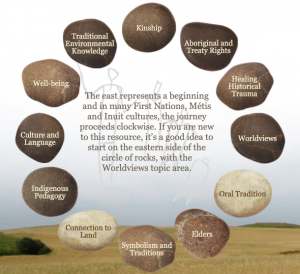
Alberta Education created a very comprehensive and interactive guide called Walking Together that provides educators with the necessary resources needed to incorporate FNMI perspectives into the curriculum.

One of my goals in my final project is to create a teacher self-reflection tool to determine which Indigenous perspectives are addressed in a particular lesson. The self-reflection tool would be a circle, similar to the front page of Walking Together, with the perspectives around the outside divided into pie pieces and then specific keywords underneath each perspective, to help guide the teacher in really analyzing their lessons.

I think this resource could also be used as a student activity, perhaps with the student reflecting on how the participation in the activity aligned with Indigenous perspectives. The student version would have student friendly language and offer sentence starter prompts for each perspective/keyword.

However, before introducing this self-reflection tool, students and teachers would both need to have an awareness of Indigenous knowledge and these various perspectives before the tool would be used meaningfully. I plan on creating an interactive multimodal game where these perspectives will be explored as a part of my final project.
M4P4: MathCatcher – Meet Small Number

“Mathematics Through Aboriginal Story Telling”

MathCatchers is an outreach program for educators and learners, encouraging numeracy through storytelling, pictures, and hands-on learning. They created a character named “Small Number” who ‘engage(s) Aboriginal learners in math and science through the use of First Nations imagery and storytelling.’ Through various videos, the opportunity for various discussions about anything from basic counting and pattern recognition to exponential growth and probability permutations and combinations. These videos will serve as a foundational part of my final project, with many Alberta curriculum pieces being tied to various sections of the video. I envision these videos being part of the regular classroom routine, with students constantly being brought back to the story and encouraged to dig deeper into the math and culture embedded within.

The main character in our animations thus far is a boy called Small Number. He is a bright, playful kid, with the ability to recognize patterns and calculate quickly.”

M4P3: Danielle Black – Indigenous Film Maker

After reading Ginsburg’s Rethinking the Digital Age, I wanted to find more about Indigenous media local to my area.

Danielle Black grew up in Calgary, and is a member of the Siksika First Nations, a part of the Blackfoot Confederacy, Plains people, Treaty 7. She is an Indigenous artist who is using film to change perspectives and tell stories about Indigenous past but also about modern Indigenous people. She created a short film titled A Love Letter To My Unborn Child, “which speaks to her future child about the joys and trials that will await him/her as an Indigenous person navigating the world.”

I chose to include this in my research for my final because it displays resilience, strength, and hope in the face of adversity. This is a good piece of media to analyze with students, as it features Indigenous youth and offers a modern perspective on the struggles that Indigenous peoples face, and I think it shows many values of Indigenous knowledge and cultures. There is a lot to unpack in this 7 minute video, and I think it is worth unpacking and diving deep into the meanings.

M4P2: Nurturing the Learning Spirit of First Nation Students

“The Report of the National Panel on First Nation Elementary and Secondary Education for Students on Reserve”

The Assembly of First Nations put out this report, which contains principles for reform as well as recommendations for foundations of a strong Indigenous education system. Within the recommendations and principles is an emphasis and importance of a child first and child-centred education. This child-centred approach will be incorporated into my final project as the foundation and backbone of any material and resources created for use in a classroom.

 “The First Nation child must be placed at the center of the national priority of building an education system.  Improving education attainment, and ensuring that children receive the supports needed to enable them to excel and thrive as learners, while their identity, culture and language as First Nation peoples is strengthened, is essential” (p. 29).

M4P1: Education – Calls to Action

With the focus on creating an Indigenous knowledge-based curriculum/lessons/assessment plan, it is important to acknowledge the work currently in progress in regards to the 94 Calls to Action. There are two Calls to Action in particular that I will be referencing in my final project. CBC News has created an interactive resource (#Beyond94) which measures the progress of the Calls to Action. This resource is something that should be referenced when speaking to teachers about the importance of incorporating Indigenous based knowledge in the classroom.

10: Draft new Aboriginal education legislation – In Progress

  • Most recent update… “In June 2021, the Yukon government announced the creation of a separate school board for First Nations, paving the way for schools geared specifically toward Indigenous students in the territory.”

12 Develop culturally appropriate early childhood education programs – In Progress

  • In 2018, a framework for Indigenous Early Learning and Child Care was released, and in February 2021, the government proposed to invest $2.5 billion to support this mandate.

This image is an up to date account of the progress being made in the 94 calls to action. It is concerning to see 20 projects not yet started, the majority of them falling under the “Reconciliation” category. 

M3P3: Indigenous Storywork Protocols

“Educating Heart, Mind, Body & Spirit”

I came across this site after reading about Dr. Jo-ann Archibald’s Indigenous Storywork framework. It shares various resources for educators but also for the public, and it also highlights and shows respect for the Elders who contributed to the website. The educator resources are not typical lesson plans, but rather they are a set of questions that create a framework Indigenous story telling; Dr. Archibald poses many questions that help guide and prepare educators for various protocols for using Indigenous stories. One important protocol she outlines is to acknowledge the storyteller, and the Indigenous culture from which the storyteller is a member, and then provides some contextual and cultural background for the story. This is a good entry point for me to be able to include Indigenous stories in my own teaching practice.

M4. P1

Jo-Anne Chrona said it best when speaking about the FFPL and what needs to happen first:

“a deep understanding of the FPPL is first necessary, and this understanding can then be used to guide educators’ choices about what is important to learn, and what kinds of learning experiences to create for, and with, learners in the contexts the learners and educators are in. This will vary from place to place, and community of learners to community of learners” (2014).

As I was researching the worldviews, I came across this incredible video resource from Focused Education Resources. You can find the link HERE. Of note for me, was the video below which goes through connectedness and relationships. Through this course I have developed a deep understanding for the importance of these particular principles and how we must “look for ways to relate learning to students’ selves, to their families and communities.”

References

Chrona, J.First peoples principles of learning. Retrieved from https://firstpeoplesprinciplesoflearning.wordpress.com/

Focused Education Resources. (2021). Retrieved from https://focusedresources.ca/en/supports-tutorialsvideosguides

M4P1: The Bill Reid Centre

The Bill Reid Centre is located at Simon Fraser University, a forty-minute hike from my school, but I did not realize its website was so rich in resources. It uses digital technologies such as photographs, drawings, videos, and other visual media to highlight the depth and vibrancy of Northwest Coast culture. Each section is so plentiful in resources that an entire year of curriculum could be developed with the website as a starting point. Its stated mandated is to (1) encourage community and academic conversations regarding the visual culture of Northwest Coast First Nations, and (2) promote public understanding and respect for the First Nations of the Northwest Coast past and present. The digital village project, in particular, could be of particular value in my class when using Minecraft to showcase knowledge.

M3P4: Gladys We Never Knew

Using the art of storytelling, this BCTF resource focuses on Gladys, an Indigenous girl from Spuzzum, and her life in a residential school. I appreciate its BC centered focus relating it directly to where students live and explore. It links to additional sites throughout the each lesson that enhance learning, but the information provided within the resource itself is rich. Each lesson is easily adaptable to earlier or older grades and provoke students to make connections to their lives. It is also available in French for those teachers who are in an immersion classroom.


Holistic approach to Indigenous Integration M3P5

This resource from Alberta is specifically designed for teachers to help them incorporate a wide range of Indigenous ways of learning into their classrooms.  This is certainly coming from a more holistic approach as opposed to specific content connections which, as we’ve been learning, is more authentic.  I think, in terms of making teachers more comfortable trying some of these ways, this site does a great job.  They have a lot of text based descriptions of different options for classrooms, as well as a wide range of videos or audio from different sources to help teachers feel more comfortable.  A perfect example of this, which would certainly make me feel more confident trying this practice is the video of Judy Louis engaging a class in a circle story technique.  Seeing the technique in action with an authentic group of kids is so much better for a nervous teacher than just reading about possibilities they might encounter.  So overall, a great resource for what I’m trying to accomplish!