First Nations Education Steering Committee (FNESC) is a Vancouver-based organization dedicated to creating resources and supporting First Nations learners in British Columbia. The specific resource I am referencing is “Science First Peoples” — a teacher resource for understanding and implementing First Peoples’ scientific knowledge for grades 5-9. FNESC works diligently to ensure their resources align well with the B.C. curriculum while also delivering curricular competencies in a way that recognizes and embodies Indigenous ways of learning. Specific local examples, stories, and materials are used throughout the guide to make for a more interconnected learning journey.
My heart is heavy this week as news breaks of the children found at a former residential school in Kamloops. And once again I look to my role as an educator within a system that has failed so many. Further, Lee Brown’s interview has served as a reminder that the “traditional” forms of education only serve those that see themselves represented within the system. And so I continue to reflect and change my practice. I come back to the First Nations Education Steering Committee (FNESC) and their guiding principles on learning. This website also provides rich resources for helping to move First Nations education in BC. While it is generalized in that it attempts to reflect a collective First Nation practice as much as possible, it serves as a reminder of the approaches I take in my classroom.
This virtual museum provides information on Métis history and culture. It presents collections, exhibits, learning resources and some information on Michif, the orally based language of the Métis. Returning to the idea of presenting and preserving culture in its many forms, this is an interesting resource for deepening student understanding of Métis people. I found it particularly relevant for a French immersion classroom, given the history of the French on the Métis. I think the use of primary documents is of particular importance as we gain growing awareness on who’s voice is being heard when history and reality are being taught. From a technology standpoint, it is an interesting blend of visual, audio and video files including oral history interviews.
UBC has made a series of curriculum bundles for Indigenizing education. The subjects range from storytelling to STEAM.
These are not lesson-plans, but frameworks that could be adapted for your local community. Besides being an excellent toolkit, this resource can also serve as a model for curriculum design. Each resource includes clear connections to the First Peoples’ Principles of Learning and the BC Curriculum. They also provide important information for educators on how to use the frameworks in a respectful and humble manner.
I stumbled across this interesting book in UBC’s library database, Looking Back and Living Forward: Indigenous Research Rising Up (Markides & Forsythe, 2018). Grounded in pedagogy, this collection brings together a vast array of research done by and with Indigenous peoples from Canada and beyond. The book is available online, and you can download the PDF version.
Here is a short sampling of some of the chapters, and what curricular connections I can see them having:
History (Ch. 1: The Cold War, the Nuclear Arctic, and Inuit Resistance)
Culinary Arts (Ch. 7: Indigenous Food Sovereignty Is a Public Health Priority)
Computer Studies (Ch. 13: Channelling Indigenous Knowledge through Digital Transmission / The Opportunities and Limitations of Indigenous Computer Games)
Digital Citizenship & New Media (Ch 17: Canadian Cyber Stories on Indigenous Topics and White Fragility)
Art and Change-Making (Ch 26: Scaling Deep / Arts-Based Research Practices)
Reference:
Markides, J., & Forsythe, L. (2018). Looking back and living forward indigenous research rising up. Brill/Sense.
Indigenous sciences often use a qualitative, integrated approach that results in a holistic understanding of how to live in harmony with nature. Research shows that Indigenous students perform better when educators provide a culturally responsive curriculum that combines Indigenous ways of knowing nature with Western scientific knowledge. Indigenous educators refer to this as “Two-Eyed Seeing” — a way of learning that leverages the strengths, perspectives, and knowledge of both cultures.
However, in most school districts, Indigenous students study science, math, and technology from a largely Western perspective; Indigenous cultures and ways of understanding STEM subjects are not represented in curriculums. As a result, many Indigenous students feel alienated, and opt out of science and math classes once they reach high school. How do we engage these indigenous learners and increase their participation?
Introducing InSTEM: Indigenous Youth in Stem. It is a national program that incorporate traditional practices of living into educational pedagogy. It aligns land-based learning to western STEM experiences and renew indigenous identity and perspectives. In the end, it fosters skills and confidence for aboriginal youth to apply to future careers in STEM.
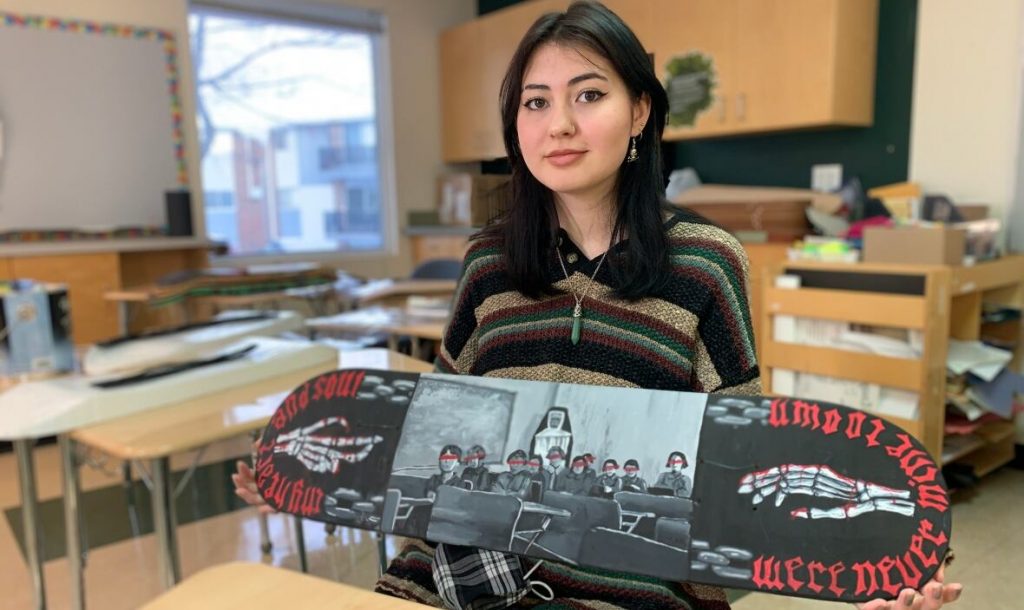
An Albertan teacher made waves with his “sk8trepreneur” course in 2020. One of the class projects was on “Exploring Colonialism, Creativity and Reconciliation with Skateboards, [which] combines skateboard design with Indigenous history” (CBC).
Kristian Basarada had his students create their own brands from the ground up, from defining their brand’s purpose to designing a logo. He teamed up with Cree artist Jon Cardinal and Cree professional skateboarder Joe Buffalo. Buffalo is also a residential school survivor and shared his experiences with the students. The project culminated in the students’ work being showcase at a local skateshop for over a month.
As a Digital Arts / Graphic Production teacher, I find Basarada’s project incredibly inspiring. He authentically ties together teen culture, history, maker-skills, and the community. Skateboards have a history of pushing the underrepresented out from under the rug of Mainstream Culture. Candian Dimension has an excellent interview with Micheal Langan, owner of Colonialism Skateboards. “Riding is resistance. Every kickflip, nose grind, or ollie in an occupied territory like Canada is an act of thrashing colonialism” (Sean Carleton, 2018).
Under the education section in the 94 Calls to Action, #10 states:
We call on the federal government to draft new Aboriginal education legislation with the full participation and informed consent of Aboriginal peoples. The new legislation would include a commitment to sufficient funding and would incorporate the following principles: i. Providing sufficient funding to close identified educational achievement gaps within one generation. ii. Improving education attainment levels and success rates. iii. Developing culturally appropriate curricula. iv. Protecting the right to Aboriginal languages, including the teaching of Aboriginal languages as credit courses. v. Enabling parental and community responsibility, control, and accountability, similar to what parents enjoy in public school systems. vi. Enabling parents to fully participate in the education of their children. vii. Respecting and honouring Treaty relationships.
What the government website says is happening…
Based on the policy proposal for transforming the Government of Canada’s support for First Nations elementary and secondary education that was co-developed with First Nations, Indigenous Services Canada has established a new policy framework for First Nations elementary and secondary education.
I’m not sure what the policy framework is, because it was not linked to the government site. But suffice to say that I will be inquiring and investigating more about it and to see if it supports this call to action.
Call to Action #8 We call upon the federal government to eliminate the discrepancy in federal education funding for First Nations children being educated on reserves and those First Nations children being educated off reserves.
The Call to Action is one that is near and dear to my heart. I worked with Fort Nelson First Nations as one of their high school science and math teachers in 2006 and at the time, the band had voted to agree to pay BC teachers the same amount as we would have had worked at one of the BC School District Schools. This meant there was less money from their accounts going to elder care, and children programs, but they wanted to recruit and retain teachers at an independent school. That’s something to note, that many of the on-reserve schools are considered independent schools and are not eligible for the same funding model from the province per student in the schools. There are also stricter reporting guidelines. My goal is to see what the government says is happening in Module 1 and research what is happening in Module 2 and how to get people interested, invested and caring about Truth and Reconciliation.
The Government of Canada says that the following about what is happening with this particular Call to Action.
To help address the education attainment gap, the Government of Canada has made significant investments, totaling $2.6 billion over 5 years for primary and secondary education on reserve. This includes funding to address immediate needs and to keep pace with cost growth over the medium term, as well as investments in language and cultural programming and literacy and numeracy.
The Government of Canada has worked closely with various First Nations partners to implement an inclusive and comprehensive engagement process on First Nations kindergarten to grade 12 education on reserve, including investing $3.6 million to support community-level discussions. The engagements were led by First Nations organizations and provided community members with the opportunity to share their views on how to improve First Nations student success.
On January 21, 2019, a new co-developed policy and improved funding approach to better support the needs of First Nations students on-reserve was announced. As of April 1, 2019, the new funding approach:
replaces outdated proposal-based programs with improved access to predictable core funding
ensures base funding is comparable to provincial systems across the country while working towards additional funding agreements based on need to better account for factors such as remoteness, school size, language, and socio-economic conditions
provides First Nations schools with $1,500 per student, per year, to support language and culture programming
provides new resources which will support full-time kindergarten in every First Nations school for children aged 4 and 5
ensures special education funding is more predictable, with fewer application-based requirements