Voices on the Rise: Indigenous Language Revitalization in Alberta is a 3 part docuseries made in collaboration with Telus and Victoria filmmaker/visual artist Eli Hirtle ((nêhiyaw(Cree)/British/German). The series follows Eli and his journey of self-actualization by visiting his ancestors’ communities and learning more about his language. He focuses on the revitalization of Indigenous language and its intimate connection to culture, family, and life. Much can be learned from Eli’s story for Indigenous and non-Indigenous peoples alike.
Tag Archives: Indigenous languages
Module 2 Post 2: Indigenous Corporate Training Inc.
Indigenous Corporate Training Inc. (ICT) is a B.C. based organization that provides training in the workplace with the goal of creating more informed and safer Indigenous relations between Indigenous and non-Indigenous people alike. I have specifically linked their blog post on guidelines for using Indigenous terminology, a place in which settlers may want to start when decolonizing their vocabulary. Their site contains paid and free resources that support Indigenous awareness and answers to questions many settlers may be too afraid to ask.
Module 2 Post 1: First Voices
First Voices is an initiative by the First Peoples’ Cultural Council that provides a library of Indigenous language learning tools and information. The site offers dozens of Indigneous languages to explore. Clicking into each language provides links to see, hear, and practice high frequency vocabulary through audio clips or games. This site will serve useful in the K-12 setting in which educators may discuss the decolonization of language in our school system.
MOD #2 POST #1: Why Indigenous Languages Matter and What We Can Do to Save Them
Lindsay Morcom at the TEDxQueensU spoke of how Indigenous languages in Canada are either endangered or vulnerable. Losing languages wasn’t by accident, she discussed how laws and policies were implemented, especially the residential school system, and the impact of cultural genocide. Her presentation included cultural and place-based examples to emphasize the importance of Indigenous languages. Dr. Morcom also described ways we can support the revitalization of languages. Examples include the Mi’kmaq culture and language-based education implemented by self-government as well as the Kingston Indigenous Languages Nest program. What can we do? Need for policies with funding to ensure Indigenous languages are incorporated meaningfully in both on-reserve and off-reserve educational settings. In addition, the need for support, not just financial but physical spaces to learn and dialogue into why Indigenous languages are important. Preserving languages is a vital step for reconciliation.
Mod#2-Post#3: IDMT-Indigenizing Computer Programming
While looking for programming environment developed with indigenous views or languages, I found the research paper ” Indigenizing computer programming for cultural maintenance” that I believe will innovate computer programming and Indigenous digital design. For his doctoral research, Corbett (2018) is working on the development of a toolkit that will unite Indigenous cultural components with natural programing language, an Indigenous Digital Media Toolkit (“IDMT”) he calls it. Corbett (2018) explains that IDMT is “a programming language with a specialized user interface that uses the Cree language and syllabic writing system to programmatically create digital artworks and provides a digital foundation for the maintenance and/or revitalization of Indigenous culture” (Corbett, 2018, p.243). He adds that IDMT also contributes to the reconciliation process (Corbett, 2018).
An important point that he mentioned about his development is that he considers the design of technology at a deeper level. I want to explain why this point is essential in computer science education for Indigenous students. Most of the modification done in culturally responsive programming tools (part of my investigation for my final project), whether visual platforms (e.g., CDSTs, Alice, Scratch) or the translated environments that are used in educational/ work contexts encounter surface changes such as modifying the language, the context the tool is presented in, or the design of the computing activities themselves. However, none of these developments have entirely escaped from the legacy of the industry and the Western-coded engines/system. In turn, Indigenous students’ self-determination in design and development and possibilities of self-expression are still very limited by the pre-existing system. IDMT is the first programming language that goes to the next level as it addresses the “underlying culture as an inherent component of the coding language itself” (p. 244).
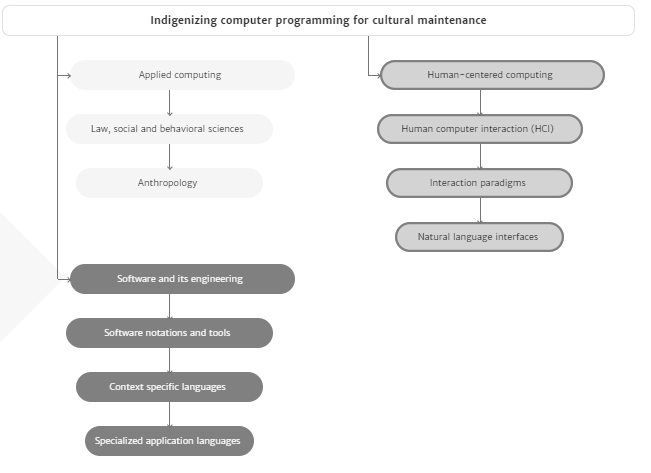
IDMT Model (Corbett, 2018)
Reference:
- Corbett, J. M. R. (2018). Indigenizing computer programming for cultural maintenance. Paper presented at the 243-244. https://doi.org/10.1145/3191697.3213802
Module 2 Post 1 – Indigenous Languages
This is Lindsay Morcom. She talks about the history of indigenous languages and how to revitalize them. She spoke about residential schools and how when you build a school and then build a cemetery right beside it because you know the students will die, what do you call that? The talk is from February 2019.
She speaks about what is needed:
- Policy – that there is attached funding with active policy and that on-reserve schools and off-reserve schools need equal funding. Special note that this is also a call to action
- Support – that there needs to be space to carry out activities and have access to immersion education in traditional languages and that there needs to be education for the non-indigenous populations
Her statement that reconciliation that does not result in the survival of language in the people is assimilation and not reconciliation.