Tag Archives: indigenouseducation

M2P4: Indigenous Learning Preferences and Interactive Technologies

A research study conducted in BC that studied the impact of interactive technologies on math achievement of Indigenous students in Grades 4-7.

Kitchenham, A. (2017). Indigenous Learning Preferences and Interactive Technologies. The Australian Journal of Indigenous Education, 46(1), 71-79. doi:10.1017/jie.2016.12

M2P2: Indspire Online Resource Centre

“Indspire is a national Indigenous registered charity that invests in the education of First Nations, Inuit and Métis people for the long term benefit of these individuals, their families and communities, and Canada.”

Within the Online Resource Centre contains documentation and evaluation of various projects that Indspire has completed. Some that interested me are:

M2P1: Stepping Stones

Stepping Stones is a publication of the Alberta Teachers’ Association Walking Together: Education for Reconciliation and is intended to support certificated teachers on their learning journey to meet the First Nations, Métis and Inuit Foundational Knowledge competency in the Teaching Quality Standard.”

This resource is helpful in providing a detailed overview of various topics including, but not limited to, terminology, Treaties, Canada’s history, First Nations Traditions and culture, and residential schools.

Module 2 – Post 5 Student Action

The Legacy of Hope website relates back to my final question of how technology can be a tool to inspire social action in my students. The 94 calls to action are a great resource for teachers but the language is overwhelming for students. What I appreciate most about the Legacy of Hope’s Get Involved page is that it provides small steps in simple language that grade 4/5 students can understand and act on. When inspiring social action at this age, there can be a push pull with the parents. These steps range from small to large and tie nicely into other areas of curriculum to further buttress against any parent complaint (which unfortunately does exist at times).

Module 2 – Post 2 Social Media as a resource?

I had never considered the possibility of posting an Instagram or TikTok account in a university discussion, but here we are 🙂

Peter NotSo White was introduced to some of my students with social media by a classmate. Since being introduced, his posts have sparked discussion and learning both in class and at home. He presents small but timely information bits on many different aspects of indigeneity, including where does knowledge on indigenous people come from and some of the stereotypes people are exposed to. He also uses story time to deliver messages about life that students in my class really connect with. His content is mostly age appropriate for grade 4/5 (scan first – I have not watched all of them) and his tone and manner are engaging.

His account, and others like it, is an important part of decolonizing my classroom. Relying on outdated texts that tell us a colonial view of history does not help move reconciliation forward. Neither does using texts or media created by non-indigenous voices. The Government of Canada, for example, has a plethora of information available but who benefits from its use?

Module 2- Post 2: Elders in Schools

A culture centred on “All My Relations” is the foundation of all First Nations teaching and learning. The inclusion of Elders in the process can be described as the ‘heart’ of First Nations Pedagogy. Since Pre-Colonial times, Elders have been the Gatekeepers of First Nations wisdom, knowledge, and history. Elders traditionally hold crucial roles in supporting both formal and informal education in First Nations communities. They impart tradition, knowledge, culture, values, and lessons using orality and role modeling traditional practices.They are important knowledge keepers, and they also help to ensure cultural continuity.

In 2013, The Elders in Schools Program provides an opportunity for Elders to be teachers within the school setting. The program was developed to ensure every school has an elder. The main purpose is for students and staff to learn from the elders about the the wisdom, knowledge and experiences, as well as their language and traditional skills of the local people in the aboriginal communities in NWT.

https://www.ece.gov.nt.ca/en/services/renouveau-en-education-aux-tno/elders-schools-program

A similar pilot project was developedled by the Tlicho Community Services Agency in 2019.

https://www.cbc.ca/news/canada/north/pilot-program-tlicho-language-program-1.5082117
M1P5: Indigenous Education Resources

This website houses some amazing information for Indigenous Education.

A school is also highlighted on this website:

“Nala’atsi is a school based in Courtenay, British Columbia for students with Indigenous ancestry in grades 10 to 12. It is a 10 month program that provides individualized support for students whose needs have not been met in a mainstream classroom setting. Nala’atsi aims to give students a sense of community and belonging, a safe and compassionate learning environment, as well as access to a variety of exciting cultural activities within the community and beyond.”

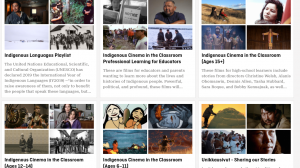
M1P4: Indigenous Cinema in the Classroom

“Our educational playlists are selections of films on themes that tie in with Canadian curricula and address the important issues of the day. Many of the playlists are also linked to our study guides.”

Within the “Indigenous Voices and Reconciliation” tab, some playlists that I have flagged for review are:

  • Indigenous Cinema in the Classroom Professional Learning for Educators
  • Indigenous Cinema in the Classroom (Ages 15+)
  • Indigenous Cinema in the Classroom (Ages 12-14)
  • Indigenous Cinema in the Classroom (Ages 6-11)

https://www.nfb.ca/education/educational-playlists/#indigenous-voices-and-reconciliation

M1P2: British Columbia’s FPPL

First People’s Principles of Learning

  • Looking forward to referencing this document and incorporating these principles into my classroom, and seeing how they can align with Alberta curriculum.
  • I also found this link as an “informational URL” on the BC Government’s website, offering suggestions for how teachers can include the FPPL in their classrooms.

M1P1: The Alberta TQS

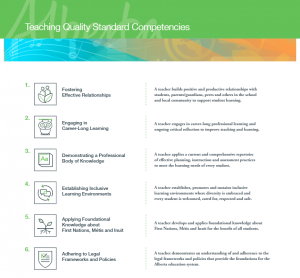
“The professional practice of all Alberta teachers is guided by the Teaching Quality Standard (TQS). This standard is the basis for certification of all Alberta teachers and holds them accountable to the profession and to the Minister of Education.”

In 2008, a sixth competency was added: Applying Foundational Knowledge about First Nations, Métis and Inuit. As it is important for all teachers to keep up to date with their professional practice, the TQS is an important document that I will be referencing throughout this course.

Alberta Teaching Quality Standard infographic