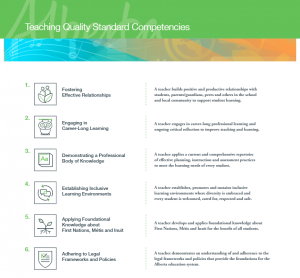
Looking forward to referencing this document and incorporating these principles into my classroom, and seeing how they can align with Alberta curriculum.
I also found this link as an “informational URL” on the BC Government’s website, offering suggestions for how teachers can include the FPPL in their classrooms.
“The professional practice of all Alberta teachers is guided by the Teaching Quality Standard (TQS). This standard is the basis for certification of all Alberta teachers and holds them accountable to the profession and to the Minister of Education.”
In 2008, a sixth competency was added: Applying Foundational Knowledge about First Nations, Métis and Inuit. As it is important for all teachers to keep up to date with their professional practice, the TQS is an important document that I will be referencing throughout this course.
My heart is heavy this week as news breaks of the children found at a former residential school in Kamloops. And once again I look to my role as an educator within a system that has failed so many. Further, Lee Brown’s interview has served as a reminder that the “traditional” forms of education only serve those that see themselves represented within the system. And so I continue to reflect and change my practice. I come back to the First Nations Education Steering Committee (FNESC) and their guiding principles on learning. This website also provides rich resources for helping to move First Nations education in BC. While it is generalized in that it attempts to reflect a collective First Nation practice as much as possible, it serves as a reminder of the approaches I take in my classroom.
Carolyn Roberts is a Coast Salish woman from the Squamish Nation in North Vancouver, British Columbia. I had the privilege to listen to Carolyn Roberts speak at a district professional development workshop this year, she is an articulate speaker and is passionate about Indigenous education. The video below was her presentation at the TEDxLangleyED event, where she speaks about her own experiences and the responsibilities of all Canadian citizens in Indigenous rights. We all have to help with reconciliation and work to right the injustice from the past that continues today.
As Roberts (2013) said it in her presentation, “in order for us to move forward in reconciliation, we need to be able to move forward side by side, not one someone in front, not someone behind, but together side by side”.
Ways to move reconciliation forward as Canadians (Roberts, 2018),
Learn about the territory where you live and work. Where is their community, what languages do you speak, and how can you give back to them.
Educate ourselves about land claims and treaties in place, what does it mean for us? What does it mean to them?
“It is education that got us into this mess, it will be education that gets us out of this mess” – Hon. Murray Sinclair as quoted by Roberts (2018)
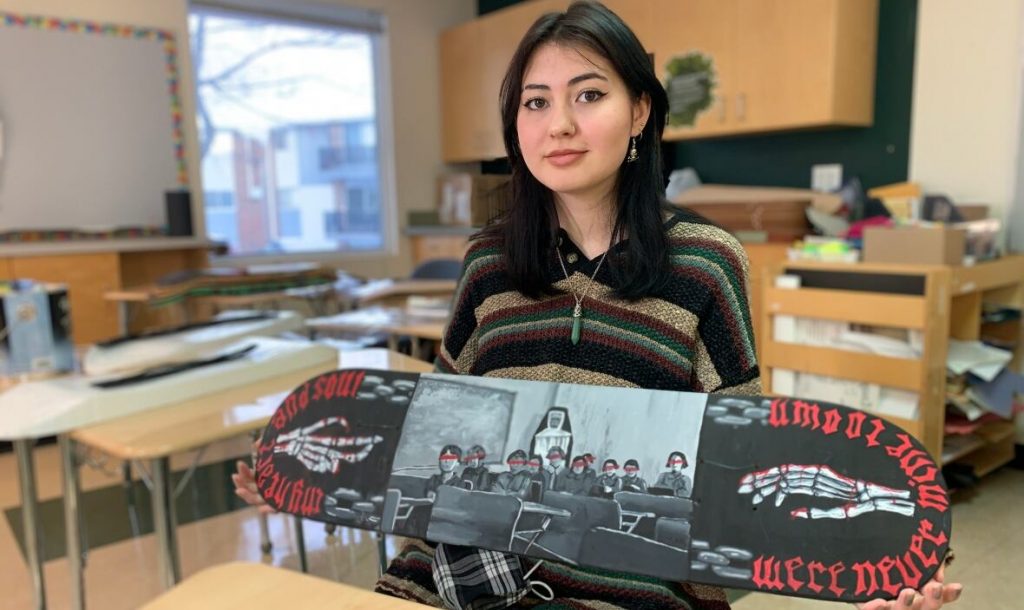
An Albertan teacher made waves with his “sk8trepreneur” course in 2020. One of the class projects was on “Exploring Colonialism, Creativity and Reconciliation with Skateboards, [which] combines skateboard design with Indigenous history” (CBC).
Kristian Basarada had his students create their own brands from the ground up, from defining their brand’s purpose to designing a logo. He teamed up with Cree artist Jon Cardinal and Cree professional skateboarder Joe Buffalo. Buffalo is also a residential school survivor and shared his experiences with the students. The project culminated in the students’ work being showcase at a local skateshop for over a month.
As a Digital Arts / Graphic Production teacher, I find Basarada’s project incredibly inspiring. He authentically ties together teen culture, history, maker-skills, and the community. Skateboards have a history of pushing the underrepresented out from under the rug of Mainstream Culture. Candian Dimension has an excellent interview with Micheal Langan, owner of Colonialism Skateboards. “Riding is resistance. Every kickflip, nose grind, or ollie in an occupied territory like Canada is an act of thrashing colonialism” (Sean Carleton, 2018).
#7. We call upon the federal government to develop with Aboriginal groups a joint strategy to eliminate educational and employment gaps between Aboriginal and non-Aboriginal Canadians.
Below is the exact wording of the budget and what happened. I found it interesting that students were supported by predictable and sustained base funding. I wonder if that translates into the same amount of dollars to dollars that a student going to school off-reserve would get? It is also interesting to note that many on-reserve schools are considered independent schools and therefore do not receive the same base funding usually. I will have to look into this more.
Below is a detailed account from the link above on what has been done to eliminate educational and employment gaps between Aboriginal and Non-Aboriginal Canadians to date.
Budget 2016 provided new investments in primary and secondary education on reserve, totalling $2.6 billion over 5 years. This includes funding to address immediate pressures and to keep pace with rising costs in the medium term, as well as provide for additional investments in literacy and numeracy programs and special needs education.
Building on this investment, on April 1, 2019, Indigenous Services Canada began implementing a new approach to First Nations elementary and secondary education, which was co-developed with First Nations education leaders and experts from across the country. This approach includes new formula-based regional models for First Nations education that will ensure that students attending First Nations schools are supported by predictable and sustained base funding that is more directly comparable to what students enrolled in provincial systems receive. On top of this base funding, this new approach will provide additional funding to on-reserve schools for language and culture programming and full-time kindergarten for children aged 4 and 5.
Budget 2016 invested $969.4 million over 5 years for the construction, repair and maintenance of First Nations education facilities. With respect to post-secondary education, Budget 2016 provided $1.53 billion over 5 years to increase amounts of the Canada Student Grants and $329 million per year after that. Budget 2016 also announced that funding provided by the Post-Secondary Student Support Program will no longer impact eligibility for the Canada Student Loans Program’s non-repayable grants and loans support. As a result, Indigenous students can access both student funding programs as long as they meet eligibility criteria. This measure will increase the amount of non-repayable Canada Student Grants and Canada Student Loans that Indigenous students may receive.
Budget 2017 provided:
$90 million over 2 years, beginning in fiscal year 2017 to 2018, for the Post-Secondary Student Support Program
$100 million for the First Nations and Inuit Youth Employment Strategy Skills Link and Summer Work Experience program
$5 million per year for 5 years, starting in fiscal year 2017 to 2018, for Indspire, a national Indigenous-led registered charity that invests in the education of Indigenous peoples, conditional on Indspire raising $3 million per year in matching funds from the private sector
The Government of Canada undertook a comprehensive and collaborative review with Indigenous partners of all current federal programs that support Indigenous students who wish to pursue post-secondary education. The purpose of the review is to ensure that these programs provide Indigenous students with the resources and support they need to attend and complete post-secondary studies.
Building on this engagement, Budget 2019 announced $815 million over 10 years, starting in fiscal year 2019 to 2020, and $61.8 million ongoing in support of Indigenous post-secondary education. This includes:
$327.5 million over 5 years to support First Nations post-secondary students and the development of regional education strategies
$125.5 million over 10 years and $21.8 million ongoing to support an Inuit-led post-secondary strategy
$362.0 million over 10 years and $40 million ongoing to support a Métis-Nation strategy
Budgets 2016 and 2017 committed to renew and expand the Aboriginal Skills and Employment Training Strategy beyond March 31, 2018. Budget 2018 announced $2 billion over 5 years and $408.2 million per year ongoing, to support the creation of a new Indigenous Skills and Employment Training Program, which will replace the Aboriginal Skills and Employment Training Strategy. Extensive engagement took place with Indigenous partners in 2016 and 2017 to develop a proposal for future labour market programming. The Government of Canada has consulted with, and heard from, Indigenous partners on the importance of a distinctions-based approach that recognizes the unique needs of the First Nations, Inuit and the Métis Nation. To that end, the new program will provide:
$1.1 billion over 5 years and $235.7 million per year ongoing, for a First Nations stream
$325 million over 5 years and $67 million per year ongoing, for a Métis Nation stream
$161.2 million over 5 years and $32.6 million per year ongoing, for an Inuit stream
$213.4 million over 5 years and $45.2 million per year ongoing, for an urban or non-affiliated stream
Work with First Nations, Inuit and Métis organizations and service providers to ensure all Indigenous people have access to the skills development and employment training they need to fully participate in the Canadian economy will continue.”
One of my interests in Indigenous Education is around the Truth and Reconciliation Commission and their 94 Calls to Action. Under the Education umbrella, we find the #6 call to action which states: 6. We call upon the Government of Canada to repeal Section 43 of the Criminal Code of Canada. Below is a youtube video created by CanadianRootsOnline and speaks to the call to action released in June 2015. Where has this call to action gone, well the Government of Canada has updates posted. To recap, Section 43 has not been repealed but has been edited to ensure that educators cannot use force against any child. I found it interesting that the laws were not gender neutral.