Categories
Online Courses Start of Term Teaching Presence Teaching Resources

Keeping on track…teaching tasks

LSFramework
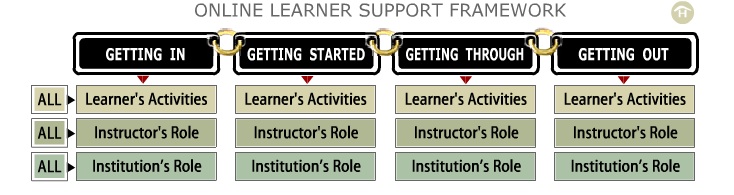
Learners, Instructors and teaching support staff are involved in different activities at each of the stages of a course or program. These stages may break down (simply) as:

  • Getting In
  • Getting Started
  • Getting Through
  • Getting Out

When planning a course or program, its helpful to consider the things that learners will be expected to do at each stage of the game and build from there to consider the role of the instructor and the institution in supporting that activity.  The Learner Support Framework (developed at OLT) is a useful resource.

For instructors new to teaching online, it may also be helpful to keep track of the various teaching tasks that you’ll want to pay attention to in these areas:

  • Pedagogical: Guiding student learning with a focus on concepts, principles, and skills.
  • Social: Creating a welcoming online community in which learning is promoted.
  • Managerial: Handling organizational, procedural, and administrative tasks.
  • Technical: Assisting participants to become comfortable with the technologies used to deliver the course.

The CSU Center for Distributed Learning offers some tools and checklists that you may find helpful:

Assessing Online Facilitation Instrument

Facilitation Activity Record.

Both of these tools were developed to assist instructors in objectively reviewing their roles as online facilitators.

Categories
Online Courses Online discussion Start of Term Teaching Presence Uncategorized Using Technology

Critical Competenies for Teaching Online

03-online learning and resource production
Image by leighblackall via Flickr

Recently, Larry Ragan, Director of Faculty Development for Penn State’s World Campus, was asked “how would you rank the critical competencies for teaching online?  Here are the 6 he identified:

1. Teaching and Learning

  • State objectives, expectations, & policies
  • Establish communication rules & group decision-making norms
  • Give prompt, effective feedback

2. Technology Aptitude

  • Know the LMS
  • Seek technology assistance
  • Be creative and flexible

3. Classroom Administration/ Management

  • Check & manage roster
  • Submit grades according to University policy
  • Manage drop/adds

4. Faculty Workload Management

  • Define time frames
  • Develop schedule & responsibilities
  • Communicate expectations

5. Building Community

  • Foster dialog & interaction
  • Provide for “space” for instructional & social interactions

6. Attitude/Philosophy

  • Be open minded
  • Take some risks
  • Be willing to fail (with support net!)

Read the full article from the Distance Education Report, November 15, 2009

How Would You Rank the Critical Competencies for Teaching Online? (pdf)

Reblog this post [with Zemanta]
Categories
Teaching Presence

Connection, Collaboration and Transformation


Trust is the Key to Web 2.0

Originally uploaded by kid.mercury

I’ve just returned from the ELI Annual Meeting in San Antonio. The topic was Connecting and Reflecting: Preparing Learners for Web 2.0 ( a much maligned term referring to principles and practices of collaborative, participatory, democratic participation on the web). Technology plays a role, no doubt – but it’s all about the learning and the transformations that are beginning to emerge.

There are so many thoughts and resources I could share. Here are a few take-aways and some accompanying resources that I will be revisiting for some time. Hopefully, you’ll find some of these as thought provoking as I have:

  • Encouraging learners to fully participate in designing their own learning leads to more “ownership”, more authentic learning outcomes and greater partnership between learner and teacher. Resource: podcasted conversation with conversation with Barbara Sawhill, Director of the Cooper International Learning Center at Oberlin College, and Jude Higdon, Instructional Technology Support Team Coordinator at the University of Minnesota (about half an hour in length).
  • There is much fear associated with the use of collaborative tools and technologies associated with web 2.0 in academia- it’s important to keep the dialogue open and moving forward. Resource: A Digi-Drama about Fear 2.0. I wasn’t lucky enough to get in on this session but have since reviewed the videoclips and they are well worth the half hour spent!
  • Access to excellent, good and mediocre quality learning resources on the web has exploded. We have a role in helping learners learn how to navigate this, learn how to make meaning and make learning processes more transparent. Resource: An assortment of the video archives of featured sessions hosted by the ELI. Average length: about an hour.

    And , if you are interested in poking around at some of the resources that Educause has to offer, you may want to start here.

  • All for now.

Categories
Teaching Presence

Diamonds in the rough


Student in Class

Originally uploaded by foundphotoslj

I thought I’d share something inspiring with all of you as we approach the end of the term. It’s about one teacher’s experience in appreciation of his students. Christopher Phelp’s Diamond in the Rough reminded me just how courageous, tenacious and adaptable we are. Appreciating those qualities in students is something we miss sometimes because we haven’t taken the time to get to know anything about them.

Getting to know students in a print-based distance course may be a bit of a challenge, but there are some ideas that you might consider:

  • Send a welcome message via the Faculty Service Centre to all of your students at the start of term. Consider sharing something interesting about you and encourage them to send you a return message.
  • Follow up regularly with students who miss assignments, don’t log into the course or haven’t contacted you in a while. A friendly check in goes a long way to creating a teaching presence that is so important in distance learning.
  • Consider sending a brief survey out to students at the start of term. It’s a good way for you to find out something about their knowledge or interest in your subject matter and their approaches to learning.
  • What about you? What do you do to get to know your students? How do you stay connected during the course? Please leave a comment and share…

    Happy Holidays all!

Categories
Teaching Presence

Connecting With Students

teacherandstudent.jpg

There is no denying that faculty-student interaction is essential for engaging a student in learning. Student engagement is an important predictor of success and (the good news is) it doesn’t need to be a time intensive proposition.

Findings from a recent study published in the Review of Higher Education and reported in last month’s edition of The Teaching Professor reveal that even the brief incidental or personal interactions that occurred between professor and student made students feel valued and important.

This theme continues in a recent brief published by NSSE (National Survey on Student Engagement) titled: Promoting Student Success: What Faculty Members Can Do.
In this piece, various suggestions and examples of best practice are provided for Faculty including:
• Making sure that students know what to do to succeed.
• Providing meaningful feedback.
• Making time for students.

In a distance education environment, this may seem a challenge – given that most of your interactions with students will be in writing – whether participating in an online discussion or providing commentary on a print based assignment.

However, the Office of Learning Technology can help by providing the following resources to encourage interaction:
• An online group chat (which you or a TA can facilitate) via LEAP (UBC’s academic support site for students).
• Integration of Live Classroom into your online course (allowing you to provide a tutorial or host a Q&A session using voice and chat).
• Connect with your students individually by telephone, Skype or other service using Voice Over Internet Protocol (VOIP), periodically through the term to check in on a more personal level.
• Publish a competency guide (OLT can provide a sample) for students in online courses – to help them know what they need in order to be successful online and provide them with the links to resources that will help them build those skills.

Let us know if you want to discuss any of these options for your course. Note that UBC has a site license for the Teaching Professor, Online Classroom and Distance Education report. If you don’t already have access, leave a comment here and we’ll be in touch with the login details.

Categories
Administrivia Conferences How to Use This Blog Learning Resources New Instructors Online Courses Online discussion Print Courses Start of Term Teaching Presence Teaching Resources

Many things to many people

Weblogs can be used for many purposes. This one is for sharing information relevant to teaching a distance course at UBC. So far, this has kind of been a one way street. But what about you? I’m sure many of you have comments, stories and issues to share with your colleagues, perhaps you’d like to seek some feedback or generate a discussion. One way to do this is through the use of Comments.

Click on the word Comments at the bottom of this entry and try it out! Your comment will appear as soon as it has been approved (annoying, I know, but the approval process cuts down on spam).

You might also want to post an entry on a subject of interest. In this case, for now, please send it to me and I will post it. If you want to post regularly, let me know and we’ll set you up as an author on the blog.

That’s all there is to it! Comment away!

Cindy

Categories
Teaching Presence

What do we know about students?

students with laptops.jpg
photo by Robert Scales courtesy Flickr.

We know (or think we know) the following things about students in DE&T delivered courses at UBC:
• More than two-thirds are women
• Average age is 33
• 77% are also taking courses on campus
• 23% are studying purely by distance

We also know, via student report, that:
• most of our students think their instructors are accessible
• instructor expertise and feedback is highly valued by students
• about 30-40% of surveyed students felt that instructor feedback on assignments could be more helpful.

From anecdotal evidence, we also know that many of our learners are not as technologically savvy as some reports would have us believe. The age of many of our students mean that they are not part of the NetGen. However, NetGen or not, students do not see the inclusion of technology as a replacement for good instruction. In a recent Educause report, authors Oblinger and Hawkins encourage us to do better to understand students IT preferences and to be aware that technological saavy does not equate with a preference for the impersonal. Quite the opposite.

Students apparently want access to their instructors and their peers both inside and outside formal learning environments. We see evidence of this in the use of online discussion boards and chat tools within online courses and the explosion of interest in social networking tools like LiveJournal and TrekConnect .

For more about establishing and maintaining a teaching presence in a distance course, see the OLT website: Instructor’s Guide: Establishing Instructor Presence

Spam prevention powered by Akismet